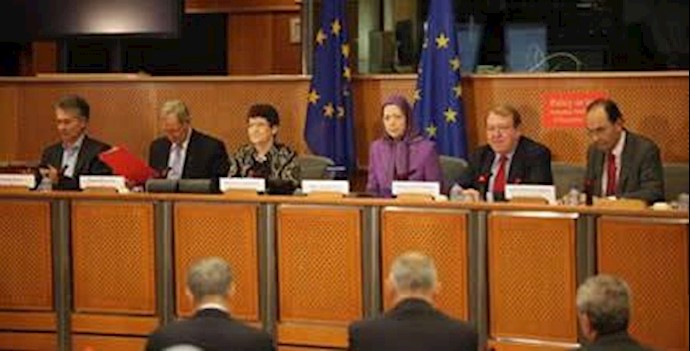
on 04 December 2013.
Mr. Chairman,
Dr. Alejo Vidal-Quadras
Distinguished Representatives,
Ladies and Gentlemen,
It is a great pleasure to be with you today.
I’d like to extend my gratitude for your interest and your sense of responsibility toward the ideal of freedom and the Iranian Resistance.
I want to use this opportunity to talk about two important developments; first, the November 24 Geneva accord between the P5+1 and the Iranian regime; and, second, the massacre in Ashraf, which took place on September 1, 2013.
These two developments are related and both have their roots in the Iranian regime’s incurable crises.
At the Geneva nuclear conference, the religious dictatorship had no other alternative but to take a step back and retreat.
Two factors have brought the clerical regime closer to an atomic bomb. The first factor is the mullahs’ urgent need for the bomb as their strategic guarantee for survival. And, the second factor has been western governments’ appeasement policy vis-à-vis this regime, especially after the revelation of the regime’s principal nuclear sites in Natanz and Arak by the Iranian Resistance in 2002.
Now, let’s think about the following questions: Why did the regime concede to this agreement? Will it comply with it? And, what would the consequences be if the agreement is implemented?
The reality is that the acceptance of this agreement was the immediate outcome of international sanctions, especially in circumstances that the regime is fearful of the reigniting of popular protests similar to the ones that took place in 2009. The entire world saw the protests and uprising of millions of disenchanted people against the dictatorship. Although those uprisings were suppressed by the Iranian regime, they have not vanished. They are rather hidden and out of sight, much like embers beneath ashes. The fire of these protest movements bursts out on a daily basis in various parts of Iran.
Otherwise, the religious dictatorship would have had no need for all these public executions using construction cranes. Today, Iran is the leading state in per capita executions.
The regime would also not need to collectively imprison 3,000 people at Camp Liberty in Iraq. And, it would not need to take hostage or massacre the same defenseless refugees.
So, what Khamenei fears and what drove and compelled him to acquiesce to this agreement is, in a word, the threat of regime change and overthrow.
We have welcomed even this degree of retreat, which was imposed on the regime after ten years of fruitless talks.
Yet this is not sufficient.
In order to prevent the religious fascism ruling Iran from getting its hands on a nuclear bomb, and in order to avoid a war that this outcome would inevitably provoke, the P5+1 could and must have completely dismantled the regime’s nuclear weapons program.
Even prior to Rouhani’s presidency, there was a trend and a dynamic that forced the regime to extend its hand toward the U.S., hold secret talks with it, and step on a path that ultimately led to this agreement. What we are saying is that that dynamic could have yielded many more results and could have once and for all removed the prospect of the regime obtaining a nuclear bomb.
This would not only have benefited the Iranian people, but it would have also benefited people in Syria, Iraq, Lebanon and the entire region. It would have been against the spread of terrorism and fundamentalism.
But, the current agreement gives the Iranian regime the opportunity to continue with its deception and cover ups, because uranium enrichment at 5 percent will still continue, the Fordow and Arak sites have not been shut down, the additional protocol and unannounced inspections have not been immediately put into place, and even inspections of the well-known Parchin site has not been accepted.
Today everybody knows that the Iranian regime has not informed IAEA about its nuclear sites or programs voluntarily and it was the Iranian Resistance that during three decades, in an extensive campaign, exposed the regime’s nuclear projects, in particularly the secret sites in Natanz and Arak in 2002, and informed the world about the danger of the religious fascism ruling Iran armed with nuclear bomb.
That is why we have warned, and I repeat the warning, that without the full implementation of the UN Security Council resolutions, in particular adoption and implementation of the additional protocol and unconditional inspections, the possibility of the regime obtaining a nuclear bomb still exists.
Does the acceptance of this agreement really mean that the mullahs have abandoned dreams of a bomb?
Absolutely not! The commitments they have made in this agreement are reversible and the mullahs still hold the key to manufacturing the bomb.
Only a week after the signing of the agreement, the regime’s deputy Foreign Minister, who is also a senior member of its negotiating team, said: “The text of the agreement between Iran and the P5+1 cannot be considered a legal accord with binding commitments. It is rather closer to a political statement.”
The red lines drawn for the Geneva talks by the Supreme Leader Ali Khamenei in his November 20 speech delivered to tens of thousands of Revolutionary Guards and Bassij paramilitary forces clearly illustrate that for him this is only a tactical maneuver. In other words, nothing has changed in the nuclear strategy and essence of the mullahs’ regime.
Khamenei said: “Any action, whether aggressive or defensive, much like in the battlefield, must be adopted in pursuit of predetermined objectives.”
Former President Hashemi Rafsanjani said it much more explicitly than Khamenei, that prior to this agreement, the regime was in a bind and the circumstances were akin to the final weeks of the Iran-Iraq war when Khomeini was forced to drink the chalice of poison and conceded to a ceasefire.
The prerequisite for drinking the chalice of poison at the end of the futile 8-year war with Iraq in 1988 was the massacre of PMOI political prisoners on Khomeini’s orders, so that he could regain control over the situation.
This time around, the Iranian Resistance paid the heavy and bloody price beforehand on September 1 in Ashraf.
Earlier I said that what forced Khamenei to accept this agreement was in a word the threat of regime change and overthrow. The Iranian Resistance and the PMOI are precisely the force and the axis that can steer the explosive state inside Iran toward a fundamental transformation and regime change.
But if this agreement is a prelude to the complete implementation of UN Security Council resolutions it can be considered the beginning of a trend where the regime’s internal and external balance will be upset.
There is widespread pressure from the Iranian people to end the mullahs’ demented and insane nuclear program.
Nothing short of the full and complete dismantling of the regime’s nuclear program is acceptable.
The clerical regime is in an extremely weak position.
The West must not dole out concessions to the regime and thereby become an obstacle to the path of changing this regime at the hands of the Iranian people. The changing of this regime would be the guarantor of peace and stability in the region.
Dear Friends,
The Iranian people’s conflict with the mullahs’ dictatorship is not constrained and limited to the nuclear program, which undermines the Iranian people’s national interests. This program has been set up at the cost of pervasive poverty and shattering the Iranian economy.
The main conflict revolves around the fact that the mullahs have usurped the popular sovereignty, freedom and votes of the Iranian people. This is a regime that has so far been condemned 60 times at the United Nations for its flagrant human rights violations.
Despite mullah Rouhani’s claims about temperance and moderation, since he took office, the number of registered hangings has reached 400.
Last week, in Ghezel-Hessar prison alone in Karaj city near Tehran, 3,000 prisoners started a hunger strike in protest to the collective executions of other inmates.
Ban on using satellite dishes, censorship, filtering of websites and social networks continues in Iran and young people are deprived of these means that are commonly available worldwide.
Inaction and turning a blind eye toward cruel human rights violations in Iran for the sake of nuclear negotiations would be a fatal mistake, which would eventually encourage the mullahs to become more belligerent when it comes to their nuclear program.
In the eyes of the Iranian people, the mullahs’ nuclear program has no legitimacy whatsoever.
As Massoud Rajavi, the Leader of the Iranian Resistance, has said in this regard: “The mullahs seek to mask the intrinsic weakness of a regime on the brink of death with enriched uranium. But, are freedom, sovereignty, food and shelter not the Iranian people’s inalienable right above and beyond nuclear energy? What kind of peaceful energy and science and technology is this that is entirely under the control of the IRGC?”
Dear Friends,
The same policy of hesitancy with respect to the mullahs’ nuclear program and their terrorism, is also behaving in a shocking way when it comes to the massacre of PMOI members in Ashraf and Liberty.
The acts of suppression, the siege, the psychological torture and the mass murder of Ashrafis at the hands of the mullahs’ puppet government in Iraq over the past five years would never have been possible without the persistent U.S. and UN violations of their written commitments.
The Iraqi government has become more emboldened as a result of the U.S. and the UN shirking their responsibilities regarding their commitments about the protection of Ashrafis.
The residents of Camp Liberty and Iranian expatriates in eight countries around the world are on hunger strike in order to awaken the international community’s conscience regarding this great injustice.
Looking at those thin and suffering faces plunges me every hour and every day in a great sadness and pain.
I have consistently tried and still try in various ways to ask those in bad health to end their hunger strike.
They ask: why have the U.S. and western governments, who in exchange for obtaining the Ashrafis’ weapons committed in writing to protect each and every one of them until their final disposition, have abandoned them without any defenses in front of wolves?
They point to a list of violated commitments by the U.S. and the UN, and stress that the U.S. must fulfill its written pledges.
In his letter to the residents on December 28, 2011, the UN Special Representative announced that he would guarantee the safety and security of the residents until every last one of them is out of Iraq.
This commitment was frequently repeated, including in the quadripartite agreement of August 16, 2012 and the U.S. State Department’s August 29, 2012 press release.
Why does the Iraqi government, which pretends to have had no role in this great crime against humanity, still refuse to hand over the bodies of the 52 martyrs for burial, despite the daily actions, referrals and demands of lawyers and families?
Today, even after returning from his trip to the U.S., Maliki flagrantly and repeatedly talks about arrest warrants for 120 refugee-seekers and refugees at Camp Liberty. All of these refugees possess “protected persons” identity cards under the Fourth Geneva Convention, and the UN High Commission for Refugees considers them persons of concern.
The U.S. and the UN have been silent in this regard, despite the fact that they are fully aware that these fabricated warrants are actually a means to pave the way for committing another large-scale massacre.
With your help here today, I would like to use this platform to invite the UN, the EU and the U.S. to exercise their influence in order to force the Iraqi government to release the seven hostages and to accept all the practical requirements to ensure Camp Liberty’s security while working to prevent the occurrence of another humanitarian catastrophe.
Dear Friends,
In the midst of the catastrophes being produced by the policy of appeasement, I am glad that pioneering members of Parliament like yourselves have hoisted the flag of a prudent and responsible policy. You are the trailblazers for this policy while facing a variety of pressures and trials.
I wish all of you every success on this admirable path.
I also wish to express my gratitude to Mr. Stevenson, for his productive trip to Iraq and his attention into the suffering of the Iraqi people and the situation of members of Resistance in camp Liberty.
Thank you.