
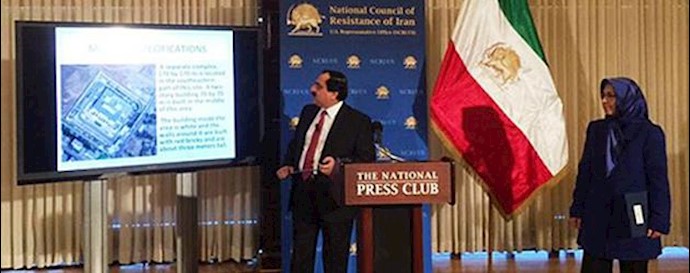
The National Council of Resistance of Iran (NCRI) published a 28-page report on Thursday revealing the Iranian regime’s deceptive tactics in nuclear negotiations with the world powers which proves Tehran has employed at least eight different tactics to keep its nuclear infrastructure intact for building the bomb.
Main tactics employed by Tehran in negotiations
1. Buying Time:
Buying time and prolonging the negotiations
Amongst the principal methods specified by Khamenei to be employed in the talks was to buy time and prolong the negotiations. This tactic was conducted in this manner that although Tehran would not offer anything specific or offer precious little, the negotiations would continue and not be halted or if they come to a halt this period would be for a short period.
2. Avoiding the PMD:
Distracting attention and focus from the possible military dimensions of the program, pushing it to the sidelines, and deferring to provide responses in this regard
3. No Access to Sensitive Sites:
Refusing altogether or deferring access of IAEA to sensitive sites
4. Hide until Exposed:
Refusing to provide information and lack of transparency regarding projects, smuggling networks, or illicit measures until disclosures and revelations are made by other sources (constant emphasis by the regime that the whole project and its dimensions have been disclosed and there is nothing more to disclose).
5. Defer to Lengthy Reports:
Deferring providing answers until lengthy reports are prepared and until pertinent authorities of the regime’s counterparts have studied the reports
At several junctures during these years, Tehran has bought time at the specific time and also for a certain period afterwards by presenting “comprehensive and detailed reports” or even by simply promising such reports “that would explain everything and would clarify all issues”. This tactic in turn delays clarifications and disclosures of aspects of the program.
6. Inject Optimism:
Inducing a perception that negotiations are proceeding forward as a tactic to extract concessions
Tehran frequently fans this perception in its counterparts that the talks are going forward and gaps are being bridged in order to extract further concessions.
7. No Halt to R&D:
Removing the issue of research and development from discussions
Tehran has always insisted that research and development is not up for discussion.
8. Side Talks:
Tehran attempts to resolve an outstanding issue with just one party in the talks or tries to strike a deal with one party on the margins of the negotiations and then cornering other parties on the topic as a fait accompli.
It then uses this agreement as a lever to advance its aims instead of resolving the issue in collective negotiations where all parties are present. It conveys that the agreement reached at the sidelines is an agreement by all parties to the negotiations and abrogating it will derail the talks.
The report, unveiled by the NCRI’s US Representative Office in Washington, reviewed 12 years of negotiations between Tehran and the EU3 and P5+1. Alireza Jafarzadeh, the NCRI-US Deputy Director, conducted the online briefing.
The report’s key finding was that the mullahs’ Supreme Leader Ali Khamenei has insisted on three red lines in the negotiations: barring inspectors from access to Iranian military sites and nuclear scientists and forbidding a halt to nuclear Research and Development (R&D).
In a speech broadcast live on state television on Tuesday, Khamenei ruled out any freeze on the regime’s nuclear enrichment for as long as a decade, as a preliminary accord in April with the P5+1 stipulates, and he repeated his refusal to allow inspections of Iranian military sites.