Examiner website, June 25, 2015
Iran, the United States, and other world powers are entering the final stage of nuclear negotiations ahead of the June 30th deadline. Progress remains slow for the already much delayed nuclear deal, and in recent weeks Iranian officials have backtracked on their willingness to negotiate.
According to Iranian dissident group the National Council of Resistance of Iran (NCRI), this is not due to accident or even changing minds. Instead, the constant flip flopping and increasingly unwillingness of Iranian officials to be flexible is part of a larger plan.
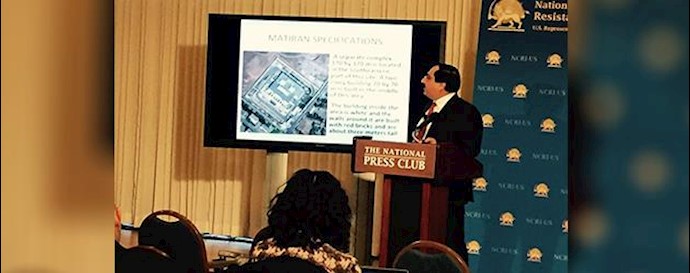
NCRI held a press conference today in which deputy director Alireza Jafarzadeh outlined a strong argument that Iran’s tactics are part of a larger effort to secure favorable terms, while giving little ground in exchange. NCRI gathered information from both public sources, including books written by leading Iranian officials, and also connections within the regime itself.
While it is difficult to determine the veracity of the NCRI’s inside claims, the group is widely credited for having revealed the existence of Iran’s nuclear program. Among others, President George W. Bush credited the NCRI with revealing Iran’s nuclear program back in 2005.
Given the NCRI’s track record of success, it’s difficult to dismiss their claims, especially with a nuclear deal appearing all the more elusive and any potential deal likely to be watered down. At various times the Iranian government hinted that it would be willing to send its uranium to third party countries, such as Russia, for enrichment. This past February the Iranian government shot that idea down for good.
Meanwhile, in recent weeks both Iran’s Supreme Leader Ali Khamenei , and Defense Minister Hossein Dehqan have stated bluntly that its military bases will be off limits , and will not be a part of any agreement.
If this turns out to be correct it should come as no surprise, according to the NCRI. The NCRI has argued that Iran’s non-military nuclear installations are, in fact, only a small part of the country’s nuclear programs, and are not vital for the continued research and development of a nuclear weapon.
Khamenei has drawn three red lines in negotiations, and as Iran’s Supreme Leader, these lines cannot be ignored under any circumstances, unless Khamenei gives the go-ahead. No promises by negotiators or President Rouhani will be able to stipulate otherwise.
The Supreme leader has stipulated that there will be no access to military sites for the inspectors, no access to Iranian nuclear scientists for the inspectors, and no stopping of Research and Development (R& D) in the nuclear field.
As long as these three red lines are maintained, Iran could theoretically continue with its alleged efforts to develop a nuclear weapon. Further, only disclosed nuclear sites are on the bargaining table while any still-hidden nuclear sites would remain hidden.
So why are negotiations even continuing? Ever continuing talks are also allegedly a part of Iran’s tactics. Iran’s president Hassan Rouhani is apparently afraid of another mass uprising, similar to the 2009 green revolution which nearly brought Iran to its knees.
One easy way to keep people placated is to ensure that there is hope of a nuclear deal. If sanctions were lifted, Iran’s economic situation would almost certainly improve substantially. In this scenario nuclear negotiations could be as much a stalling tactic as they are a part of Iran’s legitimate plans.