
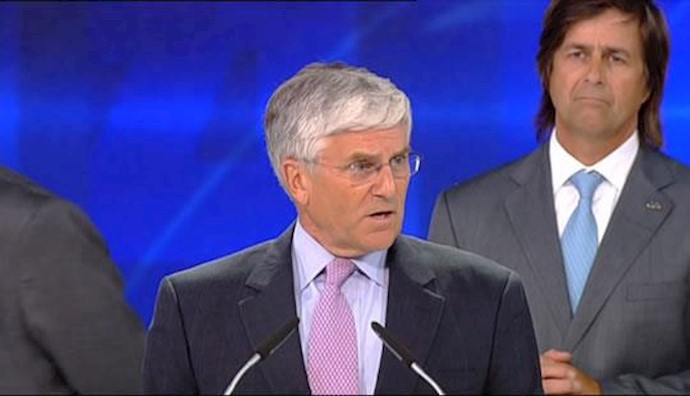
Gen. Gorge Casey said: “I have some firsthand experience dealing with the forces of the Iranian regime. As I have been reading the press back in the United States, I heard people starting to say because the situation in Iraq has gotten so bad that we might have common interest with the regime in Iran. I am here to tell you from my personal experience that it is not the case today, and it certainly was not the case when I was in Iraq from 2004 to 2007.
I think it is fundamentally important to remind ourselves that particularly with Iraq, we have fundamentally different views and I believe this after we went to Iraq. I believe the regime’s goals in Iraq were two folds. One that they wanted a friendly supportive Iraqi government in place, but two, they wanted the United States government to fail in its efforts to help the Iraqis build a government that was fairly representative above all of the ethnic and sectarian groups in Iraq.
And I believe that type of government is fundamentally important to stability not only in Iraq, but also in the region.
I watched how the regime pursued those goals aggressively with 3 prong approach:
First: they build political influence by financial contribution to the Iraqi political parties and political leaders.
Second: they build public support by economic contributions to the communities especially the southern part of the country.
And third: they fostered sectarian violence.
I can tell you that our knowledge of their activities grow over time but by mid-2006 there was no question that the regime leadership were actively supporting terrorism inside Iraq to accomplish their political objectives. It was also crystal clear that they were playing a significant role in training and equipping Shiite militias that had the effect of enforcing sectarian trouble that went on there from 2006 to 2008.
And lastly because of that role they are directly responsible for the death of hundreds of coalition forces and thousands of Iraqis.
In the spring of 2006, ambassador Khalilzad and I, the US ambassador took that information to the newly elected Prime Minister Maliki and told him about the improvised explosive devices that can only have been made in Iran. We showed him pictures of modern Iranian weapons that we had found in the Shiite militia caches. We told him about the training camps inside Iran and we told him about the Quds force present in Iraq. At the end of the briefing he looked at both of us and said they are conducting terrorism in my country. We confirm that, later that year when we arrested 6 Quds force operatives in a command center in Baghdad. And in that command center they had a map on the wall, and the neighborhoods on that map were color coded by ethnic group. And there were arrows on the map showing the plan for displacement of people from those neighborhoods. We were never more certain that the prime minister was absolutely right.
I can tell you, given that experience the Iranian regime would be destabilizing the region for some time to come. And that Iranian regime is not just a challenge to the people of Iran, but for the people of Iraq and the region and is a challenge for the international community.
And there can only be one conclusion and you heard it many many times already today, that regime must go.