UK Progressive, Posted on 14 December 2009
by Glyn Strong
“We’ve got to do all we can to raise awareness of this so that people will know what is going on – but more importantly, so that the Iraqi Government knows that the world is watching and that if what they did in July is repeated there’s going to be, again, a huge question mark about why British troops, men and women, gave their lives to give a new chance for Iraq to build a society that’s free and democratic.” – Lord Corbett of Castle Vale, 10 December 2009
Ten days before Christmas more than 3,000 people face eviction from their home of 20 years in what Labour peer and civil liberties champion Lord Robin Corbett has described as ‘a pact with the devil’.
The men, women and children facing forcible displacement are Iranian refugees, members of the People’s Mujahedeen Organisation of Iran (PMOI), a pro-democracy group granted safe haven under the Geneva Convention. They live in Ashraf, an isolated desert encampment 60km north of Baghdad, dependent on deliveries by road for its survival. Their forced removal comes with the endorsement of Iraqi President Nouri al-Maliki whose website publicised a 15th December ‘deadline’ for the evacuation.
While the Iraqi Government now claims that ‘agreement’ has been reached with Ashraf residents the message from those inside is that this is untrue and they are under siege. For days deliveries of meat, vegetables, medicine, fuel and hygiene products have been blocked. Food rots outside the gates. Doctors and journalists are denied access.
To some Iraq’s fixation with a refugee camp in the middle of nowhere is perplexing and dismissed as a domestic issue. But as Iran’s nuclear capability comes under increasing scrutiny and Iraq’s internal stability is shaken by bomb attacks on the capital a bigger picture becomes clearer.
During Iran’s sham elections Ayatollah Khamenei officially demanded that the Iraqi President and Prime Minister agree to expel the PMOI from their country as soon as possible.
President-elect of the National Council of Resistance of Iran, Mrs. Maryam Rajavi, in a message to British supporters, explained “Ashraf is the frontline bastion in defending democracy and human rights in Iran. If the regime is defeated in its bid to destroy Ashraf, it cannot contain the people’s uprising.”
Ashraf has achieved iconic status among freedom-loving Iranians, exerting an influence well beyond its geographical boundaries. Paradoxically, this was enhanced by the Iraqi assault on its inhabitants in July.
Mrs. Rajavi told British peers and MPs “The UN High Commission for Refugees, the International Committee of the Red Cross and UN Assistance Mission Iraq has warned repeatedly against forced displacement of Ashraf residents in violation of international human rights law.
“The mullahs are horrified at the rising protests. They insist on distancing Ashraf as far from the (Iranian) border as possible in order to eliminate the dedicated women and men who act as inspiration to the Iranian people’s struggle for freedom. The inhuman siege on Ashraf is the prelude to this plot.”
Speaking only hours ahead of the publicised eviction deadline Lord Corbett asked why the Iraqi president was so exercised about removal of refugees when the country’s capital, Baghdad, was being wrecked by explosions.
“Is this all President Al-Maliki has on his mind? The young, struggling democracy that people are trying to build in his country is still under threat from extremists and one finger we know is in that pie, determined to make life difficult for the new Iraq, belongs to those across the border (in Iran) who, in this pact with the devil, have demanded that whatever force is needed will be used against Camp Ashraf.”
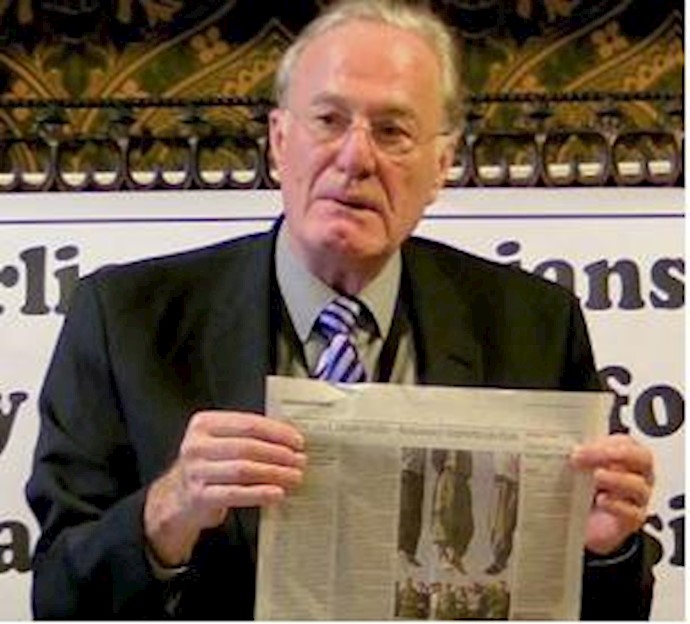
Addressing a cross party assembly of MPs, peers and guests Lord Corbett expressed his disgust at the British Government’s inertia and lambasted Ivan Lewis, Minister of State for the Foreign and Commonwealth Office, who still regards the refugees as members of a terrorist organisation.
(In fact the “terror-tag” was formerly lifted from the PMOI last year by the POAC (Proscribed Organisation Appeal Commission). The then Home Secretary Jacqui Smith’s appeal against the POAC decision was not only thrown out but branded by the Appeal Court as “capricious and speculative”).
Lord Corbett said “I wrote to Ivan Lewis at the end of last month (November), to make sure he knew about the threat to Camp Ashraf made on the 29th of October. He treated with contempt the decision of the POAC and the Court of Appeal and the Council of Ministers of the European Union . . . . The FCO hangs on to stale allegations about the PMOI that have no current relevance. And in many cases the source of the allegations cannot be confirmed.
“When Ivan Lewis wrote back to me, on December 2nd, his letter didn’t even mention the threat to use force against Ashraf in 120 hours time. I find this shaming and I have written to tell him so.”
“I said please do not waste time repeating the many undertakings Iraq has given about its responsibility in ensuring the safety and security of Iranian dissident refugees in Ashraf. Its government violently breached those in a brutal attack on defenceless residents on the 28th of July; residents who offered only passive resistance against thugs in security uniforms who attacked with chains, axes, poles and live ammunition, killing 11 and wounding 500.”
To suggestions that there was no evidence Lord Corbett said “He has had – as have others in the FCO – a DVD of those events. And the Embassy in Baghdad has had copies of the DVD because I gave it to someone in the FCO who said his colleague was going out there the next day.”