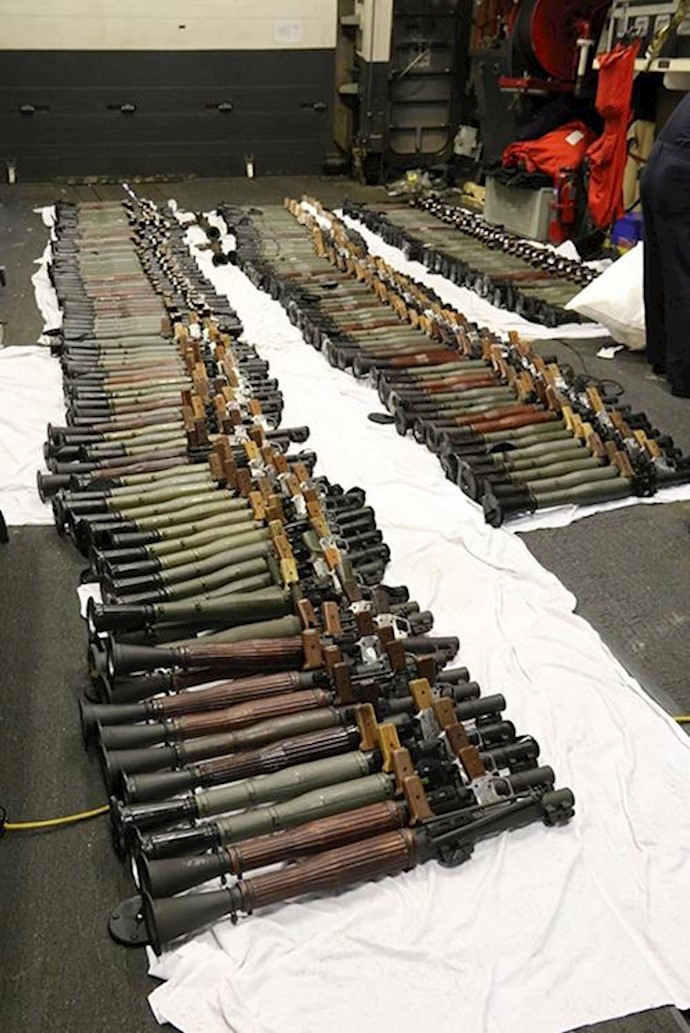
The Navy disclosed Monday that it recently confiscated a weapons cache from a small fishing craft in the Arabian Sea, seizing about 1,500 Kalashnikov rifles, 200 rocket-propelled grenade launchers and 21 .50-caliber machine guns. It marks the fourth seizure by a U.S.-led maritime task force in the region since September — and underscores the difficulties the United States faces in stopping weapons smuggling to nations like Yemen, where Houthi rebels continue to rely on Iranian arms.
The weapons commonly move on a small craft known as a dhow, a traditional sailing vessel in the Middle East. Foreign policy and military experts said the smuggling has occurred for years, but it comes now at a sensitive time in which the Obama administration is trying to manage the nuclear agreement it reached last year with Iran. International economic sanctions against Tehran were lifted this year as part of the deal in exchange for Iran sending the bulk of its enriched uranium out of the country, disabling one nuclear reactor and shelving the majority of its centrifuges.
Iran has continued a variety of other actions in the Middle East that the United States considers destabilizing. While the U.S.-led coalition has confiscated several shipments of weapons, there’s no way of knowing how many boats have made it through to Yemen, said Michael Knights, a fellow with the Washington Institute, a think tank focused on Middle Eastern issues.
Retired Navy Adm. Jim Stavridis, who led a carrier strike group in the Persian Gulf in the early phases of the Iraq and Afghanistan wars, said the Persian Gulf, Strait of Hormuz and northern Arabian Sea have been hotbeds of smuggling for many years. But their use to supply arms to Yemen is relatively new, and stopping the flow is a “difficult tactical proposition,” he said. There are thousands of dhows at sea every day, and many are used for legitimate shipping and fishing purposes.
Stavridis, now the dean at Tufts University’s Fletcher School for international affairs, said the United States must rely on intelligence from the international coalition that has been built over the last two decades to identify and capture dhows that are carrying weapons.
“A very key element in all of this of course is surveillance of cell phone technology,” the retired admiral said. “But overall, the key is international inter-agency and private-public cooperation.”
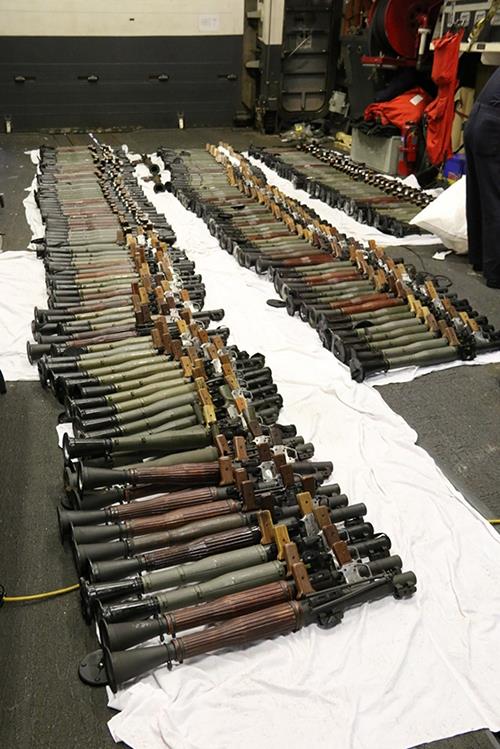
A cache of weapons is assembled on the deck of the guided-missile destroyer USS Gravely in the Arabian Sea on March 31.
A Navy spokesman in the region, Cmdr. Kevin Stephens, declined to discuss trends in the confiscation of weapons, saying only it “speaks to the intelligence that led us to these recent successes.” But he said the United States and its partners will continue to carry out maritime operations in the region to disrupt the flow of illicit arms to the Houthis in Yemen.
“These weapons only serve to exacerbate the situation there and prolong the conflict,” Stephens said.
A U.S. Navy officer, speaking on condition of anonymity due to the sensitivity of the interdiction missions, said the most recent boarding of a dhow carrying arms was “likely straightforward.” The crew had no incentive to resist the U.S. troops from the USS Sirocco, a coastal patrol ship.