Washington (AFP) – The United States and Europe began preparing to lift the trade sanctions that have hobbled the Iranian economy on Sunday as the nuclear deal came into effect.
The procedure to lift the embargo began 90 days after the UN Security Council endorsed the accord signed in Vienna in July, a milestone referred to as “Adoption Day.”
But foreign firms will not be able to resume ties with Iran’s oil industry and banks right away — sanctions will remain in place until Iran fulfils its end of the bargain.
The next stage in the process — “implementation day” — will only come when UN nuclear watchdog the IAEA confirms Iran has dramatically scaled back its nuclear program.
Iran said that lengthy process will probably start this week.
Tehran will have to surrender or dilute the bulk of its enriched nuclear fuel stocks, dismantle most of its centrifuges and halt a reactor capable of making plutonium.
Only then will the sanctions “waivers” that US President Barack Obama ordered his administration to issue on Sunday come into effect and trade can begin to resume.
“Today marks an important milestone toward preventing Iran from obtaining a nuclear weapon and ensuring its nuclear program is exclusively peaceful going forward,” Obama said in a statement.
US Secretary of State John Kerry, who played a central role in the painstaking negotiations between Iran and the West, added: “If fully implemented, it will bring unprecedented insight and accountability to Iran’s nuclear program forever.”
The European Union also adopted a legal framework for lifting sanctions imposed on Iran.
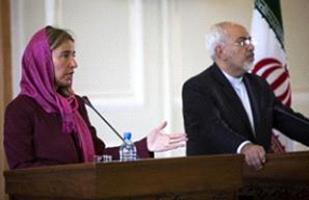
EU foreign policy Chief Federica Mogherini speaks during a press conference with Zarif
The accord “brings us a step closer to the beginning of implementation of the (July deal), to which we are strongly committed,” EU foreign policy chief Federica Mogherini said in a joint statement with Iranian Foreign Minister Javad Zarif.
– ’Huge task’ –
Ali Akbar Salehi, head of Iran’s nuclear agency, was awaiting President Hassan Rouhani’s order to remove thousands of centrifuges from sites at Natanz and Fordo.
“What we need to accomplish is a huge task. We hope to start this week or next week,” he told state television.
Dismantling the centrifuges, which enrich uranium, was part of the July 14 deal, known as the Joint Comprehensive Plan of Action, between Iran and six world powers.
As well as slashing the number of centrifuges at Natanz and Fordo to around 6,000, Iran will have to satisfy the IAEA that its Arak reactor cannot be used for military purposes.
China has agreed to work with Iran and the United States to “modernize” Arak so that it cannot produce plutonium, which can be used in a bomb, US officials said.
– Challenges remain –
Iranian regime says it hopes “implementation day” will come quickly — in less than two months — but Washington is more cautious.
“For us it’s important that it’s done right, not that it’s done quickly,” a senior administration official told reporters. “We cannot imagine less than two months.”
Some have voiced hope that, once the nuclear stand-off is out of the way, the United States and Iran can begin moves to improve relations in other domains.
But ties have, if anything, become more fraught, with Iran last week testing a ballistic missile and stepping up its military intervention to support Bashar al-Assad in Syria.
Hardliners in both the US Congress and the Iranian regime are opposed to a broader detente.
This week the United States will begin to issue waivers to companies seeking to trade with Iran in sectors touched by nuclear-related sanctions, such as transport, oil and banking.
“Those waivers will be out and issued so people will know what will be getting waived but it won’t actually take effect until Iran completes its steps,” an official said.
On Monday, envoys of the deal signatories — Britain, China, France, Germany, Russia and the United States — meet in Vienna to form a commission to oversee the implementation of the JCPOA.