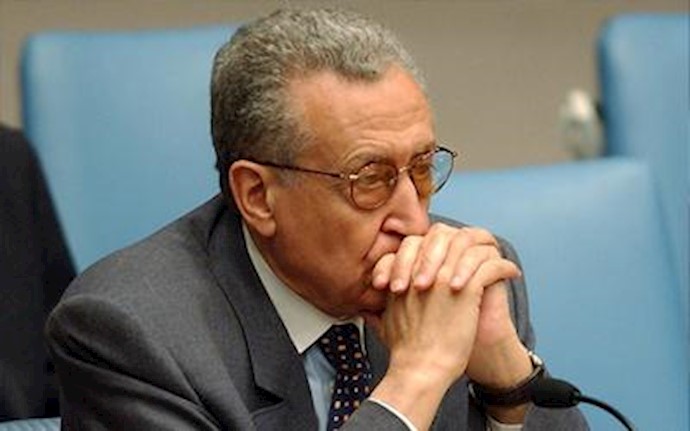
Al Arabiya, 21 Sep 2012 – Those who are part of the crisis in Syria should convert to being part of the solution, Syria’s new peace envoy Lakhdar Brahimi told Al Arabiya’s Studio Beirut weekly show on Friday. He was referring to about Iran’s stance on the Syrian crisis.
“I have repeated this often — I don’t have a plan at the current time because I have only started my job 3 weeks ago, and I haven’t even met all parties — whether Syrian or regional. I am aware of and I appreciate people’s sense of urgency,” he said.
When asked on his peace plan, following Kofi Annan’s resignation after his failure in implementing his six-point peace plan in Syria, Brahimi said that his plan needs time. “Following the failure of Kofi Annan [six-point plan], I don’t think [we] are capable of withstanding another failure.”
He added that on his first visit as peace envoy, he wasn’t expecting groundbreaking outcomes.
“This was the first visit, to get to know the grounds and the people. I did not expect any groundbreaking development in this complicated crisis.”
Brahimi said that people do not want reforms to be made, but rather real change in their country, and this not only applies to Syria but to the rest of the Arab world.
“There have been developments in many aspects, but it’s not enough. People feel disappointed and hopeless — people want a change, not reforms. They want genuine change,” he said.
“They want to build their countries with their own hands — not leader X or group X to take matters into their hands on behalf of the people,” Brahimi continued.
The U.N. special envoy added that the government must play its role in facilitating this change.
“Every government is capable of leading the change if it is able to convince its people of its full potentials. But if it doesn’t, it will be the victim of this demand for change,” he said.
He did stress that the government in Syria definitely has the upper hand when asked about the regime and the opposition having equal opportunities.
“The government is naturally stronger — it has planes, helicopters and weapons. In turn, there is no doubt that it is responsible for a lot of what is happening in Syria.”
They have no right to say that there is equality [between the regime and the opposition]. There is no equality between the victim and the assailant.”
Brahimi didn’t specify whether Iran’s stance towards the Syrian crisis was part of the crisis or the resolution.
“I don’t use this phrase very often but if you insist, let’s just say that whomever is part of a problem must convert to being a part of the solution, otherwise how will we reach a resolution? Our region has interrelations, interests and greed…But we now have to look to Syria and help the Syrian people. Everyone must cooperate,” he said.
“The situation in Syria cannot be restricted within the country to the point of no return. If it continued, it would spread onto its neighbors and turn into a global problem. The problem has already spilt into Lebanon — it has also started to spill into Turkey and Jordan in the form of refugees,” he concluded.