

ABOARD THE USS NEW ORLEANS — Iran’s elite Revolutionary Guard Corps on Monday dispatched five military vessels to monitor a U.S. warship. The five Iranian vessels consisted of four speedboats, three with mounted machine guns, as well as a guided missile patrol ship.
The Iranian vessel with its antiship cruise missiles did what ships from Iran often do — cruise within 500 yards of a U.S. Navy vessel.
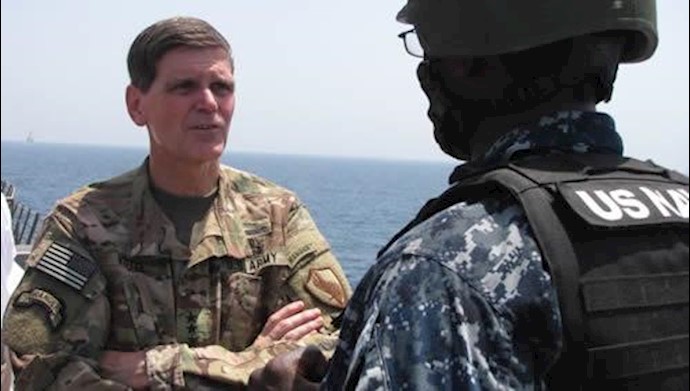
Only this time, the USS New Orleans had a special guest — Army Gen. Joseph Votel, head of U.S. Central Command. Votel was visiting the ship in the Strait of Hormuz as part of his tour of the 20-nation CentCom region, which began last week when he flew out of headquarters at MacDill Air Force Base.
Two days after visiting Afghanistan, Votel arrived aboard the New Orleans on a tilt-rotor V-22 Osprey, landing on a flight deck in sweltering heat. He landed just in time to see a Houdong-class warship, belonging to the Iranian Revolutionary Guards Corps navy, cruise close by.
It would happen five times during the hours Votel spent passing through the Strait of Hormuz aboard the New Orleans, an amphibious transport dock ship. The experience gave Votel a front-row seat to the complex challenges Iran poses to the U.S. and its allies in the region — challenges that fall on Votel’s shoulders as officer in charge of U.S. military operations in the Middle East and Southwest Asia.
Seeing so many Iranian ships validated Votel’s concerns about the chances of a miscalculation between two nations with no formal relations that compete for influence in Middle Eastern affairs. These ships are operated by the same group, separate from the regular Iranian navy, that captured and briefly held 11 U.S. sailors earlier this year.
“As you’ve seen in a relatively compressed space here, there is great opportunity for miscalculations,” Votel, head of the U.S. military’s Central Command, told reporters on the bridge of the USS New Orleans, an amphibious dock ship with about 650 Marines aboard.
It was also the latest sign that the IRGC appears to be sticking to a familiar posture in the Gulf that predates last year’s nuclear accord between Iran and six world powers including the United States.
One of the four speedboats that approached the New Orleans and its escort, a Navy guided missile destroyer, the USS Stout, cut its engines and watched as the U.S. warships passed. An hour before, a larger Iranian guided-missile patrol craft came by.
U.S. Navy ships pass through the Strait of Hormuz, a narrow body of water between the Persian Gulf and the Sea of Oman, about 250 times a year, said Cmdr. Bill Urban, a Navy spokesman. The strait is a key choke point through which about 30 percent of the world’s oil and natural gas passes, Votel told sailors and Marines gathered on the New Orleans flight deck Monday.
Last year, there were more than 300 interactions between U.S. and Iranian military vessels, including approaches at high speed, Urban said.
“What concerns me is that people don’t always have a lot of time to deal with those interactions,” Votel said. “What we have learned here today is it is measured in minutes.”
CAPTURE OF U.S. SAILORS
The U.S. military’s concerns about Iran’s behavior in places like the Strait, one of the world’s most important oil shipping channels, have persisted despite the accord under which Tehran curbed its disputed atomic program in exchange for relief from economic sanctions.
“That (the nuclear deal) certainly has addressed one very important threat … but their other activity out here has not changed,” Votel said.
Memories of Iran’s brief capture of 10 U.S. sailors in January are also still fresh. Iranian Supreme Leader Ali Khamenei awarded medals to IRGC commanders after the incident. Iran took video and pictures of the American sailors surrendering after blundering into Iranian territorial waters.
A U.S. Navy report also said the Iranians replaced an American flag on board with an IRGC one, ransacked the vessels, and damaged equipment. The Navy also admonished U.S. sailors for straying into Iranian waters.
When asked about the captured sailors, Votel said he expects the Iranians to act as the U.S. does. Since 2012, Urban said, the Navy assisted 11 Iranian vessels in distress, including four in the past two months.
The interactions in the strait are just some of Votel’s concerns with the nation.
“Whether its instability in Yemen, whether it is their backing of a Syrian regime that attacks their own people — drops barrel bombs on them causing refugees to flow into Europe and rioting in their capitals — I think they need to be held accountable,” Votel said.
Asked if he would like to see additional naval resources devoted to the region, perhaps an aircraft carrier battle group, Votel said he would — but also acknowledged competing priorities.
“As the CentCom commander, I would love to always have a carrier in the region,” Votel. “I think that sends a very important message. I understand that you have to have balance. We have a lot of other things going on.”
Source: Reuters, Tampa Bay, 11 July 2016