The US Congress resolution Iran Sanctions Act which due to expire at the end of 2016 is back on the table for the administration to extend or reject. But as it has surfaced, the Obama administration has expressed openness to reconsider and extend the Act again. The administration has said it is open to reconsider that if it does not interfere with the international nuclear agreement with Tehran
The Obama administration is open to renewing the Iran Sanctions Act, which expires at the end of 2016, ,.
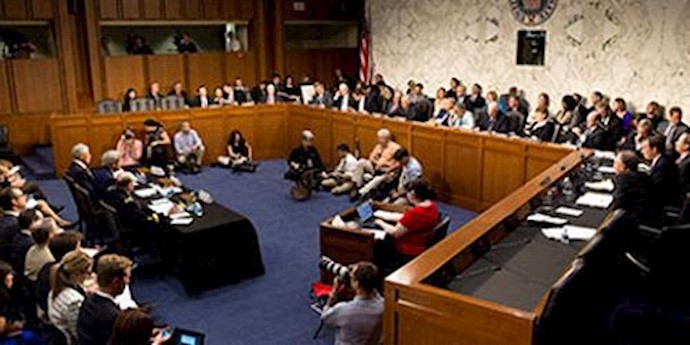
“We would be happy to engage with this committee and the Congress on a renewed Iran Sanctions Act, assuming that it does not complicate or prevent us from meeting JCPOA (Iran nuclear deal) commitments,” U.S. Under Secretary of State for Political Affairs Thomas Shannon said at a hearing of the United States Senate Foreign Relations Committee, Reuters cited.
The Iranian regime’s recent ballistic missile launches “violated the intent” of a United Nations resolution, Shannon said at the hearing, according to The Hill.
“I believe it violated the intent of [U.N. Security Council Resolution] 2231.”
“Whether our international lawyers will say it violated 2231, this is why we use the word inconsistent. But from our point of view, these launches are prohibited, and we’re going to do everything we can to stop them.”
Iran’s regime launched multiple ballistic missiles on back-to-back days in March. The tests infuriated Republicans and some Democrats in the U.S. Congress, who said the move calls for a strong response from the United States.
The Iranian regime’s hardliners are doubling down on ballistic missiles after the nuclear deal, and as such, more launches are likely in the future, Shannon said.
U.N. Security Council Resolution 2231, which was passed in July in support of the nuclear deal with Iran’s regime, says that, “Iran is called upon not to undertake any activity related to ballistic missiles designed to be capable of delivering nuclear weapons, including launches using such ballistic missile technology.”
Shannon’s testimony is “Exhibit A” in why there was concern about the nuclear agreement, said Senate Foreign Relations Committee Chairman Bob Corker (R-Tenn.).
Sen. Corker also said he was disappointed that a letter from the United States, Britain, France and Germany to Spanish U.N. Ambassador Román Oyarzun Marchesi and U.N. chief Ban Ki-moon didn’t use the word “violation.”
“We knew when the language said ‘called upon’ this situation would likely occur,” Corker said. “It has. It’s disappointing. I was disappointed that a letter from our European partners said it was ‘inconsistent’ and didn’t say it was a ‘violation.’ Obviously, there was some wordsmithing taking place.”
Sen. Ben Cardin (D-Md.), ranking member of the committee, said the ballistic missiles should be a “relatively easy” issue.
“On ballistic missiles, it seems to me this is a relatively easy matter working with the administration to have a statutory framework that goes beyond any one administration to make it clear we are going to take action against Iran,” Cardin said.
Corker and Cardin said they are working on legislation to sanction Iran’s regime in response to the tests and other destabilizing actions.
The administration would support sanctions legislation, Shannon said, so long as it doesn’t interfere with the nuclear deal.
That position drew rebuke from Sen. Bob Menendez (D-N.J.), who said it walks back previous comments from the administration that Congress could pursue action against Iran’s regime outside of its nuclear portfolio.
“I see all of the cautionary remarks all of the time — I see all these caveats — I don’t understand them,” he said. “What bothers me is we seem to create a permissive environment that is exemplified in the ballistic missile issues that have been raised.”
Shannon clarified that he didn’t mean Congress could not act against the ballistic missile tests.
“My purpose wasn’t to say that are walking on eggshells with the Iranians,” he said.
“My purpose was not to say that we are somehow pulling punches or somehow stepping away from pursuit of JCPOA commitments or, as you noted, broader understandings of concerns about Iran. That’s not the case. We just want to make sure that as Iran meets its commitments, we meet our commitments.”