
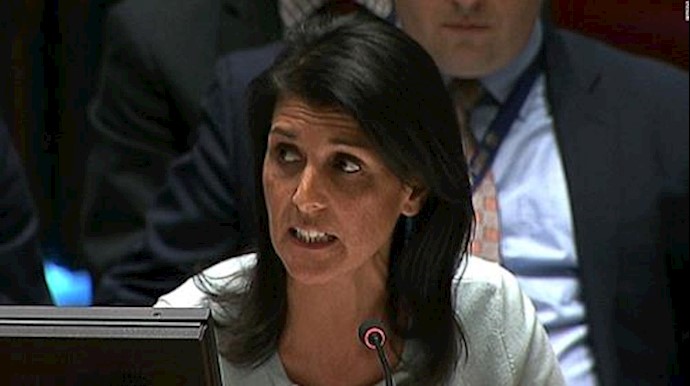
Canada Free Press, April 23, 2017 – Ambassador Nikki Haley, U.S. Permanent Representative to the United Nations, chaired the UN Security Council’s latest perennial debate on the situation in the Middle East, including the Palestinian question, on April 20th.
Ambassador Haley then focused her attention on the one country in the Middle East that is by far the biggest troublemaker – Iran. “If we are speaking honestly about conflict in the Middle East, we need to start with the chief culprit: Iran and its partner militia, Hizballah,” Ambassador Haley pointed out. She then went on to list all of the ways in which Iran and its terrorist proxy have destabilized the entire region, from Syria, Lebanon, Bahrain and Yemen to the Palestinian territories themselves. “Hizballah is a terrorist group spreading its influence across Middle East with the backing of a state sponsor,” she said. “Iran is using Hizballah to advance its regional aspirations. They are working together to expand extremist ideologies in the Middle East. That is a threat that should be dominating our discussion at this Security Council.”
Ambassador Haley made clear that the U.S. under President Trump will not sweep the Iranian threat to peace and security under the rug, as the Obama administration had done. Sanctions imposed on Iran for its state sponsorship of terrorists will be enforced. Moreover, she condemned Iran’s continued ballistic missile tests.
Last week U.S. Secretary of State Rex Tillerson certified that Iran was technically compliant with its commitments under the 2015 Iran nuclear deal, known more formally as the Joint Comprehensive Plan of Action (JCPOA). However, this is only because of all the concessions that the Obama administration had made, which lowered the bar for Iran’s technical compliance to an absurdly low level.
First, there are the missile tests, which violate a Security Council resolution endorsing the nuclear deal.
In addition, since Secretary Tillerson’s certification and Ambassador Haley’s remarks to the Security Council, evidence has surfaced indicating Iran’s continued work on nuclear explosive trigger technology. With satellite imagery in hand and intelligence gleaned from inside Iran, members of the National Council of Resistance of Iran (NCRI) held a news conference in Washington D.C. on Friday in which they claimed that the Iranian regime was continuing covert work on nuclear bomb technologies despite the nuclear deal. Reportedly, the Iranians are using their military base at Parchin, to which UN inspectors have only very restricted access, to perform work on explosives that are believed to be connected to Iran’s overall nuclear program.
The monitoring of JCPOA compliance has been more narrowly focused on the production of fissile materials, which the Iranians have largely mastered. Centrifuges are still spinning at a relatively low level, but the Iranians can afford to wait for full scale production with more advanced centrifuges when the JCPOA restrictions on production expire. Iran is presumably using its resources in the meantime to perfect the other elements it needs to successfully deploy nuclear weapons – detonation and delivery with high explosives and ballistic missiles, respectively. And they appear to be getting away with it.
Ambassador Haley has astutely challenged the United Nations Security Council to deal honestly with the most dangerous state in the Middle East – Iran – and to leave Israel alone for once. She is proving to be one of President Trump’s best choices to serve in his administration.