
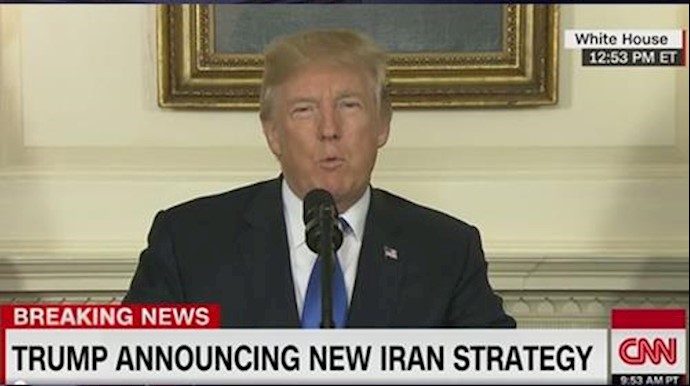
CNN, Oct. 13, 2017 – President Donald Trump on Friday threatened to pull out of a deal limiting Iran’s nuclear program if Congress and US allies do not agree to strengthen it, as he unveiled a tough and comprehensive new policy toward the Islamic Republic.
“As I have said many times, the Iran deal was one of the worst and most one-sided transactions the United States has ever entered into,” Trump said in a major speech at the White House.
In effect, Trump put the agreement in limbo without killing it off entirely as some backers of the agreement had feared. But his strategy risks setting off a chain of unpredictable consequences that could end up derailing it anyway and eventually raise the risk of war between the US and Iran.
Trump accused Iran of committing “multiple violations of the agreement,” despite the fact that the International Atomic Energy Agency, America’s European allies and even his own government say that Tehran is complying with the 2015 deal agreed by former President Barack Obama and major world powers.
He said that Iran had “failed to meet our expectations in its operations of advanced centrifuges,” and “intimidated” international inspectors into not using their full authority. He also accused the Obama administration of lifting sanctions on Iran under the terms of the deal at a moment when the Iranian clerical regime was about to collapse,
He also ordered US intelligence agencies to mount a new assessment of Iran’s compliance.
The President announced that he would no longer make regular certifications that the lifting of sanctions under the deal was in the US interests.
“We cannot and will not make this certification. We will not continue down a path whose predictable conclusion is more violence, more terror and the very real threat of Iran’s nuclear breakout,” he said. “I am directing my administration to work closely with Congress and our allies to address the deal’s many serious flaws so that the Iranian regime can never threaten the world with nuclear weapons.”
He said the flaws of the agreement included “sunset” provisions under which limits on Iran’s nuclear program will begin to expire. Proponents of the deal dispute that. The President warned that the deal was plagued by “insufficient enforcement” and near total silence on the missile program.
And he had a warning that if he did not get the changes he wanted, he would unilaterally kill the deal.
“In the event we are not able to reach a solution working with Congress and our allies, then the agreement will be terminated. It is under continuous review and our participation can be canceled by me as President at any time.”
The comment appeared to be a classic negotiating gambit by Trump, leaving other parties to the deal in no doubt that he is ready to walk out to get better terms. Given the deep reluctance of the Europeans, Russia and China and Iran to reopen the agreement, his approach is a high-risk one.
The administration wants to include new sanctions in US law that would snap into place should Iran continue to launch ballistic missiles or refuse to extend restrictions on its uranium enrichment when the deal expires in eight years time. European powers have said they are open to negotiating separate deals with Iran, but they are not in favor anything that would endanger the original agreement. Iran has warned against any action that could be seen as renegotiating the 2015 deal retrospectively.
As Trump spoke, the Treasury Department issued a statement saying that it would designate Iran’s Islamic Revolutionary Guard Corps for new sanctions over its support for terrorist organizations throughout the Middle East. It did not, however, single out the powerful militia as a foreign terror organization through the State Department. Earlier, the head of the Atomic Energy Organization of Iran, Ali Akbar Saleh, warned that terming the guards as a terror group would be “tantamount to a declaration of war.”
Trump’s comments are likely to dismay America’s allies who oppose re-opening the deal, even though they support countering what they see as nefarious Iranian activity throughout the Middle East.
They also went a lot further than senior aides, including Secretary of State Rex Tillerson had suggested. While Trump’s move sends the deal’s fate to Congress he did not rip up the agreement. Tillerson had suggested that if Congress does not agree to impose new sanctions on Iran the deal would remain in place. But Trump’s warning that he would terminate the agreement appeared to call that into question.
If lawmakers decide to impose new punitive economic sanctions on Iran immediately, the deal will likely fall apart. Instead, the Trump administration wants members of Congress to adopt new measures that would keep the deal intact, while spelling out parameters by which the US would impose new sanctions should Iran violate its agreements.
Trump had been weighing his Iran decision for weeks and faced intense pressure from European allies to maintain the US commitment to the accord. His national security advisers had encouraged him to avoid completely withdrawing from the agreement, which was signed by the US along with Britain, France, Germany, Russia, China, the European Union and Iran in 2015.
A complete removal of the United States from the nuclear deal would isolate the United States and provide an opening for Iran to rethink its own commitments on reducing nuclear stockpiles, some of Trump’s advisers and foreign counterparts warned.