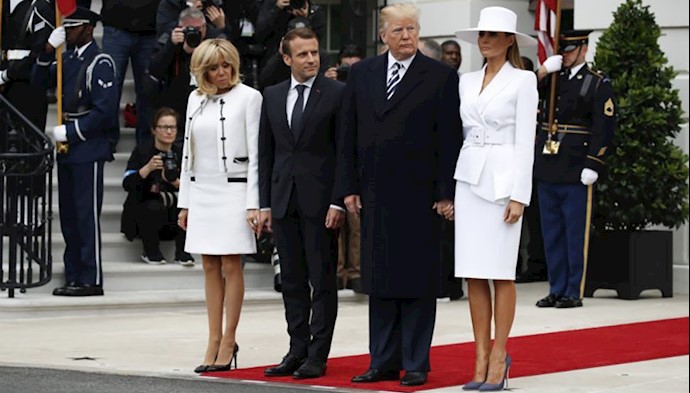
French President Emmanuel Macron and President Trump spoke about the Iran nuclear deal at a joint news conference at the White House April 24
BERLIN, Washington Post, April 24, 2018 — President Trump is hosting sort of a Europe week at the White House, with French President Emmanuel Macron in town for a state visit and German Chancellor Angela Merkel expected to arrive at the Oval Office on Friday.
To both European leaders who often closely coordinate their foreign policy moves, one issue will define their agenda in Washington: the Iran nuclear deal. Or, as Trump likes to call it: the “bad” and “terrible” deal with a country he has blamed for being “behind every problem” in the Middle East. Trump doubled down on his criticism of the 2015 agreement on Tuesday, calling it “ridiculous” and “insane.”
“It was a terrible deal. It should have never been made,” Trump said as French President Macron's state visit was already underway.
Despite his criticism, Trump has reluctantly certified Iran’s compliance in the past. That may change with a new deadline that's coming May 12.
A U.S. decision to withdraw would not come as a full surprise to its European allies. Trump had already announced a withdrawal of presidential “certification” of the Iran nuclear deal in October, ahead of a prior deadline. His decision did not automatically result in the United States leaving the agreement, however.
This time — as a supposedly final U.S. deadline Trump set himself is quickly approaching — the stakes are much higher, even though all other signatories of the deal said that they want to stick to it. France, Britain, and Germany have urged the president to drop his resistance and have threatened to stay committed to the agreement even if the United States decided to leave it. (China and Russia are also parties to the deal and are unsurprisingly also in favor of keeping it.)
So why are European leaders ready to risk a transatlantic rift to uphold the Iran deal?
Europe thinks that a flawed deal is better than no deal
Even though there might be flaws, the current deal is better than no deal, European governments are arguing. “We have no indication of Iran violating its JCPOA commitments,” said an official in the German Federal Foreign Office last year, referring to the Iran deal, the Joint Comprehensive Plan of Action, by its abbreviation. French officials have reached the same conclusion, and even U.S. officials have made the case that Iran is in compliance.
“It is essential to maintain it to avoid proliferation. In this period when we see the risks with North Korea, we must maintain this line,” French Foreign Minister Jean-Yves Le Drian said. The U.N. watchdog tasked with monitoring compliance has reached a similar conclusion.
Europe could still stick to the deal without U.S. support but at a high political cost
The lifting of sanctions under the deal prompted a rush of European corporations to do business in Iran. These are now lobbying their governments to prevent the dismantlement of the deal and are hoping that Iran may continue to adhere to its conditions if Europe refrained from reimposing sanctions.
Theoretically, the deal’s non-U.S. signatories, which include Britain, France, Germany, China, Russia, and Iran, could agree to stick to the deal without U.S. participation. Asked about such a possibility at a European-Iranian investment conference last fall, Philippe Delleur, senior vice president of public affairs for transport company Alstom, said: “I suppose that they will not put again the European sanctions. [In that case], we should be able to continue to work.”
Such a decision could still have severe implications for transatlantic relations at a time when Trump has already faced open disagreement and anger from many of his allies there over defense spending, trade, climate change and other issues.
Existing trade connections and investments make the deal’s dismantling increasingly difficult
Iranian exports to the European Union increased by 375 percent from 2015 to 2016, and European companies have already invested a significant amount of money in the country, raising the stakes of any decision that could result in the deal’s collapse.
The surge in trade volume has been facilitated by the reintroduction of banking connections between Iran and the West, although major European banks have so far refrained from directly dealing with Iranian institutions. European credit agencies have stepped in to provide export guarantees to companies willing to trade with Iran.
Iran's president, Hassan Rouhani, defended the international nuclear deal Oct. 7 and warned President Trump against violating it
But would Europe be able to protect its businesses from U.S. sanctions?
Such a model to save the Iran deal could unravel, however, if the United States decided to punish European companies, banks or agencies cooperating with Iran. Officials are examining options to protect European companies and individuals from U.S. sanctions.
Some European business leaders doubt whether such efforts would provide sufficient protection. “Our stance and the stance of international companies is that we need to be compliant with international law, applicable law. And if sanctions come back and that means we cannot do our work inside or outside Iran, then we will stop,” said one senior executive at a major multinational corporation who spoke on the condition of anonymity to discuss the sensitivity of decertification.
“People have discussed the idea of protective legislation [E.U. blocking sanctions]. I think in practice, with real multinational companies, they wouldn’t want to rely on that to do Iran investment,” the executive said.
In any case, European governments would still face an awkward decision: Would they side with a regime they frequently accuse of human rights violations, or with the United States?