
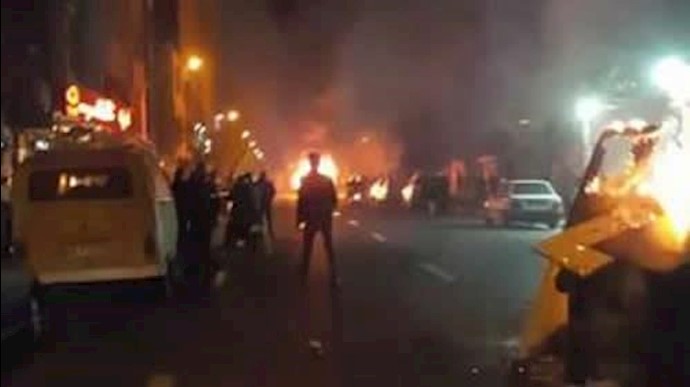
London, Riyadh Daily, 04 January 2018 – The London-based The Times newspaper has called on the Europeans to reconsider their policy towards Iran.
The paper, commenting on the current protests in Iran, said ” So far Tehran has played the European signatories of the nuclear deal off against Trump. Now we have to sit down with the Trump team and agree on common aims”.
The paper added” is it in the joint western interest that Iran becomes the military leader of the region? How can additional sanctions help? How do we reach ordinary Iranians and convince them that their government’s subversion abroad is damaging their standing in the world? That their economy is being usurped by the rapacious Revolutionary Guard? For Iranians there is a clear choice to be made, between guns and butter. We should nudge them towards the right future”.
The uprising of rich and poor Iranians is a golden opportunity to halt Tehran’s reign of terror, the paper said.
The paper said the latest protests show the West was wrong in 2015 to gamble on Rouhani’s survival and his plan to modernize Iran.
The paper said the latest protests show the West was wrong in 2015 to gamble on Rouhani’s survival and his plan to modernize Iran. The calculation was that curbing Iran’s nuclear programme would make the region more secure, would allow sanctions on Tehran to be lifted and fund a Rouhani-led liberalization that would make the regime’s future use of nuclear weapons unthinkable. A prosperous Iran would stabilize the Middle East. Instead, funds have been ploughed into propping up the Assad regime in Syria, bankrolling the Lebanese-based Hezbollah militia and a policy of military adventurism. They have also ended up in the pockets of the Revolutionary Guard.
For Donald Trump, the uprising is proof that the deal was flawed. For European governments, the priority is to secure the survival of Rouhani, who they regard as a moderating influence on the ayatollahs, and the curbs on Iran’s nuclear programme, which are still regarded as a diplomatic triumph. They have heavily invested in Rouhani, the paper noted.
Not so the Iranians on the streets. Unemployment is at 12.5 per cent and youth unemployment is twice that. Rouhani’s budget last month promised to spend $4.8 billion on creating new jobs. He plans to pay for it, however, by cutting fuel and food subsidies and imposing a levy on those who travel abroad. That has given every segment of society a grievance: to factory workers who see real wages falling fast while managers enrich themselves, to city-dwellers who have seen the price of eggs from the countryside soar by 40 per cent in the past few weeks, to the middle class who scrimp to be able to afford a foreign holiday.
It is an explosive situation that reminds of Poland in 1980, when the Solidarity movement, driven by worker discontent, brought together various strands of society. It was brought to a halt by the imposition of martial law the following year that was supposed to buy time for cautious, state-led reform. In fact it showed that communist power could only be maintained by the use of force. It sounded the death knell for communism as a ruling ideology — and it collapsed eight years later, the Times added.
Rouhani, and perhaps the whole theocratic system, has even less time. He will try, as the desperate communists did, to split the opposition; he will arrest some and try to co-opt others. He will buy off some factory workers but also find creative ways to block social media. Either he will cling on to power, and perhaps seek to replace the supreme leader, and in so doing suffocate every reform that was implicit in Obama’s grand bargain. Or he will be outwitted by others in the political game who will turn Iran into even more of a police state and make plans to resume its nuclear programme. There is, in short, not much difference between the “liberal” Euro-favorite Rouhani and his supposedly more hardline opponents.
Whatever the outcome Iran, which bragged that it was an oasis of stability during the turmoil of the Arab Spring, is heading for an implosion, the paper concluded.