As Foreign Minister Julie Bishop ate Tasmanian smoked salmon and avocado mousse with her Iran¬ian counterpart this week, there were several subjects her lunch guest would not have wanted to discuss.
Mohammad Javad Zarif would not have wanted to talk about, for example, Iran’s treatment of religious minorities.
He would not have wanted to talk about Iran’s treatment of journalists, according to the Committee to Protect Journalists at least 19 reporters, cartoonists and editors are still incarcerated.
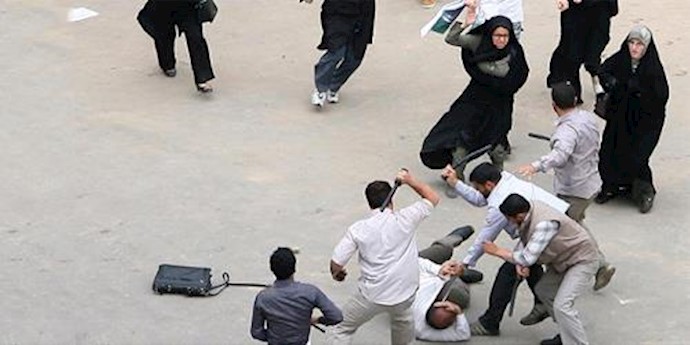
He would not have wanted to talk about the notorious Basiji militia, the secret police whose role is undeclared to their neighbours and work colleagues but who, if called on, will torture and kill whoever they are told to.
During 2009, I watched the Basiji in the streets as they openly bashed and dragged away peaceful protesters, prowling the streets like packs of hyenas looking for “enemies of the regime”.
The Basiji are part of the Revolutionary Guard — they are the ayatollahs’ enforcers and the ultimate line of defence for the Islamic regime.
Given the many human rights abuses in Iran, it is interesting to see Zarif in Australia this week lecturing Australia about its human rights problems.
Having spent five weeks in Iran over two trips — in 2009 and 2014 — I can say that Tehran’s regime is the most brutal I saw anywhere in the Middle East, ranking alongside Muammar Gaddafi’s Libya and Bashar al-Assad’s Syria.
Happily, Ahmadinejad has departed the national scene, taking with him his crazed rhetoric of Holocaust-denial.
But the most important reality in Iranian politics has not changed: the man who rules Iran with an iron fist continues to be the Supreme Leader, Ali Khamenei.
Khamenei’s title says it all — nothing happens in Iran without the approval of the Supreme Leader. He retains control of the 86-member Assembly of Experts, the body of ayatollahs that elects a Supreme Leader — much like the College of Cardinals elects a Pope. However, the violence of 2009, when Khamenei backed Ahmadinejad in an election widely seen as stolen, damaged Khamenei’s standing inside Iran and internationally.
Since then, sitting alongside him on the Assembly of Experts have been some powerful players who want to assassinate him politically — the most dangerous for him being Akbar Rafsanjani.
Rafsanjani is a billionaire — he made his money from Iran’s oil — who leads the moderate group among the ayatollahs.
My assessment, based on extensive travel around Iran and discussions with Iranians, is that the hardliners still hold about 60 per cent of the Assembly of Experts. The Islamic regime is not regenerating itself — Iran is a young and extremely well-educated population.
About 70 per cent of its 78 million people were not born when the ayatollahs came to power in the “Islamic revolution” of 1979, and most of the young people I spoke to had no real investment in the Islamic regime.
Although the regime tries to kill various social media outlets, the reality is most young people I spoke to have found ways to get around the clunky attempts to cut them off from the rest of the world.
While Zarif presents a smiling face to Bishop and the world, inside Iran the regime’s brutal machinery remains firmly in place.
The structure of the Basiji militia has been carefully constructed since 1979. My research in 2009 and 2014 showed why the Basiji are prepared to be ruthlessly loyal to the regime.
If a young person is having trouble getting into university or finding a job, the Basiji’s state-sponsored network will quietly pull some strings to help out.
But this is the ultimate Faustian bargain — in return that young person essentially sells their future to the Basiji.
They may be called on in future as they were in 2009, to put down civil unrest.
They give a commitment that if they learn that a neighbour, relative or work colleague is agitating against the regime that they will inform on that person.
If, in turn, another Basiji discovers that they did not pass on such knowledge they, too, can feel the wrath of the regime’s anger.
Source: THE AUSTRALIAN, 18 March 2016