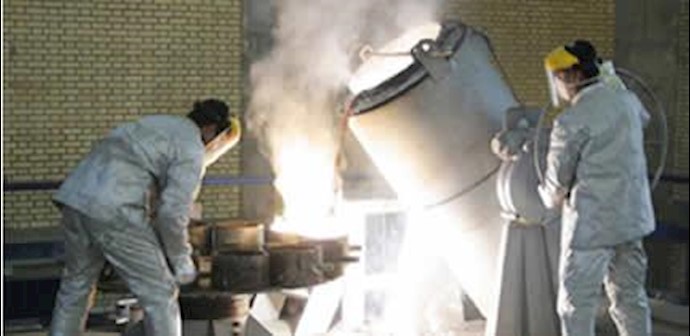
Iran and six world powers have agreed on a framework for negotiating a comprehensive deal over Iran’s nuclear program. At issue is how to stem Tehran’s ability to create enough fissile material — the stuff capable of sustaining a nuclear fission reaction — for an atomic weapon. The first round of talks concluded on Thursday in Vienna, with the next set scheduled for March.
“What this is about is reducing the timeline it would take Iran to convert a peaceful nuclear program into a military one,” said Mark Hibbs, senior associate of the Carnegie Endowment’s Nuclear Policy Program. “If this negotiation succeeds, then the time it would take Iran would be significantly longer. It could be measured in a small number of years, instead of weeks or a small number of months, if it were really, truly successful.”
Many countries have accused Iran of pursuing nuclear weapons capability. Severe economic sanctions have been imposed on Iran by the U.S. since the mid-1990s (with other sanctions stretching back to 1979 Tehran hostage crisis), the UN since 2006 and the EU since 2009.
The international community’s goal is to build on November’s interim, six-month accord in Geneva, designed to give negotiators time to hammer out the details of a longer term plan. That agreement, which went into effect in January and expires in late July, mandates a cap on the enrichment of uranium at 5 percent, suspended construction of a reactor, and heightened inspections of facilities, among other things.
In return, Iran gets some minor relief from sanctions over the interim period, totaling less than $10 billion. That figure pales in comparison to the $100 billion of Iranian reserves that the U.S. has restricted or blocked from use, and the $80 billion in oil the country was prohibited from selling over the past two years.
“The relief is comprised mostly of allowing Iran access to its own money denied by sanctions,” David S. Cohen, Under Secretary for Terrorism and Financial Intelligence, testified at a Senate hearing in December. “In light of the Iranian economy’s deep distress, the approximately $6 to $7 billion value of the relief package … simply will not move the needle on the Iranian economy.”
Making fissile material from uranium requires several steps; the goal of the agreement is to slow Iran’s ability at each phase in the process. Here’s a simplified explainer on how that process works.
First, uranium ore is mined from the Earth. That ore gets processed into what’s known as yellowcake powder and then converted to a gas. Uranium oxide contains two main parts, or isotopes: uranium-235 and uranium-238. To make an atomic bomb or power a nuclear power plant, the uranium needs to contain more of the uranium-235 than the uranium-238. That’s done using a centrifuge. The centrifuge spins the gas so quickly that the heavier uranium-238 flings out towards the sides of the centrifuge. The lighter, sought-after isotope — uranium-235 — concentrates near the center. Connecting thousands of centrifuges together creates what’s called a “cascade” through which the uranium moves, and becomes enriched as the distribution of uranium-235 increases.
Nuclear power plants rely on uranium enriched to 3 to 5 percent, whereas reactors used for research use uranium enriched between 12 and 20 percent. At 20 percent, the uranium is considered enriched enough to power a weapon. At 85 percent, it’s considered weapons-grade and the uranium can be weaponized — a very sophisticated and complex process on its own.
One requirement of the interim agreement calls for no enrichment past 5 percent, well within the low-enrichment level.
Why is 5 percent enrichment a line in the sand? It’s kind of like a new runner training for a marathon — the first part is the hardest. Getting to 5 percent enrichment is difficult, according to Christopher Bidwell of the Federation of American Scientists, but enriching beyond that gets exponentially easier.
“It’s more like you’re 70 percent there when you’re [at] 20 percent enrichment,” he said.
US President Barack Obama has previously said chances of success for a final agreement were no more than 50-50.
“I think [the president] is right,” Hibbs said. “That’s not an evasion tactic, that’s where things really are. There’s a lot of heavy lifting that needs to happen. It involves the Iranians admitting to disclosing activities that they so far refuse to do. They’re going to have to agree to essentially, significantly reduce the scope of their nuclear program. They haven’t agreed in public to do that yet.”