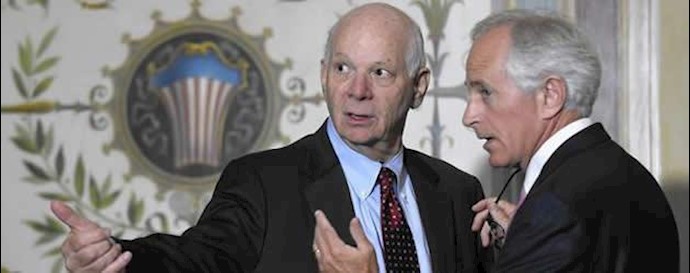
President Obama should not go to the United Nations with a proposal to lift sanctions on Iran before Congress acts, said Sen. Ben Cardin (Md.), the senior Democrat on the Foreign Relations Committee.
Cardin said the administration should not move forward with a proposal to draft a new U.N. resolution affecting international sanctions until lawmakers have a chance to review the nuclear deal, which was unveiled this week.
Cardin said he has communicated his concerns to senior administration officials.
U.S. ambassador to the U.N. Samantha Power on Wednesday circulated a draft resolution that would end international sanctions on Iran once the International Atomic Energy Agency verifies its compliance with a deal curbing its nuclear program
Senate Foreign Relations Chairman Bob Corker (R-Tenn.) said he told Power the action is inappropriate.
“I’m sorry. I look at that as an affront to the American people. I look at that as an affront to Congress and the House of Representatives. I talked to them this morning about the fact that I don’t think that was a prudent step. I just talked to our U.N. ambassador,” he told reporters.
Corker and Cardin sent a letter to Obama Thursday urging him to postpone a U.N. vote.
“We are deeply concerned that your administration plans to enable the United Nations Security Council to vote on the agreement before the United States Congress can do the same,” they wrote.
They argued such a vote would contradict Obama’s pledge to give the American public and Congress full opportunity to review the deal.
Cardin said lawmakers were surprised the administration decided to move forward with action to ease international sanctions before Congress weighs in.
“We sort of assumed that we would have this 60-day period without that action,” he said.
He noted, however, that the U.N. would not have a chance to lift sanctions before Congress votes on a resolution of disapproval that could scrap the deal. The new U.N. resolution cannot take effect for 90 days, which would delay the lifting of international sanctions until October.
“The administration said, ‘Look, we’ll take it to the U.N., but it can’t take effect until 90 days later, so they think they probably complied with the spirit of the 60-day review,” he added.
The issue came up during a briefing Biden gave to Democratic members of the Foreign Relations panel that lasted for more than an hour Thursday.
The Hill, 16 July 2015