
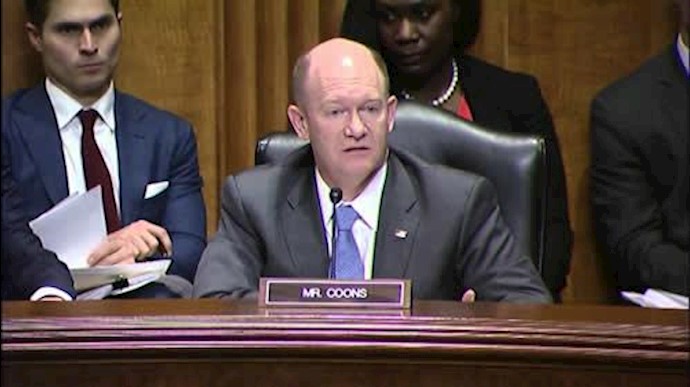
WASHINGTON – U.S. Senator Chris Coons (D-Del.), a member of the Senate Foreign Relations Committee, spoke at the Council on Foreign Relations to assess the nuclear agreement with Iran roughly one year since it was reached.
Following is part of the Senator Coons’ opening remarks as delivered at the Council on Foreign Relations:
Today, as we approach the one-year anniversary of the announcement of the Joint Comprehensive Plan of Action, or the JCPOA, I will evaluation whether this deal has succeeded so far, and explain what I’ve done to honor my commitment to aggressively oversee its implementation and its enforcement…
In the years to come—in the many years to come—we have to focus on continuing aggressive enforcement, and congressional oversight will remain critical. But we also have to continue to push back on Iran’s destabilizing and provocative actions outside the four corners, the parameters of the nuclear agreement. From its repeated calls for the destruction of Israel, to its support for terrorism in Syria and Iraq and Yemen, to its ongoing illegal ballistic missile tests, and its human rights violations, Iran is not a responsible state seeking to rejoin the international community. These actions underscore an important point about the deal: The JCPOA was, is, and will mostly likely remain a transactional, not a transformational, agreement.
This deal seeks to prevent Iran from developing a nuclear bomb, not to bring Iran into the community of nations. Only a genuine change in direction by the Iranian regime can do that…
With that said, let me briefly review broadly where we are today, nearly a year into the deal. Two things really haven’t changed at all. First, Iran remains untrustworthy. Since its 1979 revolution, Iran has pursued interests and advocated values that are completely opposed to those of the West. And its approach to regional crises has not changed. Second, Iran continues to exploit weak states and power vacuums. And we need to disrupt Iran’s destabilizing activities in the Middle East and to support our regional partners…
The United States has upheld our end of the bargain. We have not prevented Iran from receiving economic benefits associated with the deal. In fact, their recent activity, significant increases in oil exports, billions of dollars in recent deals, and projected economic growth of 3 to 5 percent casts real doubt on Iran’s claims. In my view, Iran alone is responsible for making its market an attractive and safe place in which to do business. And for many corporations and individuals, Iran is neither attractive, nor safe. And I am concerned that by entertaining Iranian complaints of inadequate sanctions relief we risk giving these claims legitimacy.
If Iran is unhappy with the level of economic benefits its received since the JCPOA, it has only itself and its own actions to blame. Today, as we look beyond year one of the JCPOA and look ahead to five, 10, or 15 years from now, one thing is clear: If this agreement is to succeed long term, engaged congressional oversight remains essential. This oversight falls into two categories, starting with congressional pushback on Iran’s bad behavior outside the deal’s parameters.
That’s why I’ve continued to be outspoken on the floor of the Senate in calling for stronger efforts to interdict Iranian arms shipments to the Houthi rebels in Yemen, and in celebrating those interdictions that have occurred. I’ve also asked foreign leaders, including those from Israel, Saudi Arabia, Qatar, India, and Russian, about how to strengthen our efforts together to counter Iranian aggression…
I’ve called on the administration as well to levy additional sanctions against IRGC-affiliated entities, like Mahan Aar, which Treasury has done. And I’ve worked to secure increased funding for Treasury’s Office of Terrorism and Financial Intelligence, which enforces these sanctions.
But Congress also has to remain engaged in overseeing the enforcement of the nuclear deal itself. In January, I joined a congressional delegation in visiting IAEA headquarters in Vienna, where we met with Director General Amano.
And I’ve called for the renewal of the Iran Sanctions Act, so that we have a viable mechanism to snap back sanctions in Iran violations the JCPOA. I intend to uphold my commitment to oversee strict enforcement of this deal, regardless of who is elected president this fall…
We can, and we should, distinguish between the Iranian regime and the Iranian people… They have repeatedly demonstrated in the streets for democracy and engagement, risking their lives to do so. The Iranian people deserve our support in their struggle for human rights and democracy, especially during this sacred month of Ramadan, as Muslims around the world reflect on their hopes for peace. But the Iranian regime deserves condemnation for a decades-long pattern of human rights abuses, support for terrorism, and other bad behavior.
The government of Iran, the Iranian regime, remains a dangerous revolutionary government, and it will continue to present a potential nuclear threat for decades to come. Preventing Iran from obtaining a nuclear weapon will require steady leadership, an understanding of the complexities of international diplomacy, and constant scrutiny of Iran’s behavior. These tasks must be the responsibility not just of this president this year, but a top priority for the next president, the intelligence community, and members of Congress for many years to come. That’s why I intend to stay actively engaged in monitoring enforcement of the deal, in advocating for a strong foreign policy that supports our allies in the Middle East and promotes American interests and values around the world.
Source: Political News, 28 June 2016