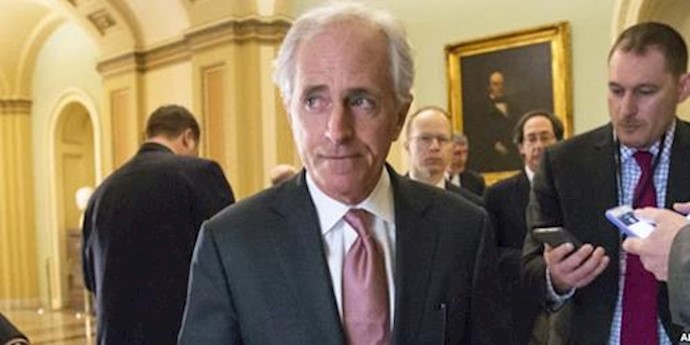
CAPITOL HILL-The chairman of the Senate Foreign Relations Committee said that Iran’s missile launches are sparking stronger resolve in Congress to renew and boost U.S. sanctions on Tehran.
“There are three categories [of sanctions] that can be looked at in a bipartisan way, and we are attempting to do that now,” Republican Senator Bob Corker said.
In particular, Corker said he is working to extend the Iran Sanctions Act, which was suspended as part of last year’s landmark international nuclear accord with Tehran. The law targets international investment in Iran. It remains on the books but will expire at the end of the year unless Congress extends it.
President Barack Obama has stated repeatedly that sanctions will “snap back” if Iran violates the nuclear accord. Such leverage will be lost if the Iran Sanctions Act expires, according to Corker.
“In the event there are violations, the snap-back provisions that are a part of the [nuclear] agreement mean that there has to be something to snap back to,” the senator said. “So extending that, dealing with conventional weapons and dealing with ballistic missiles are three areas that I think we have a possibility of reaching consensus on.”
“Iran is developing a nuclear program so that they can put it on top of a ballistic missile and destroy the nation of Israel,” Republican Senator Cory Gardner said. “They wrote as much on the ballistic missile [launched this week] itself.”
“Absolutely Congress should increase our sanctions and efforts. But the president might veto it, because this president doesn’t seem to want to stop Iranian bad behavior. In fact, in many ways, I think the Iran nuclear deal has enabled Iranian bad behavior,” Gardner added.
Democratic Senator Chris Coons hopes for a unified international response to Iran’s violations of the U.N. resolution.
“I think this calls for sustained active global engagement. I think the Security Council should act against this recent ballistic missile launch,” Coons said. “I continue to urge the administration to be engaged and strenuous in enforcing our existing sanctions against their ballistic missile program, their ongoing human rights violations, as well as their support for terrorism in the region.”
Corker said renewing the Iran Sanctions Act would be a unilateral U.S. move, but could cause other nations to act, as well.
“We’ve seen in the past, sometimes when we begin – just like with North Korea – there are follow-ons that are taken up by other countries,” Corker said.
Source: News Agencies, 11 March 2016