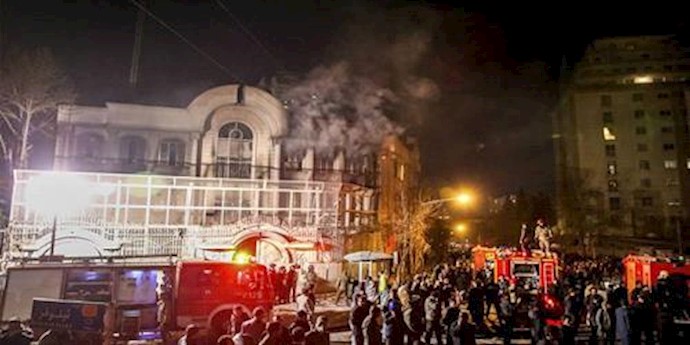
TEHRAN, Iran – Iranian regime mobs broke into the Saudi embassy in Tehran early Sunday Jan. 3rd 2016, setting fires and throwing papers from the roof.
While Saudi Arabia insisted the executions were part of a justified war on terrorism, Iranian politicians warned that the Saudi monarchy would pay a heavy price for the death of al-Nimr.
The Iranian Foreign Ministry summoned the Saudi envoy in Tehran to protest, while the Saudi Foreign Ministry later said it had summoned Iran’s envoy to the kingdom to protest the critical regime actions, saying it represented “blatant interference” in its internal affairs.
In Tehran, the crowd gathered outside the Saudi embassy and chanted anti-Saudi slogans. Some protesters threw stones and Molotov cocktails at the embassy, setting off a fire in part of the building
Some of the protesters broke into the embassy and threw papers off the roof. Al-Nimr’s execution promises to open a rancorous new chapter in the ongoing Sunni-Shiite power struggle playing out across the Middle East, with Saudi Arabia and Iran as the primary antagonists. The two regional powers already back opposing sides in civil wars in Yemen and in Syria. Saudi Arabia was also a vocal critic of the recent Iranian agreement with world powers that ends international economic sanctions in exchange for limits on the Iranian nuclear program.
The cleric’s execution could also complicate Saudi Arabia’s relationship with the Shiite-led government in Iraq. The Saudi embassy in Baghdad reopened for the first time in nearly 25 years on Friday. Already on Saturday there were public calls for Prime Minister Haidar al-Abadi to shut the embassy down again.
State Department spokesman John Kirby said in a statement that the U.S. is “particularly concerned” that al-Nimr’s execution risked “exacerbating sectarian tensions at a time when they urgently need to be reduced.”
Al-Nimr’s death comes 11 months after Saudi Arabia issued a sweeping counterterrorism law after Arab Spring protests shook the region in 2011 and toppled several longtime autocrats.
The executed al-Qaida detainees were convicted of launching a spate of attacks against foreigners and security forces a decade ago.
Saudi Arabia says all those executed were convicted of acts of terrorism. Al-Nimr and the three others mentioned had been charged in connection with violence that led to the deaths of several protesters and police officers.
Saudi Arabia’s top cleric Grand Mufti Sheikh Abdulaziz Al Sheikh defended the executions as in line with Islamic Shariah law.
The Lebanese Shiite militant group Hezbollah issued a statement calling al-Nimr’s execution an “assassination” and a “ugly crime.” The group added that those who carry the “moral and direct responsibility for this crime are the United States and its allies who give direct protection to the Saudi regime.”
One of the executed was Faris al-Shuwail, a leading ideologue in al-Qaida’s Saudi branch who was arrested in August 2004 during a massive crackdown on the group following the series of deadly attacks.