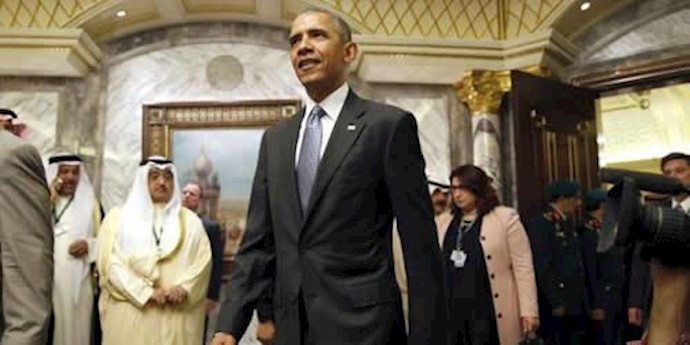
RIYADH- President Barack Obama pledged to “deter aggression” against Gulf Arab allies increasingly concerned about Iran’s influence in the region.
Obama’s visit to Riyadh to meet Gulf Cooperation Council (GCC) leaders was aimed at allaying fears in Saudi Arabia and its neighbors that Washington’s commitment to their security had diminished.
The president also hoped to use his fourth and probably final trip to the kingdom to dispel some of the frustration felt by Gulf countries toward his administration, in what one senior U.S. official said was a chance to “clear the air”.
“I reaffirmed the policy of the United States to use all elements of our power to secure our core interests in the Gulf region and to deter and confront external aggression against our allies,” Obama said after the summit on Thursday.
Saudi Arabia’s King Salman lauded the summit as “constructive and fruitful”, according to the Saudi Press Agency, and pledged the “desire and commitment” of GCC countries to continue developing their ties with the United States.
Footage and photographs aired on state media showed the leaders at a large circular table under a chandelier, with Obama sitting with King Salman on his left and the Abu Dhabi crown prince Sheikh Mohammed bin Zayed al-Nahayan on his right.
Most of the GCC states, which include Saudi Arabia, Kuwait, Qatar, Bahrain, the United Arab Emirates and Oman, have been bitterly disappointed in Obama’s presidency, during which they believe the United States has pulled back from the region, giving more space to Iran.
They were also upset by Obama’s remarks in a magazine interview that appeared to cast them as “free-riders” in U.S. security efforts and urged them to “share” the region with Tehran.
In his remarks after the talks, Obama acknowledged the strains that have afflicted ties between Washington and its Gulf partners, even as they have worked together on shared concerns such as the wars in Syria, Iraq and Yemen.
“What is true between the United States and the GCC, as is true with all of our allies and friends, is that at any point of time there are going to be differences,” Obama said. But he also said: “I think that a lot of the strain was always overblown”.
CLEARING THE AIR
Ben Rhodes, Obama’s deputy national security adviser, said a two-hour meeting with King Salman on Wednesday was the longest the two leaders had shared and included a “very open and honest discussion” that included issues which were a source of tension, without specifying them.
“I think they both agreed that it was good to essentially have this opportunity to clear the air,” he told reporters at a briefing in Riyadh.
The United States remains deeply enmeshed in Gulf security, cooperating closely with the monarchies to strengthen their armed forces and share intelligence aimed at countering Islamist militant groups.
Obama said the United States shared the Gulf countries’ concerns about what he called destabilizing activities by Iran, which agreed with major powers in July 2015 to curb its nuclear program in return for the lifting of some sanctions.
“Even with the nuclear deal we recognize collectively that we continue to have serious concerns about Iranian behavior,” he said.
The underlying strong relationship was underscored in a cartoon published on Thursday in the pan-Arab daily Asharq al-Awsat, owned by King Salman’s branch of the Al Saud ruling family.
It showed a Shi’ite cleric in black turban and robes, marked “Iran”, sweating with alarm as he read a newspaper headlined “Obama in Riyadh”.
All the Saudi newspapers published several pages of photographs of Obama’s meetings with Salman and other princes.
In keeping with a noticeably low-key approach by Saudi Arabia’s government, however, neither that photo opportunity, nor the GCC meeting’s opening statements, were broadcast on live television, as has often been the case before.
Source: REUTERS, April 21