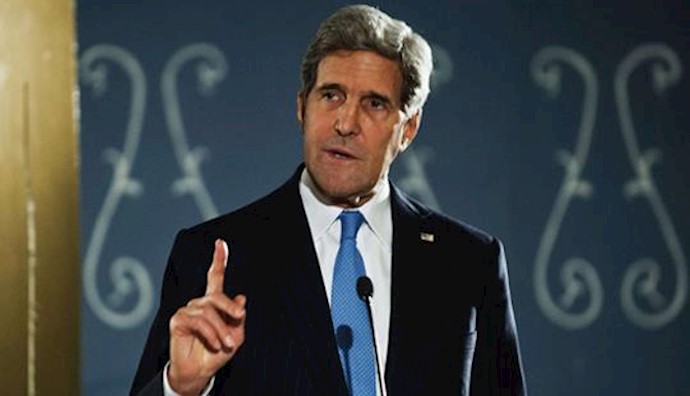
AP, Ankara, Turkey, 12 Sep 2014 — Secretary of State John Kerry, in Turkey to press its leaders on hardening its borders against extremist traffic and funding, said it’s not appropriate for Iran to be at the discussions, given its support for the very government in Syria whose brutality helped fuel the Islamic State group.
“Under the circumstances, at this moment in time, it would not be right for number of reasons,” Kerry said. “It would not be appropriate, given the many other issues that are on the table with respect to their engagement in Syria and elsewhere.”
He said Iranian forces have fought rebels in Syria, and accused Tehran of being “a state sponsor of terror” in some areas of the world.
He noted that France, for example, has made clear it is willing to use deadly force against the militants in Iraq, as has Obama. And Kerry said that as many as 40 countries have offered various levels of support, from humanitarian aid to cracking down on illicit cross-border funding and fighters flowing to the insurgents, to providing intelligence and supplies to rebels in Syria and security forces in Iraq.
The U.S. is also seeking partners on a planned military campaign that could broaden ongoing airstrikes against extremists in Iraq and extend them into Syria. “There are other countries that are currently making up their minds, making decisions,” Kerry told reporters after a day of meeting with Turkish President Recep Tayyip Erdogan and other top officials. “It’s just not appropriate to start laying out as we are in the process of talking to all these countries, which country is doing what.” He described himself as “very pleased” with the talks so far. “I am comfortable this will be a broad-based coalition with Arab nations, European nations, the United States, others contributing to every single different facet to what President Obama laid out as a strategy, and fully embracing the need to degrade and destroy ISIL,” Kerry said, using an acronym for the insurgency.
Earlier, at the start of a meeting with Kerry, Turkish Foreign Minister Mevlut Cavusoglu cited “challenges and threats” in Iraq and Syria. He did not mention the Islamic State group by name and did not respond to a shouted question about why Turkey refused, a day earlier in Saudi Arabia, to join the U.S. with a coalition of Mideast nations. Pledging to curb the extremists’ resources, the coalition also promised to repudiate their ideology, provide humanitarian aid to their victims and potentially contribute to a military campaign.
Turkey sits on the front line of the extremist group’s battleground in Iraq and its haven in Syria and already has assisted refugees and cracked down on some suspicious cross-border traffic from both countries.
Senior U.S. officials who briefed reporters traveling with Kerry said Ankara already has been working against the Islamic State group, including by recently stopping about 6,000 people from entering Turkey and deporting 1,000 more who were deemed suspicious.
Turkey has taken in an estimated 1 million Syrian refugees since the Syrian civil war began in March 2011.It’s not clear whether Turkey will be willing to contribute to the potential military campaign that the new coalition is planning. The effort is likely to include training and equipping Syrian rebels and Iraqi forces, providing intelligence, and expanding airstrikes against extremists in Iraq and potentially into Syria.
Because of its location, Turkey could be an ideal staging place for allied fighter jets and drones that would launch the airstrikes. But the U.S. officials said there currently are no plans to do so.
The U.S. officials all spoke on condition of anonymity because they were not authorized to be named in briefing reporters.