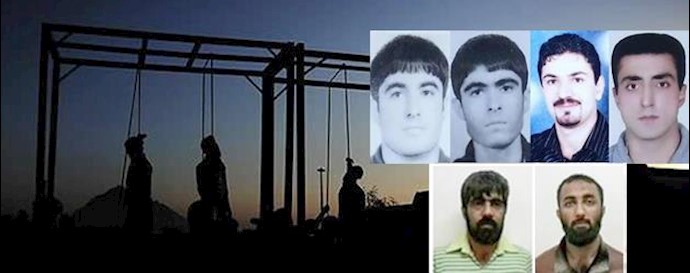
At dawn today, Wednesday, March 4, 2015, the anti-human regime of Iran hanged 6 Sunni political prisoners in Gohardasht Prison, west of Tehran. Their names are, Hamid Ahmadi, 33; Jahngir and Jamshid Dehghani – two brothers, one 28 years old and the second 29 – Kamal Molahie, 30; Seddigh Mohammadi, 28; and Hadi Hosseini, 31.
Their families and many friends had gathered outside Gohardasht prison from early hours of last night. One member of Hamid family said two ambulances left Gohardasht prison at 5 o’clock in the morning attracted the attention of the families thinking that their loved ones could be in there. We couldn’t see the bodies, but the prison guards said all six had been executed and that we had to receive the bodies at the cemetery.
Earlier on Tuesday and before the prisoners were transferred to the solitary for execution, 77 Sunni prisoners also in Gohardasht prison started a hunger strike in protest to the execution of these six Sunni young men.
Amnesty International had issued a statement yesterday, March 3rd to spare the lives of the six Sunni political prisoners on death row.
Hassiba Hadj Sahraoui, Deputy Middle East and North Africa Director at Amnesty International had urgently appealed to the Iranian authorities to halt the execution of these men, and quash their death sentences which followed grossly unfair trials.”
They were among 33 Sunni men currently on death row in Iran. All of the men maintain that they were targeted solely because they practiced or promoted their faith, such as taking part in Sunni religious seminars and distributing Sunni religious reading materials.
“The Iranian authorities have for too long toyed with the lives of these prisoners, causing them and their families unimaginable anguish with multiple mock executions and executions stayed at the last minute. It is high time for the authorities to end this cruel practice and allow the prisoners to seek judicial review of their cases from the Supreme Court,” said Hassiba Hadj Sahraoui.
In June 2014, the Iranian authorities halted the execution of four of the men after appeals from Amnesty International and other human rights organizations. The authorities then promised to allow the prisoners access to a lawyer of their own choosing, if the families stopped a sitting protest in front of the prison. However, seven months later, the authorities have yet to allow the men’s lawyers to meet with them or even access their court files.
Amnesty International understands that the authorities did not inform the six men’s lawyers that their execution has been scheduled for Wednesday even though there is a 48-hour notification requirement under Iranian law.
Iran remains the second largest executioner in the world, after China. In 2013, according to Amnesty International figures, the Iranian authorities officially acknowledged 369 executions. However, reliable sources have reported that hundreds of additional executions took place that year, bringing the possible total to more than 700. The trend has continued since then, affecting members of Iran’s ethnic and religious minorities in particular. Amnesty International will release the number of Iran’s death sentences and executions in 2014 in an upcoming report in April.