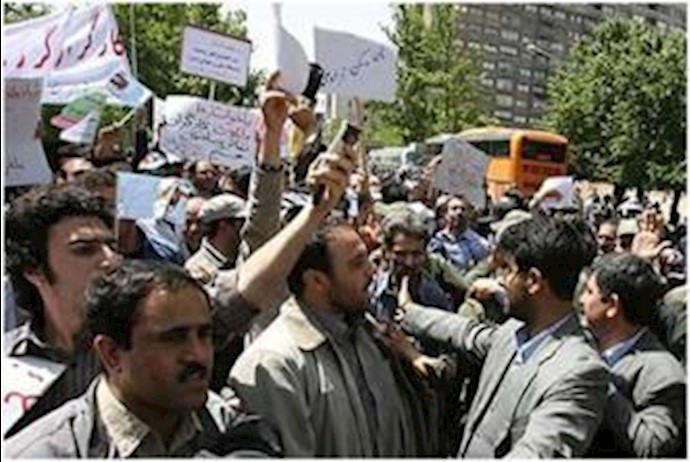
Bloomberg, 3 Oct 2012 – Police sealed off parts of downtown Tehran and fired tear gas rounds after street protests triggered by the country’s tumbling currency.
More than 200 policemen were stationed today around Ferdowsi Street, near one of the main areas for traders in the capital, and broke up groups of passers-by.
They were also sent to the city’s bazaar after shopkeepers refused to open and trash cans were set alight in the streets.
‘ The price of the dollar was unclear so we went on strike and decided to shut our store, ‘ said Rouhollah, who works in a wholesale food shop in the bazaar.
Shopkeepers didn’t know at what price to sell their goods, he said.
President Mahmoud Ahmadinejad called for calm yesterday, blaming the weakening of the rial on foreign pressures.
Iran’s economy is suffering after the U.S.and the European Union tightened trade and financial sanctions in the past year.
The restrictions, aimed at curbing Iran’s nuclear program, have limited the country’s ability to sell oil, its biggest export, and other goods in return for currencies such as dollars and euros.
‘ The fact that there are street protests was in many ways inevitable given that Iranians are essentially living in a pressure cooker, ‘ said Anoush Ehteshami , professor of international relations at Durham University in the U.K. ‘The pressure is inherently economic and affecting all strata of society.’
Tumbling Rial The rial, which has declined in value over the past year, dropped about 18 percent on Oct. 1, reaching a record low of 35, 000 to the dollar on the unofficial market. It weakened from 12, 100 to the U.S.currency in September 2010 to 13, 200 in November before slumping to its current level.
While the Iranian currency was valued at 36, 100 today, according to the state-run Mehr news agency, traders in Tehran said in interviews that most exchange houses have halted dealing in the greenback.
The current street value of the rial is less than a third of the official rate of 12, 260 per dollar set by the central bank, a rate to which most Iranians, except some importers of essential goods including medicines, meat and grains, don’t have access.
‘ Lack of Confidence’ The crisis has been compounded by poor economic policies, said Ehteshami. ‘The protest also reflects the lack of confidence in the elite’s ability to sort things out, ‘ he said.
‘People are also aware of tensions at the highest level of the state and you put these things together and they want at the very least to show their anger.’
The rial’s dive happened about a week after the opening of an exchange center by the government, aimed at stabilizing the market.
Central bank Governor Mahmoud Bahmani , cited in the Donya-e-Eqtesad newspaper yesterday, said the institution will ‘fully cover real demand’ for foreign currencies.
Importers of basic goods such as industrial and agricultural machinery can benefit from a discount from the market rate at the center.
Ahmad Karimi-Esfahani , head of the society of syndicates and bazaar, said the government ‘isn’t fit’ to make decisions for the markets.
‘The government’s wrong decisions have fed the price bubble for foreign currencies, ‘ Karimi-Esfahani said in a report published by Mehr.
‘The government has incited ordinary Iranians to trade currencies and today we are seeing that as much as it injects currencies into the market, it still can’t meet demand.’
The U.S. , the EU and Israel have expressed concern that Iran intends to develop nuclear weapons, an allegation the Islamic Republic denies.
Israeli Prime Minister Benjamin Netanyahu called for a ‘red line’ to be drawn on the uranium- enrichment program, at a speech at the United Nations last week.