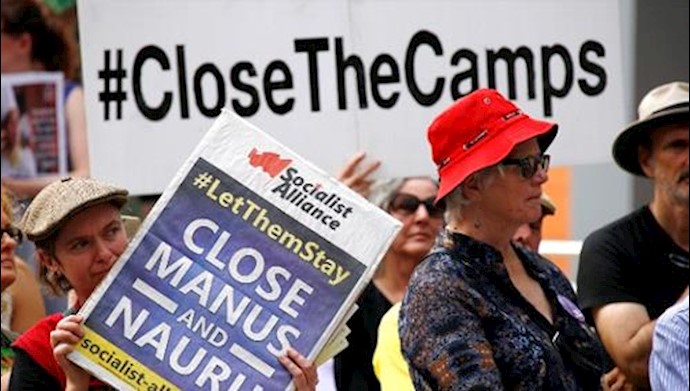
An Iranian refugee who set himself on fire at Australia’s immigration detention camp on the Pacific island nation of Nauru died of his injuries on Friday, officials said.
The 23-year-old man, who set himself alight on Wednesday in an apparent protest over Australia’s strict asylum seeker policies, died in an Australian hospital after being airlifted there for treatment, Australia’s immigration department said in a statement.
The refugee’s actions were a protest intended to coincide with a visit to the island by representatives of the U.N. refugee agency, Nauru’s government said earlier this week.
He has been on Nauru for three years.
Australia-bound migrants who are intercepted at sea are detained in Nauru or Papua New Guinea, 4,500 kilometres (2,800 miles) from Australia, often for extended periods, under agreements Australia has with those countries. On Wednesday, officials from the United Nations refugee agency were visiting Nauru, where 450 men, women and children were being held, when the man set himself on fire there.
“This is how tired we are,” the man said before igniting the fire, according to witnesses quoted in news reports. “This action will prove how exhausted we are. I cannot take it any more.”
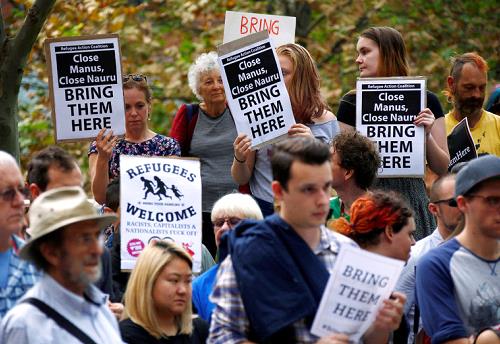
People protesting Australia’s offshore detention centers outside the offices of the Department of Immigration in Sydney, Australia, on Friday.
His self-immolation, along with a court ruling on Tuesday in Papua New Guinea that declared the detention agreement unconstitutional and forced the closing of a detention center there, has renewed criticism of Australia’s policy toward boat migrants, whom the government refuses to allow to settle in Australia.
witness to the incident earlier this week said, Omid got distressed during a meeting with UNHCR staff.
“He got very angry and distressed and burnt himself,” she said.
“None of them helped. None of them called an ambulance, they just called the police and ran away.
“Doctors didn’t know what to do. They didn’t have supplies to help him.”
Before he died, Omid’s wife told Guardian Australia she did not expect him to survive, and blamed Australian officials for what she saw as delays in getting him to hospital in Queensland.
Speaking through an interpreter, she said that once her husband was taken to the Nauru hospital it took two hours for a doctor from International Health and Medical Services to arrive and treat him, and he was unable to be given intravenous pain relief.
She said he was not given a sheet or a place to lie down, and that the hospital “didn’t even have a clean syringe”.
“Staff in Nauru hospital couldn’t help Omid in any way because they were unequipped,” she said. “A lack of proper equipment and facilities was the reason that staff couldn’t help and treat Omid in the Nauru hospital.”
She said Omid suffered a cardiac arrest during the night, and doctors performed emergency surgery with her consent. Upon arrival in Brisbane, she said doctors told her he was already brain dead.
Omid’s wife was brought to Brisbane and waited in the hospital with him, under guard. Some friends had spoken to her, she said, attempting to offer comfort before she was soon stopped from speaking.
“Currently I am in isolation in way that I am not allowed to talk to anyone or do interviews,” she said.
“They have taken away my mobile phone so no one can contact me and I am being observed constantly by the officers that are accompanying me.”
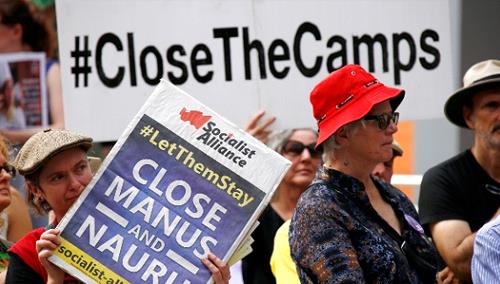
Protesters from the Refugee Action Coalition in Sydney, Australia, April 29, 2016
The policy appears likely to become a point of contention for Prime Minister Malcolm Turnbull’s conservative coalition government in the next general election.
Richard Marles, an opposition MP, described the death as an “absolute tragedy” and accused Malcolm Turnbull, the prime minister, of failing to offer migrants any hope of resettlement.
“The Turnbull government’s policy, focused only on deterrence with no feasible pathway to permanent migration in a resettlement country, is leaving people desperate and without hope,” he said.
On Friday, a senator from the opposition Greens party, Sarah Hanson-Young, wrote on Twitter: “Omid, the refugee who set himself on fire has died. And yes Prime Minister I am misty-eyed as I can only imagine his loved ones are too.”
The death of Omid has prompted increased public calls in Australia for a more compassionate treatment of refugees. A candlelight vigil was held for the man in Brisbane on Thursday night, and protests are planned in Sydney and other cities over the weekend.
Critics say the policy of holding asylum seekers and refugees indefinitely on Pacific islands is inhumane.
“This is another senseless and tragic death as a direct result of Australia’s inhumane refugee policies,” said Elaine Pearson, the Australia director of Human Rights Watch. “Refugees who have fled persecution in their homelands don’t deserve a life in limbo in a detention center or effectively imprisoned on a tiny, remote island.”
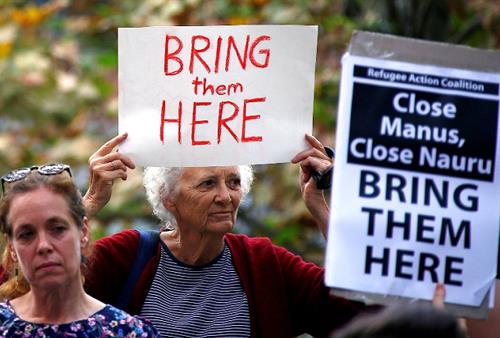
Protesters hold placards during a demonstration in Sydney, Australia, April 29, 2016.
Barri Phatarfod of the charity Doctors for Refugees said that a hospital on Nauru had trouble treating Omid, who was badly burned and suffered complications from a lack of oxygen, making the airlift to Brisbane necessary. “Hospital staff struggled with maintaining an adequate airway, and had difficulties accessing an intravenous line,” Dr. Phatarfod said in a statement. “These are quite difficult to do in a severe burns victim, and need a specialized team immediately.”
She added, “This tragic outcome once again demonstrates the complete impracticality of accommodating these highly vulnerable people so far from Australia.”
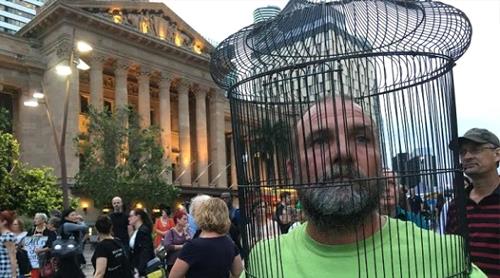
Paul Mansfield wears a cage symbolising the imprisonment of asylum seekers.
The Australian government and the largest opposition party, Labor, are in general agreement that migrants who try to reach Australia illegally by boat should not be allowed to settle in the country. Even those who are officially recognized as refugees are processed offshore and offered resettlement in other countries, not Australia.
Last year, Nauru began allowing asylum seekers to come and go freely from the detention center there. But Nauru is just eight square miles, less than half the size of Manhattan, and advocates for refugee rights say that conditions there are difficult, with a lack of services for mental health and other needs.
New Zealand has said it can take 150 refugees a year, but Australian officials have declined that offer, saying it will only encourage more people to try dangerous sea crossings. Mr. Turnbull repeated that position this week, saying that the chance of being resettled in New Zealand would be “used by the people smugglers as a marketing opportunity,” according to news reports.
A human rights group said Immigration Minister Peter Dutton has blood on his hands after the refugee who set himself alight in protest died on Friday.
On the day an Iranian asylum seeker died in a Brisbane hospital nearly 200 people rallied in King George Square to call for an end to offshore detention.
Omid’s death hung heavy on the crowd that gathered in Brisbane’s CBD Friday evening.
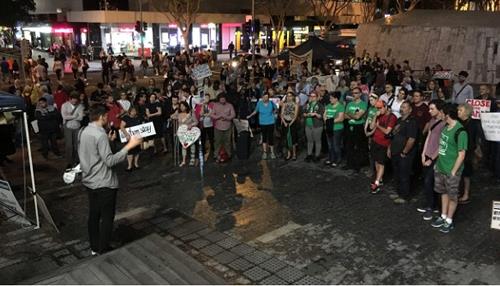
Rally organiser Tim Arnot, from the Refugee Action Collective, addresses the crowd in King George Square on Friday night.
Rally organiser Tim Arnot from the Refugee Action Collective led the crowd in a minute’s silence for Omid.
An Amnesty International report in November 2013 found that refugees and asylum-seekers detained in Nauru were living in cramped conditions, suffered from both physical and mental ailments, and routinely had their human rights violated.
Amnesty International has reported that the deliberately harsh, humiliating conditions there were designed to pressure asylum seekers to return to their country of origin, regardless of whether or not they were refugees.
Amnesty International is calling on the Australian government to end offshore processing, and to bring those people sent to Nauru and Manus Island back to Australia to have their refugee claims fairly assessed.
Source: News Agencies, 29 APRIL 2016