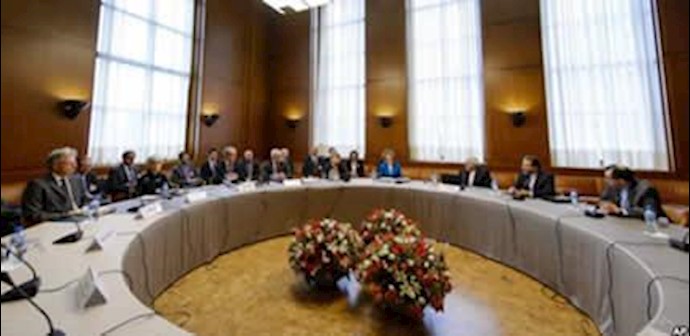
When the latest round of Geneva talks wrapped up between the P5+1 and Iran, Thursday morning, after three days of secret conclaves, the only clearcut “progress” the diplomats had to report was that they had agreed on a schedule and “framework” to do more talking.
There was no clarification of what issues, precisely, all parties had identified in these latest talks — though major disputes have been seeping out of almost every part of this process. For instance, the U.S. has said publicly that Iran’s development of ballistic missiles is a threat. Iran has said publicly that its missiles are non-negotiable.
Nor was there much clarity on offer in a background briefing later Thursday morning by a senior U.S. administration official, who said that “all of the issues of concern to the international community regarding Iran’s nuclear program are on the table.”
What does all that translate into in practice? Hard to say, except that it is both highly ambitious and enormously vague. The full text of the Joint Plan has been withheld from the public. Since it was announced, Iranian officials have been disputing important parts of what the U.S. says they agreed to. Zarif, for example, has said that contrary to White House claims, Iran did not agree to dismantle any part of its uranium enrichment facilities.
At the same background briefing, it further emerged that even the framework hammered out this week for further talks is not available in any definitive form — for the reason that it has not been formally written down. That’s supposed to be all right, we were told, because “we all know what it is.”
As things now stand, what are the benefits of this process for America and its allies? Well, there’s a temporary pause in some aspects of Iran’s nuclear weapons program; but nothing to really impede Iran rolling forward again, should its rulers so choose. There’s also the pleasure of imagining that Iran’s aging Khamenei, having presided for decades over Iran’s quest for the ultimate weapon, might decide he’d prefer to be remembered as the mullah who surrendered his nuclear ambitions to Catherine Ashton and Wendy Sherman. And for P5+1 diplomats engaged in these talks, there is of course the promise in coming months of fine dining and high-profile diplomatic dealings in Vienna.
What’s in it for Iran? With partial easing of sanctions, there’s a chance for the repressive, terrorist-sponsoring Tehran regime to regroup economically and financially. The hope of the western diplomats leading these negotiations is that sanctions relief, friendly talk and other accompanying favors might entice Iran’s despots to abandon their bellicose ways and in the general interest of their fellow Iranians take a seat as benign members of the community of nations. That hope could backfire to terrible effect, if — as seems likely — Iran’s rulers stick to their usual ways of favoring their own power, wealth and messianic ambitions over the welfare of their countrymen. While the Iranian economy is enjoying a spell of sanctions relief, the opportunities are expanding again for the funding and procurement needed for Iran’s proliferation programs.
There is also an utterly undeserved legitimacy now being conferred on Tehran’s tyranny. Iran’s regime remains the world’s leading sponsor of terrorism, a patron of carnage in Syria, and a brutally repressive power at home. Yet the attention paid to Iranian officials in these negotiations — verging at times on deference — is conferring on the likes of Javad Zarif, or Iran’s president Hassan Rouhani, a celebrity status that casually ignores their roles as longtime loyal advance men for a murderous government.
What now appears to be playing out at the bargaining table is a potentially protracted, ill-defined gamble, led by the EU and the U.S., that Iran is ready to be talked out of its nuclear program. The model that comes to mind is North Korea, where the road to three nuclear tests over the past eight years — and a fourth quite likely now in the works — entailed round after round of negotiations, under both the Clinton and Bush administrations. The pattern was one of procedural triumphs, announced as progress, only to be followed by Pyongyang’s reneging, cheating, pocketing the gains and concessions won at the bargaining table, and walking away. The diplomatic extravaganzas served not to win over the rogue nuclear-proliferating state, but to shore it up. It’s a good bet that Iran, a close ally of North Korea, learned something from watching that scene. One might have hoped that Sherman, who served as policy coordinator for North Korea during the second term of the Clinton administration, had learned something as well. But here we go again. Lots of diplomatic procedure. But who benefits?