
Mir Salim: Rouhani’s government is preventing job for the youth by selling more oil
Rejecting Rouhani’s claims of gains by reaching the JCPOA agreement, the ex-conservative culture minister Mostafa Mirsalim said “the government rejects and criticizes the essence of selling oil, but still says that they have sold two and half million barrels of oil per day.”
“This would actually bring two negative prospects which would also eliminate job,” Mir Salim added
He continued to say “we should be honest and truthful with ourselves. Claiming to have a growth rate of 8 percent while 6percent of that is just from the oil sail would leave only 2% growth rate. This is not honesty. The real growth rate of the country is just 2% and not 8%. The honest thing for the President is to acknowledge that 6 % of this comes from oil.
Embezzlement admission
On the other side, Rouhani lashed out against the rival camp by exposing billions of dollars’ embezzlement.
“We should coordinate the issue of living simple with the rules and regulations. Otherwise we would face the situation where one would say that he has a simple life, but huge corruptions and embezzlement surfaces.”
“What happened to the 3 or 4 billion dollars that were said to be used to bypath the sanctions? Who did receive those money? Who gave them those money? The government and the judiciary have to answer the people.” Mir Salim concluded.
Analysis: Is there anything Iran’s presidential election can change?
The US is said to be weighing a variety of different approaches on the regime ruling Iran after the upcoming May 19 presidential election.
This line of thought argues any punishing measure by the US now would support “hardliners” against “moderates”. The problem is that any such distinction of Iran’s political landscape is entirely incorrect.
The regime in Iran does not, to say the least, has the best interest of Iranians or people across the region at heart, let alone other nations throughout the planet. The argument of how the West’s actions may affect Iran’s elections fails to understand what Iranian Supreme Leader Ali Khamenei and his surrogates have in their playbooks.
In the elections, all candidates are vetted by a 12-cleric member Guardian Council body, effectively appointed directly and indirectly by Khamenei. The list has now been trimmed to six candidates.
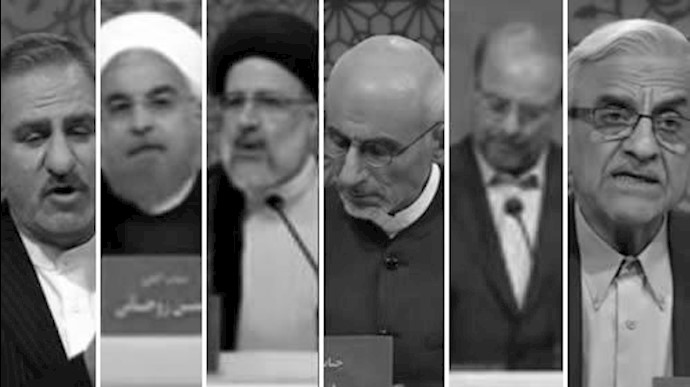
The slate includes incumbent President Hassan Rowhani, hardline cleric Ebrahim Raisi, Iran’s first vice president Eshaq Jahangiri, Tehran mayor Mohammad Bagher Ghalibaf, former minister of culture Mostafa Mirsalim and former industry minister Mostafa Hashemitaba.
A first glance indicates the remaining four will most probably step aside eventually in favor of Rowhani and Raisi.
Elections render no change
Iran’s elections do not have any impact on domestic or foreign policy. In internal issues, the hallmark “moderate” Rouhani and former president Mohammad Khatami – also dubbed “moderate” and president from 1997 to 2005 – only increased domestic crackdown, including arrests, tortures and executions.
In the past four years, Rowhani has presided over nearly 3,000 executions – far more than his firebrand predecessor, Mahmoud Ahmadinejad.
On foreign policy, never has there been the slightest difference in the regime’s eagerness to advance its nuclear program. Most recently, Rowhani made remarks signaling a shocking contrast to other Iranian officials: he boasted of the highly flawed Iran nuclear deal.
“Nuclear technology is a dire necessity for us, and that is exactly why [Khamenei] constantly underscores the need to continue developing this technology,” he said according to the semi-official ISNA news agency. Rowhani also boasted how his cabinet increased the defense budget.
“Statistics show [this] government has increased the defense budget by 145 percent… It is the pride of [this] government that the steps taken forward in providing strategic equipment and assets for the armed forces in the past 3½ years have matched those of the past 10 years,” he explained.
Rowhani is also known for his close relationship with the regime’s founder, Ruhollah Khomeini, dating back to 1979, while his main opponent, Raisi, spent the past three decades easily climbing up the regime’s ranks for his role in the judiciary, and sending dissidents to the gallows without any hesitation.
Raisi is most famously known for his membership in the notorious “Death Commission,” tasked to carry out Khomeini’s fatwa leading to the summer of 1988 massacre that left more than 30,000 political prisoners dead in the span of a few months. Most of the victims were members and supporters of the Iranian opposition People’s Mojahedin Organization of Iran (PMOI/MEK).
Iran’s presidential election is nothing but a game we witness every four years. The president has no true role in running the country, other than to implement the supreme leader’s policies. Khamenei, the Supreme Leader, has the final say on all national security and foreign policy issues, while enjoying full, unrivaled supremacy.
Khamenei even has the authority, under the regime’s so-called constitution, to veto and dismiss all powers provided to the president. The difference we will witness in Iran’s approach to domestic and international affairs will be zero. That is exactly why designating the Islamic Revolutionary Guards Corps (IRGC) as a foreign terrorist organization should not be delayed for any reason – especially Iran’s presidential election.
According to The Daily Beast the IRGC “are Iran’s most important security, military, and political institution, with financial interests in most areas of the state’s economy. Its Quds Force, which is in charge of global operations, was officially designated as a terrorist entity by the US Treasury Department in 2007. Hezbollah was designated in 1997.”
It is now time to target the main root of the Middle East’s crises.
Another discussion in the second round of debate in Iran’s presidential elections was the JCPOA [Joint Comprehensive Plan Of Action]. The candidates attacked the incumbent president Rouhani accusing him of making a bad deal with the US and other world powers.
Mullah Raisi, who is dubbed ‘the execution mullah’ due to his background history of overseeing the execution of more than 30,000 political prisoners during the summer of 1988, when he was deputy Attorney General, lashed out against Rouhani and said “you say that the JCPOA has lifted the threat of war from our country, but this is a lie and a bad message for the negotiators.”
Iran regime presidential hopeful, Mir Salim told Rouhani and his vice president Jahangiri that many of your cabinet ministers are abusing their power and use the information ministry for their own benefits.
He called them businessmen as well as cabinet ministers that abuse their power and facilities at their discretion.
Rouhani attacked Mohammad Bagher Ghalibaf the Tehran’s mayor accusing him and his followers of attacking a parliament member in the city of Shiraz with bricks while demanding a free and prosperous society and higher education for all.
Jahangiri, another candidate also attacked Ghalibaf telling him that the daughter of a minister who is unemployed has used his father’s credentials to import batches of clothing in to the country without paying taxes or customs under your watch.
In the beginning the statement by the elections’ committee was read and was reiterated that there should be no foul verbs from candidates towards other candidates. They feared that such obscene language would result in clashes of ideas between the candidates and would lead to dangerous consequences, such as what happened during the 2009 presidential elections.
The statement threatened the candidates that in case of using foul and abusive words they would be punished.
The second live election debate in Iran’s presidential elections has kicked off with 6 candidates discussing politics and cultural issues
The six candidates included the incumbent president Hassan Rouhani, Ebrahim Raisi, a powerful cleric; the hard-line mayor of Tehran, Mohammad Bagher Ghalibaf; a conservative former culture minister, Mostafa Mirsalim; Vice President Eshaq Jahangiri and former vice president Mostafa Hashemitaba.
The first debate of Iran’s presidential election, can be evaluated from a variety of perspectives. One simple conclusion is that all candidates failed to provide any hope for a better future.
Remembering how the 2009 debates paved the way for nationwide uprisings, rattling the regime’s entire establishment, this year’s debate was shortened in timing to prevent any uncontrollable sparks. Despite all this, the arguments provided a vivid view into the regime’s critical domestic crises.
More important is the fact that, similar to all previous so-called “elections” in this regime, no candidate was able to provide a comprehensive political and economic agenda. Twelve rounds of presidential elections, parliamentary polls, and votes for city councils have provided nothing but more of the same.