
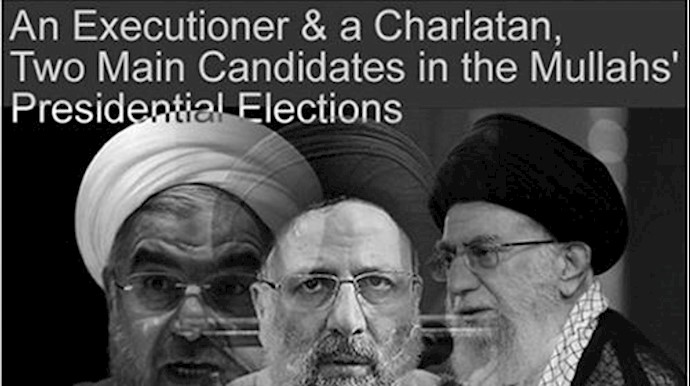
BEIRUT, (Reuters), 9 May 2017 – Determined to protect a dominant security role and vast economic interests, Iran’s Revolutionary Guards military force is quietly backing a hardliner in May 19 presidential polls, with an eye toward a bigger prize: the succession of the supreme leader.
The Islamic Revolutionary Guards Corps (IRGC), and the Basij, a volunteer militia under the Guards’ command, are taking steps to promote the candidacy of his main rival, hardline cleric Ebrahim Raisi.
Media outlets affiliated with the Guards have been criticizing Rouhani’s performance in power. Experts who study the force say they are also likely to use their street muscle to help get Raisi supporters to the polls.
“The IRGC will be running buses and mini-buses to make people vote. They will be mobilizing voters not only in the rural areas but also the shantytowns around the big cities,” said Ali Alfoneh, a senior fellow at the Atlantic Council who has done extensive research on the Guards.
“They want their supporters voting.”
The Islamic Republic’s security hawks are worried that Rouhani with a fresh mandate would chip away at prerogatives that have given the Guards huge economic and political power.
Whether or not Rouhani wins a second term, the bigger prize is controlling who will succeed Supreme Leader Khamenei, whose power far exceeds that of the elected president.
Khamenei, in power since 1989, is now 77. Some analysts say Raisi’s presidential bid is a test run for a man who could be groomed to take over as Khamenei’s successor.
“This election is not only about choosing the president. It’s about succession after Khamenei,” said Alfoneh. “The IRGC believe that it’s their chance to completely eliminate the technocrats and control the succession process after Khamenei.”
ARRESTS
Khamenei’s successor will be chosen by a body called the Assembly of Experts, elected last year for an eight-year term.
Rouhani himself sits in the assembly as one of its biggest vote-getters, and he and his allies nearly swept the seats from the capital Tehran.
But many members of the body are not firmly associated with either the reformist or traditionalist camp, and the faction that wins the presidential election could gain an advantage in trying to solidify backing for its candidate for supreme leader.
The Guards have been making their preferences known. In mid-March, the IRGC arrested a dozen administrators of reformist social media channels on the platform Telegram, which is hugely popular in Iran and used by millions of people.
The arrests prompted parliamentarian Mahmoud Sadeghi to write a letter to the head of the Guards asking the group not to interfere in the upcoming presidential election.
Sadeghi wrote that media outlets affiliated with the Guards were also “working against reformists and the supporters of the government,” according to the Iranian Labour News Agency (ILNA) which printed a copy of the letter.”
Raisi was a member of a committee which oversaw the execution of thousands of dissidents in 1988, according to the Center for Human Rights in Iran, a New York-based research and advocacy organization. During his time at the judiciary, Raisi established ties with senior members of the Revolutionary Guards.
Attempts to reach a Revolutionary Guards media office were unsuccessful.
Although Khamenei is guarded about his political preferences, Raisi also appears to have the supreme leader’s backing as a presidential candidate and possible successor.
Beginning in the early 1990s, Raisi attended religious classes taught by Khamenei for a period of 14 years, according to an official biography posted online. Last year, Khamenei appointed Raisi as head of a multi-billion dollar religious foundation, Astan Qods Razavi.
A delegation of senior Revolutionary Guards commanders went to visit Raisi in the city of Mashad when he was appointed head of the foundation last year, according to Fars News.