
Tehran: (pronunciation = Teh-ron) is the capital of Iran and Tehran Province. With a population of around 8.3 million and surpassing 14 million in the wider metropolitan area, Tehran is Iran’s largest city and urban area, and the largest city in Western Asia.In the 20th and 21st centuries, Tehran has been the subject of mass migration of people from all around Iran. The city is home to many historic mosques, churches, synagogues and Zoroastrian fire temples. However, modern structures, notably Azadi (Liberty) Tower and the Milad Tower, have come to symbolize the city. Tehran is ranked 29th in the world by the population of its metropolitan area. Throughout Iran’s history, the capital has been moved many times, and Tehran is the 32nd national capital of Iran although it has been Iran’s capital for about 220 years.
History
An important historical city in the area of modern-day Tehran, now absorbed by it, is known as Rey, which is etymologically connected to the Old Persian and Avestan Rhages.The city was a major area of the Iranian speaking Medes and Achaemenids. Tehran became the capital of Iran in 1778.
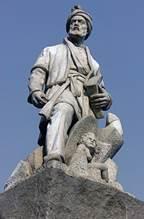
The Damavand mountain located near the city also appears in the Shahnameh as the place where Freydun bounds the dragon-fiend Zahhak. Arash, the archer who sacrificed his body by giving all his strength to the arrow that demarcated Iran and Turan, shot his arrow from Mount Damāvand. This Persian legend was celebrated every year in the Tiregan festival. A popular feast is reported to have been held in the city of Damavand on 7 Šawwāl 1230, or in Gregorian calendar, 31 August 1815. During the alleged feast the people celebrated the anniversary of Zahhak’s death. In the Zoroastrian legends, the tyrant Zahhak is to finally be killed by the Iranian hero Garšāsp before the final days.
In some Middle Persian texts, Rey (Ragha) is given as the birthplace of Zoroaster although modern historians generally place the birth of Zoraster in Khorasan.
In the 10th century, Rey is described in detail in the work of Islamic geographers. The Ghuzz Turks laid Rey to waste in 1035 and in 1042, but the city recovered during the Saljuqid and Khwarazmianera. The Mongols laid Rey to complete waste and according to Islamic historians of the era, virtually all of its inhabitants were massacred. The city is mentioned in later Safavid chronicles as an unimportant city.
The city is later mentioned in Hamdollah Mostowfi’s Nuz’hat al-Qulub (written in 1340) as a famous village.
Tehran finally became the capital of Iran in 1795, when the Qajar king Agha Mohammad Khan was crowned in the city. It remains the capital to this day.
Golestan Palace
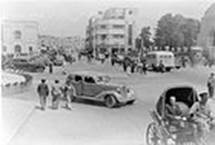
In the 1920s and 30s, the city essentially was rebuilt from scratch under the rule of the Reza Shah Pahlavi. Reza Shah believed that ancient buildings such as large parts of the Golestan Palace, Takieh-ye Dowlat, the Toopkhaneh Square, the city fortifications and the old citadel among others should not be part of a modern city. They were systematically demolished and modern buildings in the pre-islamic Iranian style, such as the National Bank, the Police Headquarters, the Telegraph Office and the Military Academy were built in their place.
The Tehran Bazaar was divided in half and many historic buildings were demolished in order to build wide straight avenues in the capital. Many Persian gardens also fell victim to new construction projects.
A street in Tehran during the 1930s
Climate
Tehran features a semi-arid, continental climate (Köppen climate classification: BSk). Tehran’s climate is largely defined by its geographic location, with the towering Alborz Mountains to its north and the central desert to the south. It can be generally described as mild in the spring and autumn, hot and dry in the summer, and cold in the winter.
Demographics
With its cosmopolitan atmosphere, Tehran is home to diverse ethnic and linguistic groups from all over the country. The native language of the city is the Tehrani accent of Persian and the majority of people in Tehran identify themselves as Persian.
Tehran saw a drastic change in its ethno-social composition in the early 1980s. After the political, social and economic consequences of the 1979 Revolution and the years that followed. A large number of Iranian citizens, mostly Tehranis, left Iran due to mounting political, social and religious pressure under the new clerical dictatorship. Many Iranians moved to countries such as Canada, the United States, France, Sweden and other European countries. The highest Iranian emigration has been to the United States, France, Germany, Sweden and Canada.
Air pollution
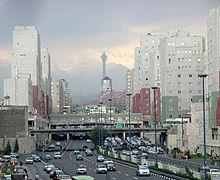
Tehran suffers from severe air pollution and the city is often covered by smog making breathing difficult and causing widespread pulmonary illnesses. It is estimated that about 27 people die each day from pollution-related diseases. According to local officials, 3,600 people died in a single month due to the hazardous air quality. 80% of the city’s pollution is due to cars.The remaining 20% is due to industrial pollution. Other estimates suggest that motorcycles alone account for 30% of air and 50% of sound pollution in Tehran.
In 2007 Iran imposed fuel rations but the plan has met little success in reducing the pollution levels
Tehran’s air pollution
Education and research
Tehran is the largest and most important educational center of Iran. Today there are a total of nearly 50 major colleges and universities in Greater Tehran.
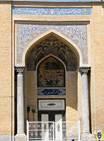 Since the establishment of Darolfonoon in the mid-19th century, Tehran has amassed a large number of institutions of higher education. Some of these institutions have played crucial roles in the unfolding of Iranian political events.
But Iran in general and Tehran in particular suffers heavily from the devastating effect of the brain drain. Due to migration of many Iranian scholars, academicians, professors and experts to foreign countries, academic centers, such as universities, suffer from low level education and scientific activities. Ministry of Science official statistics released on March 2014, show that more than 150,000 Iranian scholars and experts flee the country each year.
Dar ul-Funun is one of the first institutions of modern learning in Iran, established by Amir Kabir
Main attractions
Tehran is a relatively old city; as such, it has an architectural tradition unique to itself. Archaeological investigations and excavations in Tehran demonstrate that this area was home to civilizations as far back as 6,000 years BC in the village of Rey which is now incorporated into the city. Tehran served only as a village to a relatively small population for most of its history, but began to take a more considerable role in Iran after it was made the capital in the late 18th century. Despite the occurrence of earthquakes during the Qajar period and before, some buildings still remain from Tehran’s era of antiquity. Today Tehran is Iran’s primate city, and has the most modernized infrastructure in the country; however, the gentrification of old neighborhoods and the demolition of buildings of cultural significance have caused concerns.
National Museum of Iran
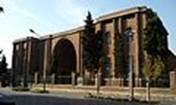
Tehran, as Iran’s showcase and capital city, has a wealth of cultural attractions. The Sun Throne (aka Peacock Throne) of the Persian Kings (Shahs) can be found in Tehran’s Golestan Palace. Some of the well-known museums are National Museum of Iran, Malek National Library and Museum, Reza Abbasi Museum, Sa’dabad Palaces Complex, Glassware and Ceramics Museum of Iran, The Carpet Museum of Iran, Tehran’s Under glass painting Museum, Niavaran Palace Complex, and Safir Office Machines Museum. The Tehran Museum of Contemporary Art features works of famous artists such as Van Gogh, Pablo Picasso and Andy Warhol.
Neighborhoods and districts of Tehran
The city of Tehran is divided into 22 municipal districts, each with its own administrative centres.
Within these 22 districts, Tehran contains the following major neighborhoods:
Abbas Abad, Afsariyeh, Amaniyeh, Amir Abad, Aryashahr, Bagh Feiz, Baharestan, Darakeh, Darband, Dardasht, Dar Abad, Darrous, Dehkadeh Olampik,Ekhtiyariyeh, Ekbatan, Elahiyeh, Evin, Farmanieh, Fereshteh, Gheitariye, Gholhak, Gisha, Gomrok, Hasan Abad, Jamaran, Jannat Abad, Javadiyeh, Jomhuri,Jordan, Lavizan, Mehran, Narmak, Navab, Nazi Abad, Niavaran, Park-e Shahr, Pasdaran, Piroozi, Punak, Rey, Sa’adat Abad, Sadeghiyeh, Seyed Khandan,Sohrevardi, Shahrara Shahr-e ziba, Shahrak-e Gharb, Shemiran, Tajrish, Tehranno, Tehranpars, Tehransar, Vanak, Velenjak, Yaft Abad, Yusef Abad, Zafaraniyeh, etc.