
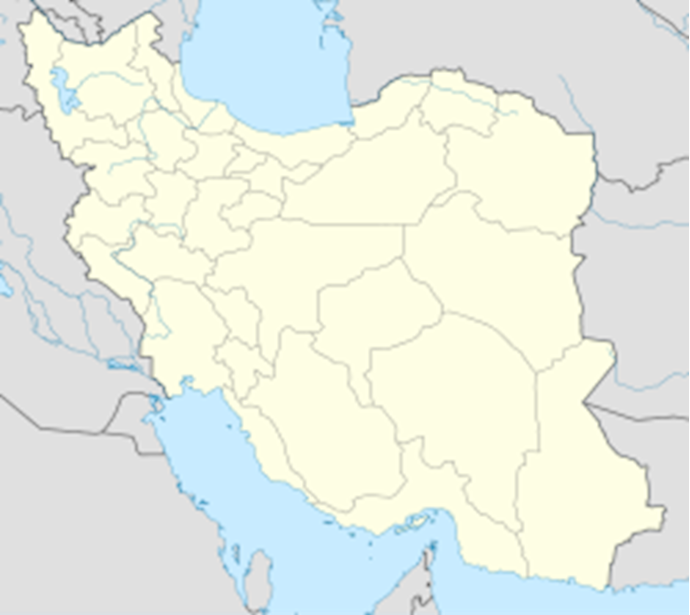
Tehran is the capital of Iran and Tehran Province. With a population of around 8.3 million and surpassing 14 million in the wider metropolitan area, Tehran is Iran’s largest city and urban area, and the largest city in Western Asia.
Tehran is the largest city and the political, cultural, commercial and industrial center of the nation.
The first mention of Tehran has been made in a work by the Greek Theodosius, who has mentioned Tehran as a suburb of Rey about 2000 years B.C.
However, the oldest Persian document on Iran shows that the city existed before the third century AH because an author called “Abu Sa’d Sam’ani” has mentioned a man called “Abu Abdollah Mohammad ibn Hamed Tehrani Razi” who has lived in Tehran and Rey and has passed away in about 261 AH or 874 AD.
Iran is a country in Western Asia and Southern Asia. Iran is home to one of the world’s oldest civilizations. The first dynasty in Iran formed during the Elamite kingdom in 2800 BC.
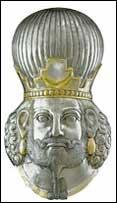
The name “Iran”, which in Persian means “Land of the Aryans”, has been in use natively since
the Sassanian era.
IRAN: The 18th-largest country in the world in terms of area at 1,648,195 km2 (636,372 sq mi), Iran has a population of about 77.77 million according to a recent survey. It is a country of particular geopolitical significance owing to its location in three spheres of Asia (West, Central, and South).
Iran is a regional power, and holds an important position in international energy security and world economy as a result of its large reserves of petroleum and natural gas. Iran has the second largest proven natural gas reserves in the world and the fourth largest proven petroleum reserves.
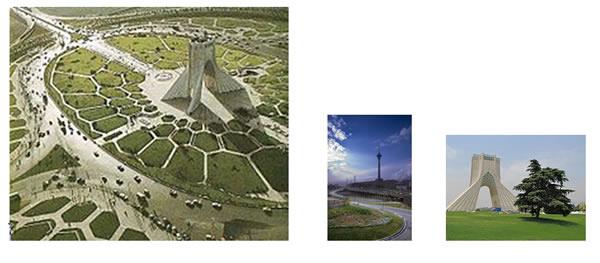
Notably Azadi (Freedom) Tower and the Milad Tower have come to symbolize the city.
Tehran is ranked 29th in the world by the population of its metropolitan area. Throughout Iran’s history, the capital has been moved many times, and Tehran is the 32nd national capital of Iran although it has been Iran’s capital for about 220 years.
There is also a shrine there, dedicated to commemorate Princess Shahr Banu, eldest daughter of the last ruler of the Sassanid Empire. She gave birth to Ali Zayn al Abidin, the fourth holy Imam of the Shia faith. This was through her marriage to Husayn ibn Ali, the grandson of Muhammad, the prophet of Islam. A nearby mountain is also named after her. However, some sources attribute the shrine to the goddess of water and fertility, Anahita, claiming it was renamed in Islamic times to protect it from any possible harm after the conversion of Iranians to Islam.
Don Ruy Gonzáles de Clavijo, a Castilian ambassador, was probably the first European to visit Tehran, stopping in July 1404, while on a journey to Samarkand (now in Uzbekistan) the capital of Timur, who ruled Iran at the time. At this time, the city of Tehran was unwalled.
In the early 18th century, Karim Khan Zand ordered a palace, and a government office to be built in Tehran, possibly to declare the city his capital, but later moved his government to Shiraz. Tehran finally became the capital of Iran in 1795, when the Qajar king Agha Mohammad Khan was crowned in the city. It remains the capital to this day.
In the 1920s and 30s, the city essentially was rebuilt from scratch under the rule of the Shah of Iran, Reza Shah Pahlavi. Reza Shah believed that ancient buildings such as large parts of the Golestan Palace, Takieh-ye Dowlat, the Toopkhaneh Square, the city fortifications and the old citadel among others should not be part of a modern city. They were systematically destroyed and modern buildings in the pre-Islamic Iranian style, such as the National Bank, the Police Headquarters, the Telegraph Office and the Military Academy were built in their place. The Tehran Bazaar was divided in half and many historic buildings were destroyed in order to build wide straight avenues in the capital. Many Persian gardens also felt victim to new construction projects.
During World War II, Soviet and British troops entered the city. Tehran was the site of the Tehran Conference in 1943, attended by U.S. President Franklin D. Roosevelt, Soviet Premier Joseph Stalin, and British Prime Minister Winston Churchill.

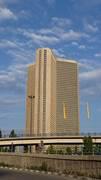
In the 1960s and 70s Tehran was rapidly developing under the reign of Shah Mohammad Reza Pahlavi. Modern buildings altered the face of Tehran and ambitious projects were envisioned for the following decades. This modern city started to expand rapidly.
.
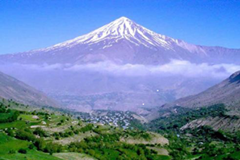
Along the foothills of the Alborz Mountains, remnants of old villages fought a losing battle against the mansions and apartment blocks of the wealthy. Tehran’s seemingly insurmountable traffic keeps on adding to the air pollution especially in the hot summer months. Most Tehranians escape the heat by heading for the hills around northern Tehran.
Tehran the Province, area:
28,225 square kilometres
Elevation:
1100 – 1700 metres above sea level
Tehran the City, area:
1,200 square kilometres
Temperature:
summer: 100 to 110 F ( 38 to 43 C )
winter: 25 to 15 F ( – 4 to – 9 C )
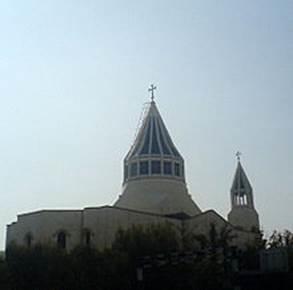
The majority of Tehranis are followers of Twelver Shia Islam, which is also the state religion. Religious minorities include followers of various sects of Sunni Islam, Mystic Islam, Yârsânism, Zoroastrianism, Judaism, Christianity (including the adherents of the Assyrian Church of the East, Armenian Apostolic Church, Roman Catholic Church, Chaldean Catholic Church, Iranian Protestant churches like Jama’at-e Rabbani (Assemblies of God), Armenian Evangelical Church, Armenian Brotherhood Church, Russian Orthodox Church, and the Presbyterian Church) and some from the Bahá’í Faith. Tehran also has small number of third generation Iranian Sikh community that has a gurudwara visited by Indian Prime Minister in 2012.
Tourism and attractions
Tehran, as Iran’s showcase and capital city, has a wealth of cultural attractions. The Sun Throne (aka Peacock Throne) of the Persian Kings (Shahs) can be found in Tehran’s Golestan Palace. Some of the well-known museums are National Museum of Iran, Sa’dabad Palaces Complex, Glassware and Ceramics Museum of Iran, The Carpet Museum of Iran, Tehran’s Underglass painting Museum, Niavaran Palace Complex, and Safir Office Machines Museum. The Tehran Museum of Contemporary Art features works of famous artists such as Van Gogh, Pablo Picasso and Andy Warhol. The collection of these paintings was selected by former Empress Farah Diba.Tehran is also home to the Iranian Imperial Crown Jewels, also called the Imperial Crown Jewels of Persia, it is claimed to be the largest, most dazzling and valuable jewel collection in the world.The collection comprises a set of crowns and thrones, some 30 tiaras, numerous aigrettes, jewel-studded swords and shields, a vast amount of precious loose gems, including the largest collections of emeralds, rubies and diamonds in the world. It also includes other items collected by the Shahs of Iran during the 2,500 year existence of the Iranian Kingdom. The Imperial Crown Jewels are still on display in the Iranian Central Bank in Tehran.
Education and research
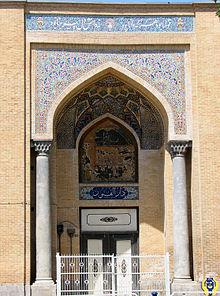
Dar ul-Funun is one of the first modern institutions in the world, established by Amir Kabir
Tehran is the largest and most important educational center of Iran. Today there are a total of nearly 50 major colleges and universities in Greater Tehran.
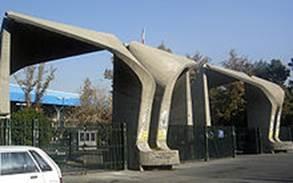
University of Tehran
Since the establishment of Darolfonoon in the mid-19th century, Tehran has amassed a large number of institutions of higher education. Some of these institutions have played crucial roles in the unfolding of Iranian political events. Samuel M. Jordan, whom Jordan Avenue in Tehran was named after, was also one of the founding pioneers of the American College of Tehran. Among major educational institutions located in Tehran, University of Tehran, Tehran University of Medical Sciences, Sharif University of Technology are the most prestigious universities of Iran. University of Tehran is also the oldest university in Iran and one of the oldest in Central and South Asia.
Sport in Iran
Tehran was the first city in the Middle East to host the Asian Games. The 7th Asian Summer Games in 1974, was held with the participation of 2,363 athletes and officials from 25 countries.
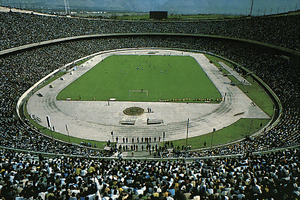
Tehran is also the site of Iran’s national football stadium on Azadi Sport Complex with 100,000 seating capacity. Azadi Football Stadium is one of the largest in Western Asia and one of the biggest in the World. Many of the top matches of Iran’s Premier League are held here. In 2005, FIFA ordered Iran to limit spectators allowed into Azadi stadium because of a fatal crush and inadequate safety procedures.
The ski resort of Dizin is situated to the north of Tehran in the Alborz Mountains. Tochal Ski Resort is the world’s fifth highest ski resort, at over 3,730 meters (12,240 ft.) at its highest 7th station. The resort was completed in 1976 shortly before the overthrowing of the Shah.
Here, one must first ride the eight kilometers (five miles) long gondola lift which covers a huge vertical and is probably the longest line in the world. The 7th station has three slopes. The resort’s longest slope is the south side U shaped slope which goes from the 7th station to 5th station. The other two slopes are located on the north side of the 7th station. Here, there are two parallel chair ski lifts that go up to 3,900 meters (12,795 ft.) near Tochal’s peak (at 4,000 m/13,125 ft.), rising higher than the gondola 7th station. This altitude is higher than any of the European resorts.
From the Tochal peak, one has a spectacular view of the Alborz range, including the 5,610 metres (18,406 ft) high Mount Damavand, a dormant volcano.
At the bottom of the lifts in a valley behind the Tochal peak is Tochal Hotel, located at 3,500 metres (11,483 ft) altitude. From there a T lift takes skiers up the 3,800 metres (12,500 ft) of Shahneshin peak, where the third slope of Tochal is.
Tochal 7th station has skiing eight months of the year. But there are also some glaciers and year-round snow fields near Tehran where skiing began in 1938, thanks to the efforts of two German railway engineers. Today, 12 ski resorts operate in Iran, but the most famous are Tochal, Dizin, and Shemshak, all within one to three hours of Tehran.
Football
Azadi Stadium is the 3rd biggest football stadium in the world and the 2nd largest in West Asia.