
Iran is a large country in the Middle East, between the Gulf of Oman, the Persian Gulf, and the Caspian Sea. It is bordered by Iraq to the west, Turkey, Azerbaijan’s Naxcivan enclave, Armenia, and Azerbaijan to the northwest, Turkmenistan to the northeast, Afghanistan and Pakistan to the east. Comprising a land area of 1,648,195 km2 (636,372 sq mi), it is the second-largest nation in the Middle East and the 18th-largest in the world; with over 77 million inhabitants, Iran is the world’s 17th most populous nation.
Iran is home to one of the world’s oldest civilizations. The Iranian Medes unified the country into the first of many empires in 625 BCE. Iran reached the pinnacle of its power during the Achaemenid Empire (First Persian Empire) founded by Cyrus the Great in 550 BCE, which at its greatest extent comprised major portions of the ancient world, making it the largest empire the world had yet seen. The empire collapsed in 330 BCE following the conquests of Alexander the Great. The area eventually regained influence under the Parthian Empire and rose to prominence once more after the establishment of the Sassanid Dynasty in 224 CE, under which Iran became one of the leading powers in the world along with the Byzantine Empire for the next four centuries.
The name of Iran is the Modern Persian derivative from the Proto-Iranian term Aryānā, meaning “Land of the Aryans.” Historically Iran has been referred to as “Persia” or similar (La Perse, Persien, Perzië, etc.) by the Western world, mainly due to the writings of Greek historians who called Iran Persis, meaning land of the Persians. In 1935 Rezā Shāh, the first ruler of the Pahlavi dynasty requested that the international community refer to the country as Iran. Opposition to the name change led to the reversal of the decision, and since 1959 both names have been used interchangeably.
History
Classical Era
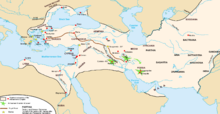 During the second millennium BCE, Proto-Iranian tribes arrived in Iran from the Eurasian steppes, rivaling the native settlers of the country. In 550 BCE, Cyrus the Great from the state of Anshan founded the Achaemenid Empire by unifying other city states. At its greatest extent, the empire included all of the Middle East, Asia Minor, East Asia and parts of Europe.
Achaemenid Empire around the time of Darius the Great and Xerxes.
In 334 BCE, Alexander of Macedonia invaded the Achaemenid Empire in 333 BCE. In the middle of the 2nd century BCE, the Parthian Empire rose to become the main power in Iran and continued as a feudal monarchy for nearly five centuries until 224 CE, when it was succeeded by the Sassanid Empire. The Sassanids established an empire alongside the Byzantines. Most of the period of the Parthian and Sassanid Empires were overshadowed by the Roman-Persian Wars, which raged on their western borders for over 700 years.
Middle Ages (652–1501)
The prolonged Roman-Persian wars, as well as social conflict within the Empire opened the way for an Islamic invasion of Iran in the 7th century. Initially defeated by the Rashidun Caliphate, Iran later came under the rule of their successors the Ummayad and Abbasid Caliphates. The arrival of the Abbasid Caliphs saw a revival of Persian culture and influence, and a move away from Arabic culture. The role of the old Arab aristocracy was slowly replaced by a Persian bureaucracy. The blossoming Persian literature, philosophy, medicine, and art became major elements in the forming of a Muslim civilization during the Islamic Golden Age. The Islamic Golden Age reached its peak in the 10th and 11th centuries, during which Persia was the main theatre of scientific activity. After the 10th century, Persian, alongside Arabic, was used for scientific, philosophical, historical, mathematical, musical, and medical works, as important Iranian writers such as NasiroddinTusi, Avicenna, Qotboddin Shirazi, Naser Khusraw and Biruni made contributions to Persian scientific writing.
The Iranian Shuubiyah movement became a catalyst for Iranians to regain their independence in their relations with the Arab invaders. The most notable effect of the movement was the continuation of the Persian language attested to the epic poet Ferdowsi, now regarded as the most important figure in Persian literature.
In 1219–21 the Khwarezmian Empire suffered a devastating invasion by Genghis Khan’s Mongol army. According to Steven R. Ward possibly 10 to 15 million people were killed. In 1370 yet another conqueror, Timur, commonly known as Tamerlane in the West, invaded Persia and reportedly killed 70,000 citizens in Isfahan alone.
Dynasties (1501–1979)
At the start of the 16th century, Shah Ismail I established the Safavid Dynasty in western Persia and Azerbaijan. He subsequently extended his authority over all of Persia, and established intermittent Persian hegemony over vast nearby regions which would last for many centuries onwards. Ismail instigated a forced conversion from Sunni to Shi’a Islam. The rivalry between Safavid Persia and the Ottoman Empire led to several Ottoman–Persian Wars. The Safavid era peaked in the reign of the brilliant soldier, statesman and administrator Shah Abbas I (1587–1629). The Safavids were eventually ended by the Pashtuns of Afghanistan.
In 1729, an Iranian Khorasan chieftain and military genius, Nader Shah, successfully drove out, then conquered the Pashtun invaders. During Nader Shah’s reign, Iran reached its greatest extent since the Sassanid Empire. Following a brief period of civil war and turmoil, sparked by Nader Shah’s assassination, Karim Khan came to power in 1750, bringing a period of relative peace and prosperity. Another civil war ensued after Karim Khan’s death in 1779, out of which Aga Muhammad Khan emerged victorious, founding the Qajar Dynasty in 1794.
Whilst resisting efforts to be colonised, Iran suffered in the 19th century as a result of Russian and British empire-building, known as ’The Great Game’, losing much of its territory in the Russo-Persian and the Anglo-Persian Wars. A series of protests took place in response to the sale of concessions to foreigners by Nasser al-Din Shah and Mozaffar ad-Din Shah of Qajar between 1872 and 1905, the last of which resulted in the Iranian Constitutional Revolution and establishment of Iran’s first national parliament (majles) in 1906. On the pretext of restoring order, the Russians occupied northern Iran in 1911. During World War I, the British occupied much of western Iran, not fully withdrawing until 1921.
In 1921 Reza Khan, former general of the Persian Cossack Brigade, was brought to power by British and became Shah. In 1941 and in the throe of WW-II, he was forced to abdicate in favour of his son, Mohammad Reza Pahlavi.
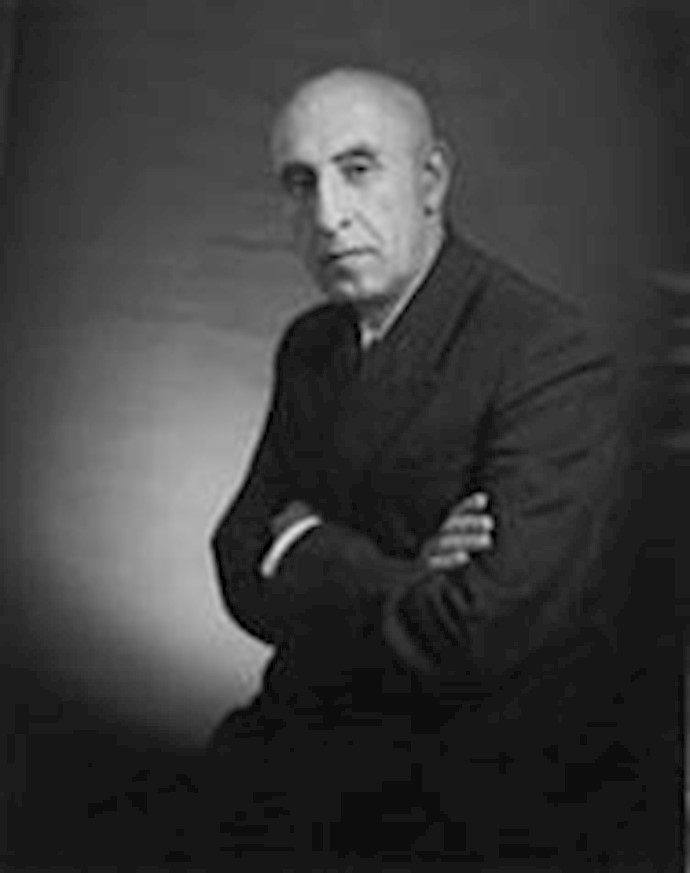
In 1951 Mohammad Mosaddegh was elected prime minister. He became enormously popular in Iran after he nationalized Iran’s petroleum industry and oil reserves. His national movement led to the Shah’s dismissal from the power and his departure from Iran. Mosaddegh shortly was known as a national hero by Iranians. He was deposed in the 1953 Iranian coup d’état, an Anglo-American covert operation that marked the first time the US had overthrown a government of another nation during the Cold War.
After the coup, the Shah returned to Iran and brought back to power and became increasingly autocratic. Arbitrary arrests and torture by his secret police, SAVAK, were used to crush all forms of political opposition. Nevertheless, two major organizations, Mojahedin and Fedaiin came to exist, struggling for a revolution in Iran. By the mid-1970s, there was growing unrest with the Shah’s repressive regime. Many educated individuals were arrested, kept in prison for many years or executed by SAVAK . The regime of the Shah was eventually overthrown by popular uprising in 1979.
Mosaddegh, Iranian democracy advocate and deposed PM in Pahlavi dynasty
Islamic Republic (1979)
The Iranian Revolution began in January 1978 and the Shah fled the country in January 1979. In April 1979, the Iranian clerics, led by Khomeini, took the advantage of Iranians’ Islamic culture to implement an Islamic rule. They soon after declared the Islamic Republic. But soon nationwide uprisings against the new regime erupted in Kurdistan, Khuzestan, Balochistan and other areas, though they were eventually suppressed.
Although nationalists, progressive Islamists and Marxists were the major forces to overthrow the Shah, tens of thousands of their members and supporters were executed by the Islamic regime afterward. On 4 November 1979, a group of Iranian students, seemingly orchestrated by government officials, seized US embassy personnel who were released after 444 days of detention.
The clerics ruling Iran seemed to look for an external cause to divert the attention of their charges from massive internal problems. Soon after the establishment of Islamic rule, they started instigating Shi’a populations in Iraq. Iraqi leader, Saddam Hussein, in an attempt to stop the clerics’ meddling, invaded Iran at Khuzestan on 22 September 1980. By 1982 the Iranian forces successfully managed to drive the Iraqi army back into Iraq. Despite the fact that peace was in access, Ayatollah Khomeini insisted on the continuation of war for another 7 years. He eventually was forced to accepted a truce mediated by the UN in 1988, following his extensive loss in war. The total Iranian casualties were estimated to be between 500,000 and 1,000,000. An estimated 95,000 Iranian child soldiers were killed during the Iran–Iraq War.
Less than a year after the war ended, Ayatollah Khomeini died on June 3, 1989. His successor, a younger clergyman by the name Ali Khamenei, has tried to follow the hard-line policies of his predecessor. His regime has faced a lot of dissent from people of all walks including students, academia, workers and farmers alike. During the administration of Mir-Hossein Mousavi, Ali Akbar Hashemi Refsanjani, Mohammad Khatami and Mahmoud Ahmadinejad over a hundred thousand dissidents were executed and many more were jailed.
In 2009, allegations of large irregularities provoked the 2009–2010 Iranian election protests in major cities of Iran. Thousands of protesters were detained, of whom hundreds lost their lives.
Hassan Rouhani was elected as President of Iran on 15 June 2013. Despite campaign promises for freedom and “the rule of law and wisdom”, the trend of executions has continued during the administration of the new president. Over 700 people have been executed during the first 10 months of Rouhani’s administration according to official statistics. Official figures show violation of Human Rights has accelerated in a higher extent under Hassan Rouhani, compared with his predecessors. The United Nation and international community have repeatedly expressed their concerns in this regard.
Geography
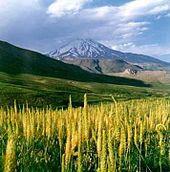
The northern part of Iran is covered by dense rain forests. The eastern and central parts consist mostly of desert basins as well as some salt lakes. The only large plains are found along the coast of the Caspian Sea and at the northern end of the Persian Gulf, where Iran borders the mouth of the Arvand River. Smaller, discontinuous plains are found along the remaining coast of the Persian Gulf, the Strait of Hormuz and Gulf of Oman.
Mount Damavand, Iran’s highest point, is located in Amol County, Mazanderan
Climate
Iran’s climate ranges from arid or semiarid in the east and centre to subtropical along the Caspian coast and the northern forests. On the Caspian coastal plain temperatures rarely fall below freezing and rarely exceed 29 °C. Annual precipitation in this region ranges from 680 mm to 1,700 mm.
The western basins experience severe winters with below zero average daily temperatures and heavy snowfall. The coastal plains of the Persian Gulf and Gulf of Oman in southern Iran have mild winters, and very humid and hot summers.
Fauna
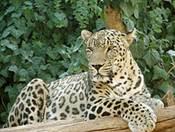
Persian Leopard
Iran’s wildlife is composed of several animal species including bears, gazelles, boars, wolves, jackals, panthers, Eurasian Lynx, and foxes. Domestic animals include sheep, goats, cattle, horses, water buffalo, donkeys, and camels. The pheasant, partridge, stork, eagles and falcon are also native to Iran. Persian Lion and Caspian Tigers are now extinct and Iranian Cheetah is on the brinks of total extinction.
Provinces and cities
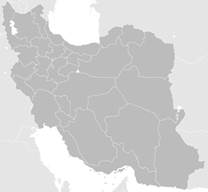
Iran is divided into thirty one provinces (ostān), each governed by an
appointed governor (ostāndār). The provinces are divided into counties
(shahrestān), and subdivided into districts (bakhsh) and sub-districts
(dehestān).
Iran has one of the highest urban growth rates in the world. From 1950 to 2002, the urban proportion of the population increased from 27% to 60%. Tehran, with a population of 7,705,036, is the largest city in Iran and is the capital. Tehran, like many big cities, suffers from severe air pollution. It is the hub of the country’s communication and transport network.
Mashhad, with a population of 2,410,800, is the second largest Iranian city and the centre of the Razavi Khorasan Province. Another major Iranian city is Isfahan (population 1,583,609), which is the capital of Isfahan Province. The fourth major city of Iran is Tabriz (population 1,378,935), the capital of the East Azerbaijan Province. The fifth major city is Karaj (population 1,377,450), located in Alborz Province and situated 20 km west of Tehran, at the foot of the Alborz mountains.The sixth major Iranian city is Shiraz (population 1,214,808); it is the capital of Fars Province.