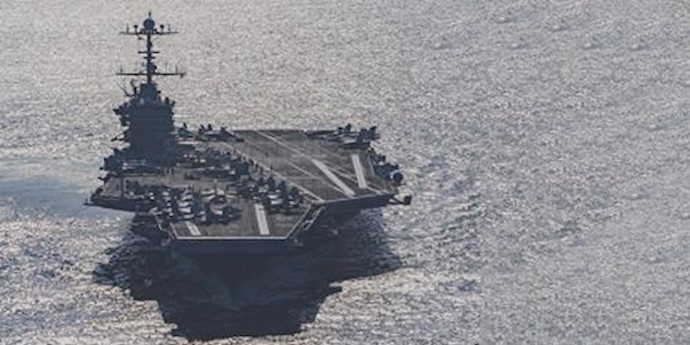
December 30, 2015 – U.S. Central Command officials have called Iran’s firing rockets within a mile of the carrier Harry S. Truman on Saturday a “dangerous” and “unprofessional” stunt, but these sorts of provocative run-ins are likely to continue in 2016 as hard-line forces in Iran exploit uneasy relations with the West, one expert warns.
The provocative test firing by Iranian paramilitary forces near the Truman as it passed through the Strait of Hormuz was likely ordered by senior leaders, said the Iran expert.
“Anything can happen, but it’s very unlikely somebody’s going to fire a missile or do anything like this without it being something known to the senior command,” said Anthony Cordesman, a national security expert at the Center for Strategic and International Studies, in a Wednesday phone interview.
IRGC vessels fired “several unguided rockets” about 1,370 meters from the Truman, the destroyer Bulkeley and French frigate FS Provence, said Cmdr. Kyle Raines, a CENTCOM spokesman, adding that while commercial sea traffic also was nearby, the missiles weren’t fired in the direction of any ships.
“These actions were highly provocative, unsafe, and unprofessional and call into question Iran’s commitment to the security of a waterway vital to international commerce,” Raines said in an email. “While most interactions between Iranian forces and the U.S. Navy are professional, safe, and routine, this event was not and runs contrary to efforts to ensure freedom of navigation and maritime safety in the global commons.”
The rockets were likely glorified rocket-propelled grenades, Cordesman said, as many revolutionary guard ships carry light armament.
The behavior is not out of character for the revolutionary guard, he said. The guard has a monopoly on operations within the Persian Gulf, while the Iranian navy has primary authority outside of it; the IRGCN is a paramilitary force that often seeks provocations with Western forces. In 2007, the IRGCN took 15 British sailors and Marines hostage in a high-stakes stand-off that ended two weeks later when they were released unharmed.
And in some cases, Cordesman added, officers responsible have been promoted later, “sort of as an award for obeying orders, showing initiative or being symbol of the guard’s independence from the rest of the structure in Iran.”
That’s not to say that those actions would be endorsed outside of the service.
“At the same time it seems unlikely that any given officer would do this, and almost impossible to believe that they didn’t realize what the political effect would be,” Cordesman said.
The climate is tense following the signing of a nuclear deal earlier this year, as the terms continue to be carried outIt is possible, however, that these stunts could continue — or even spark larger tensions.
“It is a very uncertain time, and it’s further unlikely that the revolutionary guards are not going to find ways to assert hard-line positions and occasionally protest the U.S.,” he said. “It’s unclear that the Supreme Leader would choose to stop them, simply because even though he’s allowed the terms of the nuclear agreement to move forward, his statements have often been very hard-line.”
Iran will be as big of a problem in 2016 as the Islamic State group, Cordesman said, “and at least as serious a threat.”