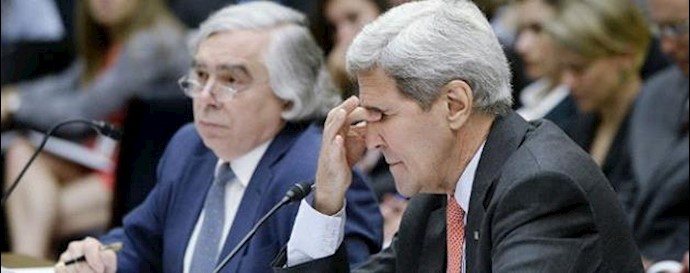
Democrats harshly criticized the Obama administration’s nuclear deal with Iran during a testy hearing Tuesday, underscoring the difficulty the White House faces in winning over its own party.
Secretary of State John Kerry had several sharp exchanges with Democrats on the House Foreign Affairs Committee, including ranking member Eliot Engel (N.Y.), who said he was “very disappointed” with the agreement.
Supporters and opponents of the Iran nuclear deal have focused on Democrats as both influencers and bellwethers in the debate.
“I have a fundamental concern that 15 years from now, Iran will essentially be off the hook,” Engel said. “My big question is this: What happens then? Are we back to square one? Is this deal just pushing the pause button for 15 years?”
Rep. Brad Sherman (D-Calif.) argued the deal was not legally binding and that a future administration could turn away from it.
“This is not a binding deal. … It’s not even an executive legislative agreement. It might be at most morally binding on this administration,” Sherman said.
He also appeared annoyed with Kerry when the secretary said he would need to consult with the president about whether the deal would be implemented if Congress passes a resolution of disapproval — and overrides an expected veto by President Obama.
“So you’re not committed to following the law?” Sherman snapped.
Even as Kerry tangled with tough questions, the administration scored a significant victory in its congressional lobbying effort when Rep. Sandy Levin (Mich.), the longest-serving Democrat in Congress, announced his support for the agreement.
The House and Senate in September are expected to vote on measures that could scuttle the Iran deal.
Under a review process set up by Congress and the administration, lawmakers can vote to disapprove of the deal, which lifts sanctions on Iran in exchange for limits and inspections on its nuclear program.
Republicans, in control of both chambers, have lined up against the agreement, meaning the central question is whether the administration will prevent opponents from winning the two-thirds majorities required to override an Obama veto.
Minority Leader Nancy Pelosi (D-Calif.) is whipping her members to back the Iran deal, but the early start to her operation highlights how the Iran vote is a difficult one for many Democrats.
A White House statement later on Tuesday announced it would host a reception for House Democrats on Wednesday, to discuss the president’s “legislative priorities, including the Iran agreement.”
At Tuesday’s hearing, Rep. Ted Deutch (D-Fla.) criticized the bilateral deals the International Atomic Energy Agency has negotiated with Iran.
Republicans have pounced on those agreements, arguing they are “side deals” the administration has not sent to Congress for approval.
“Am I right, because I don’t see any other way to read the agreement, that satisfaction of [possible military dimensions] will not be a prerequisite to Iran getting sanctions relief?” Deutch asked, setting off a back-and-forth with Kerry over the potential military aspect of Iran’s nuclear program and how it relates to the deal.
Rep. Albio Sires (D-N.J.) pushed back against Treasury Secretary Jack Lew’s argument that billions of dollars in unfrozen assets would not significantly contribute to Iran’s support for terrorism in the region.
“They don’t need billions, they can’t absorb billions. … There’s enough money to stir a lot of problems,” he said.
Republicans hope to turn public opinion against the deal, which they think will put pressure on Democrats to oppose it.
A CNN/ORC poll released showed that Republicans might be gaining traction, with 52 percent of adults saying Congress should reject the deal and 44 percent saying it should be approved.
Sen. Charles Schumer (N.Y.), expected to be the top Senate Democrat after Minority Leader Harry Reid (Nev.) retires next year, is a bellwether in the Senate.
He told the New York Post on Monday that he would not be “rushed to a decision.”
“There’s pressure on both sides, but I’m not going to let politics or pressure influence me,” Schumer said. “I’m just going to do what’s best.”