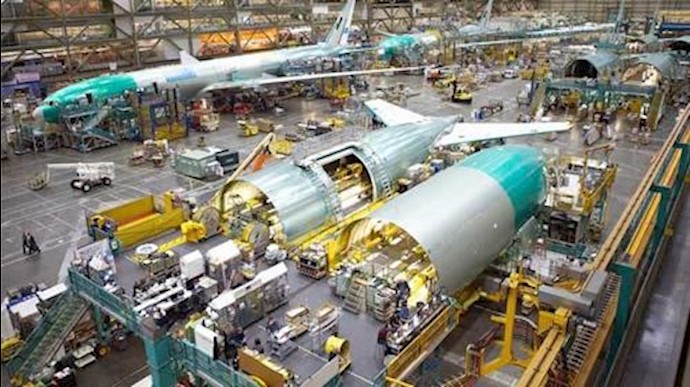
Boeing’s potential deal to sell aircraft to Iran may have benefits for the company’s ledger and for the U.S. banks that will finance it. But the deal is also fraught with danger, including the possibility that the aircraft may one day become a tool for Iran’s ongoing support for atrocities and war crimes in Syria.
The Joint Comprehensive Plan of Action (JCPOA) removed U.S. sanctions against Iran’s aviation sector, only forbidding sales of aircraft, spare parts and services to five airlines implicated in Iran’s ongoing airlift to the regime of Bashar Assad in Syria and Iran’s proxy, Hezbollah. The U.S. Treasury Department issued a general license for aircraft sales to Iran last March, and the JCPOA now permits U.S. banks to finance this transaction.
As long as the five sanctioned airlines do not benefit from the deal, Washington is permitting Boeing to sell to Iran. But how can we be sure they won’t?
Iran wants to buy up to 500 aircraft over the next decade to rejuvenate its aging fleet, and Boeing is reportedly in line to sell Tehran 100 of them. This comes on the heels of a multibillion dollar deal with Airbus to purchase 118 aircraft, a deal with ATRto buy 40 regional planes and other deals in the works with Bombardier and Embraer.
A key issue remains: How will the deal be financed?
In the Airbus and ATR cases, European banks and the export credit government agencies of Italy and France will finance the deal, rather than have Iran pay for the aircraft upfront. With Boeing, it will be more complicated, but possible, since the Obama administration is keen to smooth the way.
Dollarized transactions with Iran were previously forbidden. The rare exceptions — usually carpets and foodstuff — required a license from the Treasury Department’s Office of Foreign Assets Control (OFAC).
But the aircraft deals are now technically legal, and, given its aging commercial fleet, Iran certainly needs new aircraft for legitimate transportation. But it cannot be ignored that Tehran also needs these aircraft to run an illicit operation airlifting weapons and militias from its airports in Tehran and Abadan to Syria. Iran’s military airlift to Syria began in 2011, shortly after Syria’s Arab spring degenerated into a full-fledged civil war. With Assad’s regime on the defensive and America and its allies reluctant to jeopardize the nuclear deal over Syria, the tempo of Iran’s airlifts dramatically increased in August 2015, from weekly to daily flights.
These flights are providing fresh supplies and recruits to the embattled Syrian Armed Forces, their Hezbollah proxies and Iran’s own Islamic Revolutionary Guard Corps — all of whom are supporting Assad’s brutal regime in a war that has claimed half a million lives since 2011.
Presumably, the Boeing deal will seek to ensure that sold aircraft are not used for this lamentable business. Iran’s state-owned airline, Iran Air, will be the sole company purchasing these aircraft. Treasury sanctioned Iran Air in 2011 for its role in Iran’s weapons airlift to Syria, but its aircraft mostly has not operated the Iran-Syria route since the JCPOA was concluded. The company was delisted under the JCPOA in January. Regardless, Iran Air planes recently flew known weapons resupply routes to Syria — on June 9 from Abadan while using the Tehran-Damascus flight number, and on June 8 and 15 from Tehran while using the now-defunct Najaf-Tehran flight number.
Should it be proven that Iran Air is once again carrying weapons, supplies or forces for the Syrian regime, the airline risks getting slapped with renewed sanctions and Boeing risks having its planes aiding the brutality of the Assad regime.
Iran Air is also not likely to retain all of the aircraft it purchases. Its fleet stands at 36 aircraft and it is to be expected that many of the 500 projected acquisitions in the next decade will go to other Iranian carriers, with Iran Air presumably selling or leasing many of them to other Iranian airlines. Among those carriers is Mahan Air, which remains under U.S. sanctions for its ongoing support for Iran’s military involvement in Syria. Mahan Air is the primary airline running illicit flights to Damascus, using Abadan’s airport as the logistical hub for the supply route.
Thus, even though these aircraft deals are now legal, they come with great risk. There is no guarantee that none of these planes will participate in the airlift of weapons and militia to Syria. Indeed, some recent additions to Iran’s commercial fleet — several used Airbus A340s that Mahan Air bought last year from leasing companies based in the offshore Isle of Man — flew to Damascus only a few hours before departing Tehran for European destinations. That is, they may have airlifted weapons to Assad hours before taking tourists on their vacations.
Beyond the risks that their planes could be used by Iranian entities to support Assad or perhaps other brutal regimes, there are financial risks involved in these deals, including the threat of lawsuits from attorneys trying to collect $50 billion of outstanding judgments for victims of Iranian terrorism. These could create reputational nightmares, if not costly legal battles.
For Boeing and others associated with this deal, the risks may very well outweigh the rewards.
Source: Hill, 21 June 2016
READ MORE:
Treasury Designates Iranian Commercial Airline Linked to Iran’s Support for Terrorism
10/12/2011
WASHINGTON – The U.S. Department of the Treasury announced today the designation of Iranian commercial airline Mahan Air pursuant to Executive Order (E.O.) 13224 for providing financial, material and technological support to the Islamic Revolutionary Guard Corps-Qods Force (IRGC-QF). Based in Tehran, Mahan Air provides transportation, funds transfers and personnel travel services to the IRGC-QF.
“Mahan Air’s close coordination with the IRGC-QF – secretly ferrying operatives, weapons and funds on its flights – reveals yet another facet of the IRGC’s extensive infiltration of Iran’s commercial sector to facilitate its support for terrorism,” said Under Secretary for Terrorism and Financial Intelligence David S. Cohen. “Following the revelation about the IRGC-QF’s use of the international financial system to fund its murder-for-hire plot, today’s action highlights further the undeniable risks of doing business with Iran.”
Mahan Air provided travel services to IRGC-QF personnel flown to and from Iran and Syria for military training. Mahan Air also facilitated the covert travel of suspected IRGC-QF officers into and out of Iraq by bypassing normal security procedures and not including information on flight manifests to eliminate records of the IRGC-QF travel.
Mahan Air crews have facilitated IRGC-QF arms shipments. Funds were also transferred via Mahan Air for the procurement of controlled goods by the IRGC-QF.
In addition to the reasons for which Mahan Air is being designated today, Mahan Air also provides transportation services to Hizballah, a Lebanon-based designated Foreign Terrorist Organization. Mahan Air has transported personnel, weapons and goods on behalf of Hizballah and omitted from Mahan Air cargo manifests secret weapons shipments bound for Hizballah.
As a result of today’s action, U.S. persons are prohibited from engaging in commercial or financial transactions with Mahan Air and any assets it may hold under U.S. jurisdiction are frozen.
Identifying Information:
Entity: Mahan Air
AKA: Mahan Travel Company
Address: Mahan Air Tower, 21st Floor, Azadeghan Street, Karaj Highway, P.O. Box 14515-411, Tehran, Iran
Alt. Address: Mahan Air Tower, Azadegan St., Karaj Highway, Tehran 1481655761, Iran P.O. Box 411-14515