
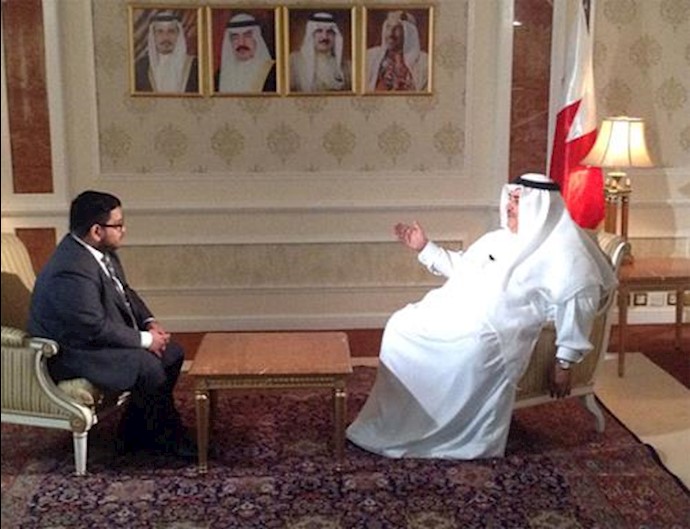
In an interview with Bahrain’s Minister of Foreign Affairs Sheikh Khalid bin Ahmed Al Khalifa, the Al Arabiya News Channel and Al Arabiya English asked the FM of the country’s relationship to Iran.
During the interview which took place in Bahrain’s capital Manama, the foreign minister cautioned that Iran had to change its foreign policy behavior with the region before any meaningful talks can take place. He also spoke on Bahrain’s recent decision to deport several Lebanese citizens for ties to Hezbollah, the group recently labelled as a “terrorist organization” by the GCC and Arab League.
The following is an extract from the interview.
Al Arabiya: Obama said he believes the GCC and Iran need to “learn to share the neighborhood.” Do you think Iran and its Gulf neighbors can coexist peacefully?
Yes, we’re ready to live with Iran as neighbors as we’ve been doing for ages. Iran is our neighbor even when there are shifting developments in countries in the region… Iran will still remain a neighbor. But without a doubt there have been problems
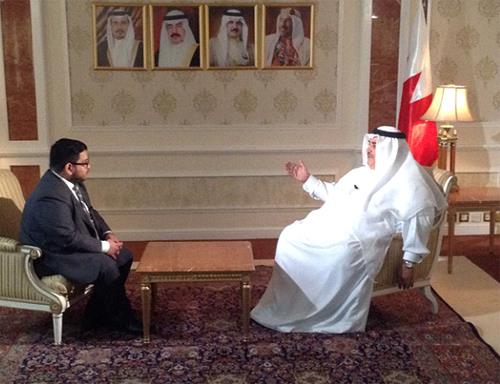
Al Arabiya English journalist Ismaeel Naar interviews Bahrain’s Minister of Foreign Affairs Sheikh Khalid bin Ahmed Al Khalifa
Al Arabiya: What essential step does Iran need to take to reopen the door for dialogue between your countries?
The first priority Iran needs to take is to widely change its foreign policy towards our region. We have seen Iran capable of shifting its foreign policy with the world and an example of this is when it used to call the US the “great Satan” and it used to have a global network of spies and cells. But now its agreement with the P5+1 has led to a change in their behavior but the only remaining file it needs to change is with the Arab region and it hasn’t yet.
If Iran does not take crucial steps in fixing its behavior, such as working through proxies in the region like Hezbollah and exporting arms to certain countries, then no progress can be made.
Al Arabiya: There have been recent suggestions that Iran took an initiative through Kuwait to open talks with the Gulf countries. We haven’t heard any new updates or comments from your side.
Yes, it’s true that there was an initiative from one of Iran’s officials who sent a letter to Kuwaiti Emir Sheikh Sabah al-Ahmad Al-Sabah who then forwarded the letter to the GCC leadership with the hope of bringing together officials from both sides. There was efforts from the Kuwaiti Emir to move that initiative forward, which we don’t refuse and none of us do.
However, the day after the invitation was received we heard statements from the Iran’s Supreme Leader against our Kingdom. During the same day, another Iranian senior figure stated that Bahrain had to “be returned to Iran.” Obviously these statements are prevocational in nature. So which side do we listen to?
The door for dialogue with Iran has always been open in the past but recently we had no choice but to cut off diplomatic ties.
Al Arabiya: Why did Bahrain label Hezbollah as a terrorist organization? What was the point in doing so?
We wanted to send a message to Iran and all its followers in the region that we are serious in confronting challenges. That message also includes that we will not hesitate in defending our countries and interests in the region and this issue is vital.
Al Arabiya: Bahrain recently deported several Lebanese citizens from the country for sympathizing and supporting Hezbollah. Should other Lebanese citizens fear that their turn is next?
The Lebanese are not new to our country. Bahrain and Lebanese ties are historical in nature that goes back ages. Lebanon, at one point in history, was the cultural center of the Arab region. But now, that open-minded society and culture is being hijacked by some relations in the country to Iran.
Those who were deported had documented evidence of their relationship with Hezbollah while living in Bahrain. But what we have to be clear about is that we’re talking about several people here and not the majority.
Source: Al Arabiya English, 31 March 2016