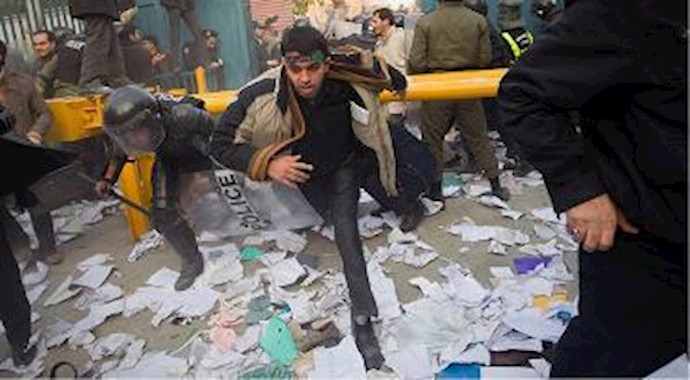
The New York Times, London, 30 Nov 2011 — With Britain‘s decision to close its vandalized embassy in Tehran on Wednesday and expel all Iranian diplomats from London, Iran appears to have moved a major step closer to international pariah status. That isolation could complicate efforts by Western governments to halt what they have identified as Iran’s covert efforts to acquire nuclear weapons, according to diplomats and others who monitor Iranian affairs.
Although the British Embassy in Tehran has long been denounced by many Iranians as “a nest of spies,” diplomats say that Britain’s maintenance of that mission through much of the 30-year period when the United States has been absent has provided a useful bridge for diplomatic contacts on the nuclear issue, even if they have been mostly unproductive.
Foreign Secretary William Hague noted in announcing the decision to close the embassies in Tehran and London that diplomatic relations had not been ruptured altogether, as they were for 18 months after Ayatollah Ruhollah Khomeini issued his notorious fatwa calling for the killing of the British novelist Salman Rushdie over the publication of Mr. Rushdie’s “Satanic Verses” in 1989.
Instead, Mr. Hague said, Britain was reducing ties to “the lowest level consistent” with having a diplomatic relationship at all — a formulation British officials said was linked, in part, to the need for continuing contacts with Tehran on its nuclear programs.
At the same time, Britain emphasized the broad international support it had received over the storming of its embassy, and noted the additional pressure that the event could place on the Tehran leadership. Along with strong backing from Washington, Mr. Hague said, Britain had received messages of support from Russia and China — veto-wielding members of the Security Council that have so far blocked further United Nations sanctions over the nuclear dispute. Other nations that Mr. Hague commended were France and Turkey, which used their missions in Tehran to help evacuate Britain’s diplomats from the Iranian capital within 24 hours of the Tuesday attack.
President Nicolas Sarkozy of France used a cabinet meeting in Paris on Wednesday to condemn “the scandalous attack” on the British mission, according to French officials, and France’s budget minister, Valérie Pécresse, said the 27-nation European Union should consider an embargo on Iran’s oil or a freeze of its central bank holdings in Europe. France, Germany and the Netherlands all announced the withdrawal of their ambassadors, and Norway said it was closing its embassy “as a precaution.” Italy said it was evaluating whether to keep its diplomatic presence in Tehran, and Austria’s foreign minister, Michael Spindelegger, said Iran had placed itself “outside the framework of international law.”
Some experts on Iran cautioned against allowing international opprobrium for the Tehran leadership to build to the point where Iran might abandon caution. “Let’s hope the crisis does not spiral out of control,” Ervand Abrahamian, an Iranian-born historian at the City University of New York, said in an e-mailed response to questions about the embassy assault.
The embassy intrusion came against a backdrop of what Iran experts have called an increasingly bitter rift between factions of the Iranian leadership over a variety of issues, including the nuclear dispute with the West. Some expressed concern that a harsh Western response to the attack could embolden the militant faction associated with Ayatollah Ali Khamenei, the supreme leader, including men who control fiercely political paramilitary units like the Republican Guards and the Basij, in their power struggle with Mahmoud Ahmadinejad, the president.
Mr. Abrahamian said that the Khamenei faction may have decided to strike at Britain after events in recent months that many in Iran have seen as part of a covert plan to destroy Iran’s nuclear aspirations. These events, he said, included the assassination of three nuclear scientists, computer-based sabotage of uranium enrichment centrifuges and a devastating explosion at a military base west of Tehran a few weeks ago that killed the general who pioneered Iran’s missile development.