Iran will never return to the past
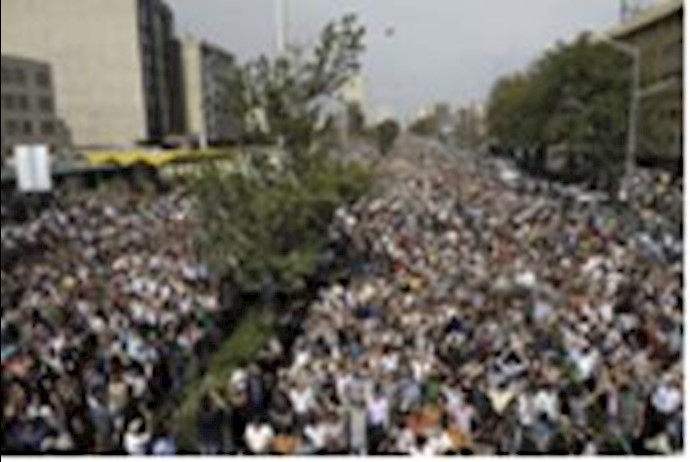
The Iranian regime lacks even the slightest potential for tolerating popular dissent and protests, which explains why when faced with such protests, it is forced to resort to false accusations and charges against others. The clerical regime’s Supreme Leader, Ali Khamenei, openly claims that it is not the people who have poured into the streets chanting “Death to dictator” and “Death to Khamenei.” Rather, he says, these are “rioters,” “CIA agents,” and the “fifth column” of the enemy. Moreover, when scenes of Neda’s death left the world in awe and distress, the regime fabricated stories accusing a BBC reporter of stage-managing the death and ultimately dismissing it as a British government conspiracy.
The regime’s lies have an eerily familiar ring for the Iranian Resistance, which over the past three decades has been bombarded with false accusations from the mullahs. Western governments, however, are completely taken aback by the regime’s lies and tactics like the taking of foreign nationals hostage. The regime’s guards have arrested British embassy employees, accusing them of being behind “street riots” in Tehran. Also, a French woman and professor in Iran was arrested at Tehran’s airport as she was heading towards Paris, and charged with “spying” for allegedly using her cell phone to take pictures of the suppression on the streets and sending them abroad.
More instances of hostage taking of foreign nationals by the Iranian regime are likely to take place in Iran these days, since hostage taking constitutes one of the principles of the clerical regime’s foreign policy. The mullahs believe that in order to bring a Western government to the negotiating table and impose their demand upon them, they should first take hostage from them. And, what do the mullahs demand? On the face of it, an end to what they call foreign intervention in Iran’s internal affairs. But, behind the scenes, the mullahs are really demanding, “Don’t adopt a firm and tough policy against us, and let us carry out whatever illegal measure our hearts desire.”
Their demand, of course, amounts to a clear form of bullying and intimidation, because Iran is a member state of the United Nations and is duty-bound to respect its international obligations. The mullahs, however, adopt measures like hostage taking to impose their will on the rest of the world.
Sadly, Western governments and politicians have failed to grasp this reality. The explanation for why the religious fascism ruling Iran has managed to successfully dictate its deplorable terms on the world stage for over three decades can be discovered solely in the policy of appeasement on the part of the international community.
Faced with the upsurge of a nationwide uprising by the Iranian people, the clerical regime reacted, on the one hand by suppression, torture, and murder of Iranians, and on the other hand by hostage taking and intimidation of Western governments. Now, the time has come for Western governments to realize a plain truth and rise up to their responsibility accordingly.
What is that plain truth? For the past 30 years, the clerical regime has stonewalled and even ridiculed international condemnations. It has effortlessly violated international conventions, of which Iran has been a signatory, silencing anyone who dares to disapprove. It has, furthermore, considered as its right to continue with its nuclear projects, despite international protest and denunciation. It disrespects even the most straightforward diplomatic rules and customs in the course of its relations with other countries.
In light of all this, a serious question lingers: Why does the international community lack the necessary will to punish the regime for its actions? What could possibly justify the continuing illusion that perhaps the Iranian regime has not been given enough packages of incentives? Was it not the case that the US and the European Union illegally and unjustly placed the organized opposition against the regime (PMOI) on their terrorist lists in 1997 and 2002, respectively, as an incentive for the regime to change its behavior? Is it not true that in 2002, the EU decided that the UN General Assembly should avoid passing a resolution in that year condemning human rights abuses in Iran, in a bid to provide a window of opportunity for the Iranian regime? Is it not the case that the EU has continued to carry out a dialogue with the regime over the nuclear issue since 2002, when the regime’s clandestine nuclear programs were first exposed by the National Council of Resistance of Iran (NCRI)? In short, is it not true that over the past 30 years, an endless slate of opportunities and incentive packages were handed to the regime in a bid to change its behavior, but that all these efforts have been counterproductive?
So, now is the time to put a stop to inaction. The illusory perception that the clerical regime has somehow not been given enough openings and opportunities must be chided in favor of a strong-willed warning to the religious fascism ruling Iran that our world will no longer accept bullying from anyone.
To this effect, Mrs. Maryam Rajavi, the NCRI’s President-elect, has urged all political parties and leaders, lawmakers, jurists and lawyers, intellectuals, authors, artists, trade and student unions and syndicates, and organizations and authorities advocating human rights and freedom of expression in various countries, to utilize any means possible to support the Iranian people’s uprising for freedom, work to free prisoners and declare solidarity with the families of victims and those arrested during the protests, and specifically call on the United Nations Secretary General, the UN Security Council, all UN member states, and all responsible international organs, to adopt the following measures:
1. Dispatch an international delegation to investigate the circumstances of people who have gone missing as well as political prisoners, especially those arrested in recent weeks, work to prevent the imposition of pressure on detainees to obtain forced televised confessions, and produce an accurate list of those killed during the uprising with their burial location;
2. Suspend all diplomatic relations and impose comprehensive sanctions on the clerical regime, while banning its officials from foreign visits, until the suppression has completely ceased in Iran and all political prisoners have been freed;
3. Force the regime to annul its illegitimate election and to instead accept a free election under UN supervision, on the basis of the Iranian people’s sovereignty and not in the context of the system of absolute clerical rule;
4. Refer the case of the June 12 fraudulent election as well as the Iranian people’s suppression and massacre of prisoners to the UN Security Council, and bring to trial the officials responsible for the massacre of Iranian people, including Ali Khamenei and Mahmoud Ahmadinejad.