
Sunday, 05 July 2009
Iran will never return to the past
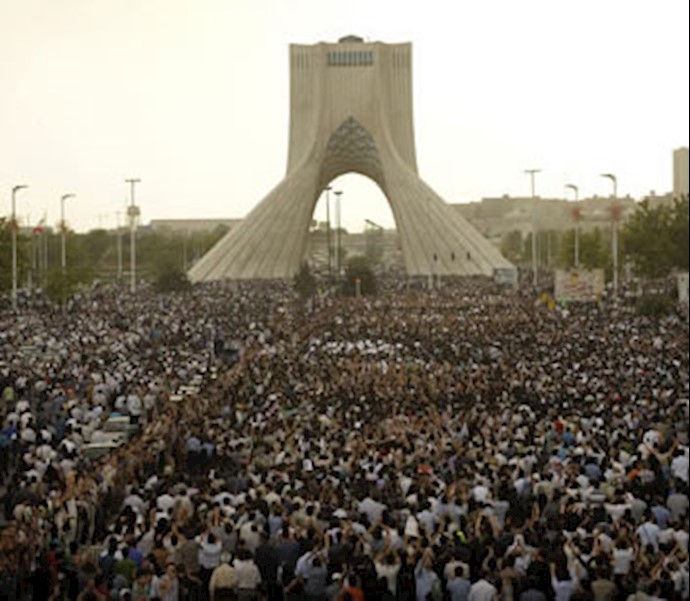
These days the world is wondering about the future of the Iranian people’s uprising, which over the course of the past three weeks has shocked everyone. Some hopelessly say that the flames of the uprising are being extinguished and a revolution will not take hold in Iran. But, we are saying that the Iranian regime will never go back to what it was previously and similarly the situation in Iran has changed forever. Were we to ignore this reality, our analyses and assessments would turn out to be completely flawed.
The prospects of the uprising
Taking into account the most general state of affairs, two possible outcomes can arise from the popular upheaval. One outcome could be that the regime fails to seal the rift between its rival factions at the highest levels and in the end fails to quell the uprising. In such a scenario, the uprising will continue with its ebbs and flows until the regime is eventually overthrown.
A second possible outcome could be that the regime manages to seal the rift at the top and completely suppresses the uprising. In this scenario, the only option would be the Third Option, in other words democratic change under the leadership of the Iranian Resistance. The Third Option will be increasingly embraced by the Iranian people and the international community will have no other alternative but to recognize it.
A: Continuation of the Uprising
Clearly, the continuation of the uprising would be the most favorable and beneficial scenario for the Iranian Resistance. The Resistance will do its utmost to prolong it since an end to the velayat-e faqih regime (Absolute rule of the Supreme Religious Leader) and the establishment of a new system, even a comparatively democratic one, would bequeath the greatest benefit to the Iranian people and Resistance. It is not important for the Resistance what role or how much influence after the overthrow of the regime it would gain. What is important is for it to have a right to political life and activity in the new system, and have its own offices and be able to participate in free elections. In that case, the best yardstick would be the decision and vote of the people.
Some people worry that if the uprising were to continue, certain international parties could attempt to set up new alternatives to the regime and sideline the Resistance movement. This worry is completely misplaced. The sole objective that the Resistance and the PMOI have been struggling for has been to bring an end to the velayat-e faqih regime and to establish democracy in its place. If other alternatives came to the fold in the midst of all this, so long as they overthrow the velayat-e faqih regime, the Resistance’s ultimate demand would be fulfilled and the National Council of Resistance of Iran would welcome it. The PMOI, too, wants nothing other than the right to free political activity and free elections. Of course, it should also be mentioned that generating an alternative to the regime is not an easy feat, and over the past 30 years all efforts geared towards doing so have failed to bear fruit, except in the case of the PMOI and the National Council of Resistance of Iran.
When the Shah’s monarchy collapsed during the February 1979 uprising, PMOI members had just been freed from prison and had no organizational capabilities outside prison. They had no medium to express their views and were not as organized and consolidated as they are today. Their total membership was not even one percent of what it is today. But with opportunities for activity arising from a semi-democratic environment, they managed to fill the gap rapidly and became a serious opposition and an alternative to the regime within a few months. In just 11 months after the Shah’s overthrow, the PMOI grew to such an extent that rang alarm bells for Khomeini, who seriously worried that if Massoud Rajavi, then-PMOI’s leader and presidential candidate, remained as a contender, then the presidential elections would go to a second round, giving Mr. Rajavi a good chance to win. As a result, contrary to his earlier pledge not to interfere in the elections, Khomeini issued a fatwa just a few days before the vote and rejected Mr. Rajavi’s candidacy.
B. Suppression of the uprising by the regime
Even if the second scenario takes hold, that is if Khamenei manages to hem the internal gap of the regime and manages to suppress the nationwide uprising, the previous state of affairs can still not be re-established. This means that the circumstances of the regime, the Iranian society, and international community are irreversible and cannot go back to those which prevailed prior to June 12, 2009. The situation is substantively different today, and so one cannot claim that the uprising has failed. On the contrary, the uprising will have favorable subsequent results for the people’s struggle against the religious fascism ruling Iran. Thus far, then, the uprising has achieved success considering either one of the two scenarios, and has led to great achievements, some of which include:
1. In the course of the uprising, the Iranian society and particularly its youth, who entered social and political life during the reign of the clerical regime, rose up in opposition and clearly separated their ranks from the regime. The regime had tried to keep this generation apolitical, but during the uprising these youth were transformed into a completely political generation, no longer fearing the regime. If the regime quells the uprising, this generation will grow to be more determined to change the current regime and will turn to the PMOI and organized resistance.
2. The regime has also become much weaker than before. After carrying out its internal purges, the regime has grown to be more vulnerable. Its internal contradictions, which have been temporarily contained and reined in, will resurface again down the line, revealing themselves with more intensity.
3. After experiencing internal purges and the nationwide uprising, the regime will now be forced to bolster its policies both internally and abroad, which naturally means that it will intensify its fight against the West in terms of exporting terrorism and pressing ahead with efforts to obtain nuclear weapons.
In short, the Third Option will be the only solution which will be increasingly embraced by the Iranian people, and the international community will have no other alternative but to recognize it.
We must now ask, “Does the West have a clear understanding of these probable scenarios and options? And, secondly, has it adopted the right course of action vis-à-vis the Iranian regime over the past three weeks?” The answer to these questions will be examined in the next article.
Analysis – Iranian uprising: Beginning of the end (part III)
RELATED ARTICLES