Iran will never return to the past
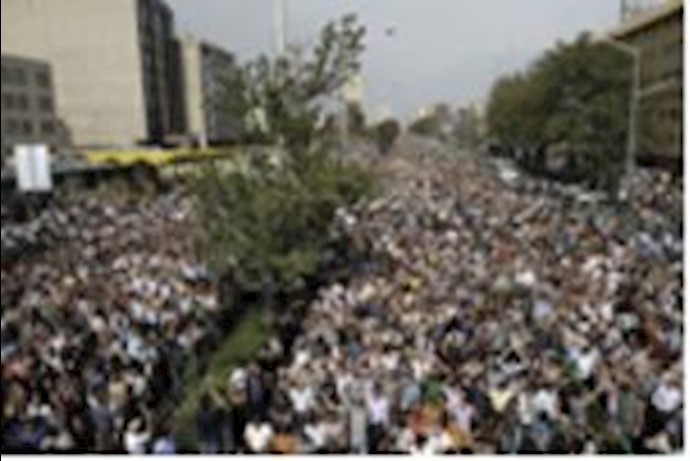
On June 13, 2009, a day after the sham election of the clerical regime, the world witnessed a massive explosion of millions in Iran which surprised everyone throughout the globe and ruffled the entire political calculations in the West.
But what was the reason for it? Did the shocking fraud in the Iranian election cause the surprise? Or was it the presence in millions of the Iranian people in the streets which shocked the world? Presence of the people who were crying out ’Down with dictator’ ending up with ’Down with Khamenei’ in a matter of one week; or perhaps it was the unbelievable cruel suppression of the uprising by the religious fascist regime that struck everyone.
This is the first article of a series which will respond to these questions and some other serious ones like what sparked the uprising in Iran and where will it lead to.
Many duped by the sham election in Iran
With its best knowledge about the nature of this regime and its sham election, Iranian resistance announced well before June 12 that this was yet another sham election and no genuine election will take place in Iran so long as the clerical regime is in power. However, prior to election day, many western governments as well as western partners of the regime wanted to believe that there was a genuine competition going on in this election and Moussavi would win as a moderate candidate, leading to a complete change in Iran. Western television networks began to prop up this notion two weeks prior to the polls.
Staging of televised debates and the unprecedented revelations marked a new phase in the escalation of factional feuding within the regime and signaled the deepening of the regime’s internal crisis. However, the West touted these debates as part of a democratic process in Iran.
In a press release on June 11, the National Council of Resistance of Iran (NCRI) stated that Khamenei had privately instructed the Interior Minister to pretend a turnout of 35 million and Ahmadi-Nejad as the ultimate choice of the people as the president. All those who expected Moussavi to win the election viewed the press release with great disbelief. Nevertheless, it soon became apparent that Khamenei had engineered the one-stage appointment of Ahmadi-Nejad with 40 million votes.
Contrary to what was shown by the regime’s television, the election was full of fraud and unprecedented exaggerations in its turnout. The real turnout was several times less than claimed figure. Vote riggings and fraudulence was exactly what had been persistently announced by the NCRI in previous elections and this time they were revealed by the rival faction of the regime. For instance, Moussav faction exposed that in 170 cities, number of announced participants were 95% to 140% of the eligible voters. In order to hide the scandal, the Council of Guardians, affiliated with Khamenei, rushed to admit such irregularities in 50 cities’ election results but ridiculously attributed them to relocation of people in different cities and called them as usual phenomena in all elections!!
What sparked the uprising?
The uprising in Iran was the result of an extremely explosive situation in the Iranian society with a serious demand for a regime change in its entirety and for the establishment of democracy. The society had suffered from despotism, suppression, corruption and crime for 30 years and faced with a deep rivalry between the heads of the two factions of the regime, it burst into an explosion. Although the election ignited the society, in reality, this uprising had no relevance to any of the rival factions or the election itself. The determinative factor was the explosive potential and extensive dissatisfaction which existed in the society and resulted in people taking advantage of the internal feuding of the regime as a historical opportunity.
The clerical regime has tried to savagely deploy all its forces in order to silence the people. According to the reports by the Social Headquarter of the People’s Mojahedin Organisation of Iran (PMOI/MEK) inside the country, over 200 protestors have so far been killed and thousands more have been injured or arrested. There is an unannounced curfew going on in big cities particularly in Tehran.
On June 20, following a threatening speech by Khamenei, the Supreme Religious Leader of the regime, more than 100 people were killed. On June 30, the French daily, Figaro quoted the eye-witnesses as saying that on June 20, 4500 people had been arrested and had undergone savage tortures in Tehran alone. Nevertheless, protest gatherings, clashes and fight and run are still going on in Tehran and many other big cities.
The most important factor in this uprising is its slogans, with the key one being “Death to the dictator”. This slogan has become stronger as time goes on and in many cases it has evolved into the chants of “Death to Khamenei”. It is therefore clear that the goal of the protestors is the overthrow of the regime and nothing else.
By and large, the activists and detainees of the uprising did not participate in the election or did not support either of the candidates. For example, relatives of Neda, a young woman who was martyred on 20 June after the regime’s agents opened fire on her, have said that she did not favour either of the candidtes in the election. The regime’s officials have also reiterated that 60 percent of those attested in Tehran and 90 percent of those arrested in Isfahan had not participated in the election.
In his Friday prayers sermon on 19 June, Khamenei reiterated that all four presidential contenders are part of the clerical establishment and are loyal to the system of velayat-e faqih (The Supreme Religious Leader). He said that those taking to the streets are opponents of the entire system. The regime’s Interior Minister, Sadeq Mahsouli, on 14 June reiterated that the street protests were planned by political group lets and has nothing to do with the candidates.
Which path will the rival faction follow?
What is the future prospect of the uprising?
How can the active and vanguard participation of women in the uprising be interpreted?
How did the international community react towards the clerical regime’s cruel suppression of the uprising and how should it have reacted?
These are partly the questions which will be dealt with in the coming articles.