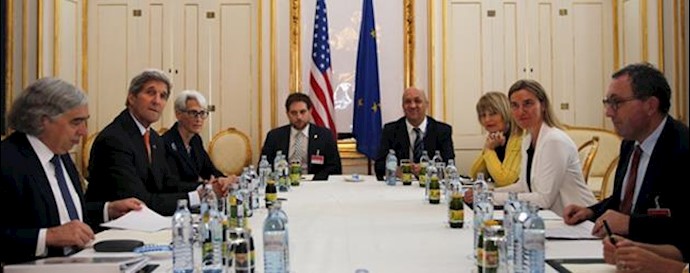
VIENNA -— As a high-level team of Iranian officials flew here on Tuesday for what appears to be an intensive final week of negotiations for a comprehensive nuclear accord, President Obama issued a warning that he was prepared to walk away from any agreement with a verification regime that consisted of “a few inspectors wandering around every once in a while” New York Times reported June 30, 2015.
The return here of Iran foreign minister, Zarif, was notable because it followed high-level consultations in Tehran. He was accompanied by Ali Akbar Salehi, the head of Iran’s Atomic Energy Organization.
The interim agreement, called the Joint Plan of Action, freezes much of Iran’s nuclear program in return for modest sanctions relief.
American officials have said for some time that they hoped to finish the agreement by July 9, in time to submit it to Congress, which would then begin a 30-day review period.
If an accord is finished later this summer, the review period would double because of Congress’s summer recess, giving critics in both countries more time to mobilize opposition.
Senator Bob Corker, the Tennessee Republican who wrote the congressional review legislation, has said it is vital that the deal provide for intrusive verification, and he said that the administration should take as much time as necessary. A bipartisan group of Iran experts, including some of Mr. Obama’s former top aides, made a similar appeal last week.
Mr. Obama made a point at a news conference in Washington of stressing his determination to get an effective deal.
“Given past behavior on the part of Iran, that simply can’t be a declaration by Iran and a few inspectors wandering around every once in a while,” he said. “That’s going to have to be a serious, rigorous verification mechanism. And that, I think, is going to be the test as to whether we get a deal or not.”
In Tehran, Mr. Rouhani said that it was up to the United States to keep its word. While he, too, was talking tough, a vow to get Western-led sanctions against Iran lifted — hangs in the balance in the next few days.
The latest round of negotiations began last week under a cloud after Ayatollah Khamenei appeared to back away from central elements of a preliminary accord reached two months ago in the Swiss city of Lausanne.
After the United States and its negotiating partners insisted that the Lausanne framework must remain the basis of an agreement, Mr. Zarif flew to Tehran on Sunday night for consultations. With American officials looking for signs that he had returned with more flexible negotiating instructions, Mr. Zarif insisted that nothing had changed.
“I didn’t go to get a mandate,” Mr. Zarif said. “I already had a mandate to negotiate.”
Any final accord would constrain Iran’s program for more than a decade in return for lifting, and ultimately revoking, the network of American, European and United Nations sanctions that have hobbled Iran’s economy. The talks involve the United States, Britain, China, France, Germany, Iran and Russia.