
Al Arabiya, 9 August 2015 – Saturday’s bold reforms proposed by the Iraqi prime minister – prompted by weeks of protests over Baghdad’s failure to provide basic services in the country – could lead to a change in the country’s entire political structure, a former high-level official and analysts told Al Arabiya News.
Among the outlines of Haider al-Abadi’s seven-point plan is the “immediate” elimination of the three vice president posts and the deputy prime minister post and the sacking of many high-level political cadres that make up Baghdad’s top-heavy government.
The highest-level figure who could have his position dissolved is current Vice President and former two-term Prime Minister Nouri al-Maliki who begrudgingly stepped aside a year ago to make way for Abadi.
Maliki was forced out by his own Islamic Dawa party in August last year after accusations of stirring sectarian sentiment, which observers say helped lead to the takeover of vast swathes of the country by the Islamic State of Iraq and Syria (ISIS).
Yet the prime minister’s vaunted move – which came after consultation with the influential spiritual leader of Iraq’s Shiite majority, Grand Ayatollah Ali al-Sistani- would require the constitution to be amended, meaning that sudden action is unlikely.
“Maliki and the others cannot do anything in the presence of such great support from the protestors and Sistani,” said Ali Al-Dabbagh, a former Iraqi government spokesman and official who is now one of Maliki’s most outspoken critics.
Vanity posts
Dabbagh said the posts of vice president and vice premier were “unnecessary” and were established to “just to satisfy some of the political blocs” which feature prominently in Baghdad’s checkered political landscape.
Maliki may risk facing corruption charges if Abadi continues pressing reforms.
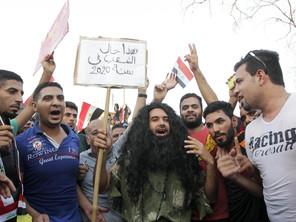
People shout slogans during a demonstration against corruption and poor services in regard to power cuts and water shortages, in Basra province, Iraq, August 7, 2015. (Reuters)
Mass corruption
Iraq, which languishes near the bottom of the U.S.-based Transparency International’s corruption perception rankings, has long found its political class facing the anger of citizens, who claim that the post-Saddam government has failed to deliver on its promises.
Popular anger boiled over after consistent power outages and the failure of government services during the recent summer heat wave – in addition to Baghdad’s inability to gain back ground seized by ISIS.
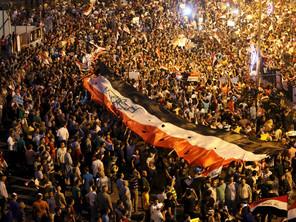
Demonstrators show support for Iraqi Prime Minister Haider al-Abadi in central Baghdad, August, 9, 2015. (Reuters)
Abadi, who “has previously been restricted,” from fully-fledged reforms due to lack of support, now has a “strong card” to make tough decisions, according to Kirkuk-based analyst Abdulrahman al-Sheikh Talib.
“Abadi must draw a clear road map for the Iraqi people over how to probe the names of officials, in spite of their position and power whether Maliki, Allawi or Nujaifi or others.”
Regardless of Baghdad’s next steps – which may require the constitution to be amended by parliament for the reforms to be enacted – Saturday’s events could have a big impact on the government’s future.
Dabbagh, who described the ongoing protests as an “uprising,” said they would be strengthened by Abadi’s reform plan and in turn “change the whole political structure.”
But what lies in store for big figures like Maliki who is accused of squandering $1 trillion?