
Published by: Pew Global, 18 June 2015
As the June 30 deadline for negotiations over its nuclear program approaches, a new Pew Research Center poll finds that attitudes toward Iran are mostly negative worldwide. Majorities or pluralities in 31 of 40 countries surveyed hold an unfavorable opinion of the Islamic Republic. And in several Muslim-majority countries in the Middle East and Asia, ratings have declined considerably in recent years.
June also marks the second anniversary of the election of Iranian President Hassan Rouhani, who generally receives low marks across the Middle Eastern nations polled.
These are among the key findings of a new survey by the Pew Research Center conducted in 40 countries among 45,435 respondents from March 25 to May 27, 2015.
Low Marks for Iran in Middle East, Other Regions
Iran is viewed negatively by most nations surveyed, with a global median of 58% saying they have an unfavorable opinion of the country that borders Afghanistan in the east and Iraq in the west.
Attitudes are negative in Jordan, where 89% have an unfavorable view of Iran. Smaller majorities of Turks, Lebanese and Palestinians also give their regional neighbor low marks.
Unfavorable views of the Islamic Republic are especially widespread in Japan and Australia (73% and 67%, respectively). Even in Pakistan, opinion of Iran has somewhat soured, with negative ratings increasing from 8% to 16% over the past year.
Iran’s image also suffers in Latin America, where a median of 61% across six countries express unfavorable views.
Amidst the negotiations over the future of Tehran’s nuclear program, publics in the so-called “P5+1” countries are generally critical of Iran. Roughly three-quarters of Americans (76%) view Iran unfavorably, virtually unchanged from last year. Majorities in France (81%), Germany (78%), the UK (62%) and China (61%) share this opinion. Only in Russia do about a third (34%) rate Iran positively, and even here the prevailing view is negative (44%).
Declining Ratings for Iran in Muslim-Majority Nations
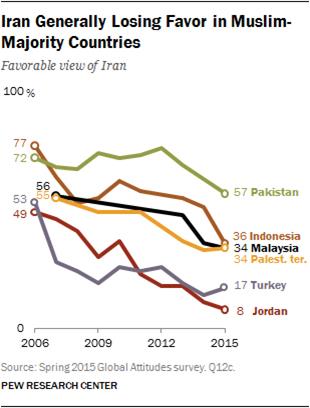
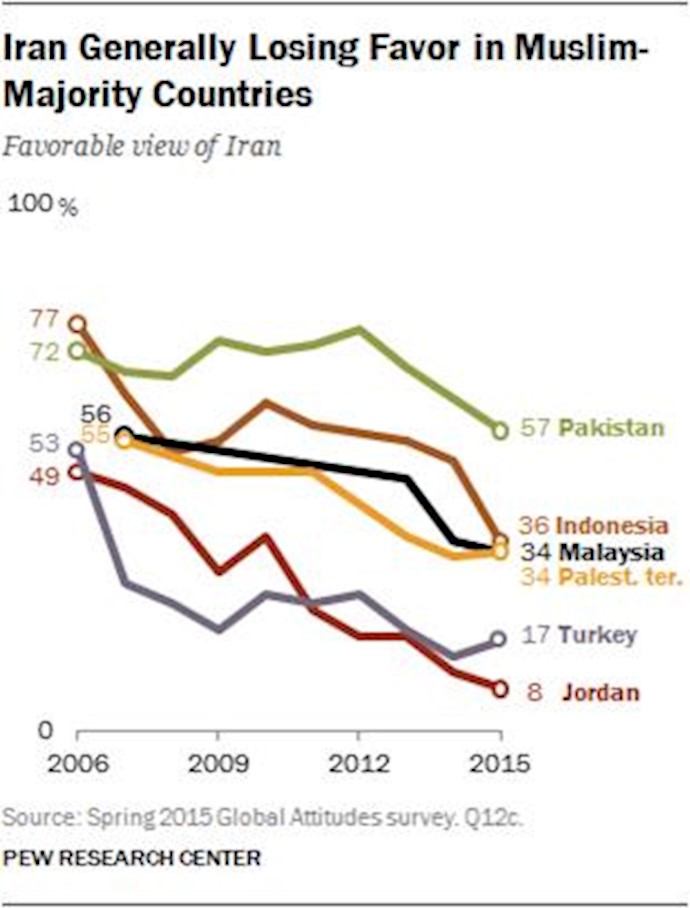
Perhaps influenced by political and sectarian tensions in the Middle East, favorable views of majority-Shia Iran have declined precipitously in some Muslim-majority countries over the last decade.
Since 2006-2007, favorable ratings of Iran have dropped by 41 percentage points each in Indonesia and Jordan. Turkish public opinion has also deteriorated significantly (-36 points) over the same period. Sizable declines in Iran’s standing are also evident in Malaysia (-22), the Palestinian territories (-21) and Pakistan (-15).
Little Support for Rouhani in Middle East
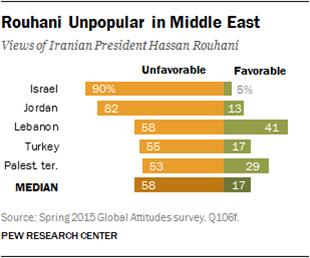
As is the case with his country as a whole, Iranian President Hassan Rouhani receives generally poor marks among neighboring publics in the Middle East, with half or more in each country surveyed viewing him unfavorably.
Lead performers in “Cabaret” sing “Money makes the world go round.” Little do these performers know about the Middle East, where money not only makes the world go round but props up dictators like Syria’s Bashar Assad. Iran is presently spending billions to keep him in power and prosecute a war in which more than 230,000 people have been killed and poison gas has been employed.
Moreover, should the “treaty” with Iran be consummated, this sponsor of global terrorism will receive at least $100 billion in sanctions relief. Not only will this money be used for Assad, but it will bankroll Hezbollah with a new generation of rockets and weapons.
For Tehran, money buys weapons, and weapons buy power and influence. President Obama is counting on an accommodative Iran that receives foreign assistance. But is there any reason to embrace this hypothesis? And even if someone does, at what point can the International Atomic Energy Agency (IAEA), or any other relevant body, determine the turnabout in Iran’s nuclear program? How do we know when a genuine peace has arrived?
Iranian leaders have made it clear that dreams of a Persian kingdom dance like sugar plums in their imagination. For that to happen, the money pump cannot run dry. There is a need to support their Houthi surrogates in Yemen; resupply Hamas rockets that were destroyed in the last war with Israel; continue to add to the Hezbollah war machine that is poised to attack Israel; and keep Assad afloat, the mechanism by which control of Lebanon is retained.
It is hardly surprising that Iranian leaders insist that sanctions are dropped as soon as a deal with the P5+1 (the five permanent members of the U.N. Security Council, plus Germany) is signed, while U.S. negotiators contend sanctions will be reduced incrementally based on certain milestones being met. What is not said may be most significant: The bonus received from any deal should not be used for terrorist activity or the promotion of imperial goals. Since money is fungible, this provision is difficult to enforce. Nonetheless, it represents a statement of intention the U.S. should not gloss over.
One way to defeat militant Islam is to dry up its resource base. Oil pays the bills at the moment, but it may not in 10 years. Hence, trade and FDIs (foreign direct investments) are what the Iranian leadership seeks. One scenario, however, is for Iran to unite with the Shiite population in eastern Saudi Arabia, where the major oil fields are located. Saudi oil, along with Iraqi and local oil production, would give Iran clear dominance in oil production (about 70 percent of global supply), thereby generating enough capital to sustain the Shiite Empire and offer enough of a hedge to secure Iranian leadership decades ahead.
To Iranian leaders, there is always a profit to be made, an advantage to be generated. The West, most significantly the U.S., thinks money will alter behavior; indeed, put the Iranians in the position of thinking as we do. But there isn’t any evidence to support this conclusion. It is a policy stance based on hope.
Money can obviously be used for many purposes. We would be wise to withhold our generosity until there are signs of behavioral change. I doubt that we will see any, yet cynicism shouldn’t dictate policy; nor of course, should naivete.
Since 1979, Iran has behaved as a rogue state fomenting death and destruction and taking at least 1,500 American lives. It has a vast terror network in Argentina, Cuba, Venezuela and even parts of Asia, all outside narrowly defined regional interests. Will Iran scale back these investments because of Western assistance or will it promote its worldwide goals? Surely, we should obtain answers before one dime changes hands. Are you listening, President Obama?.