

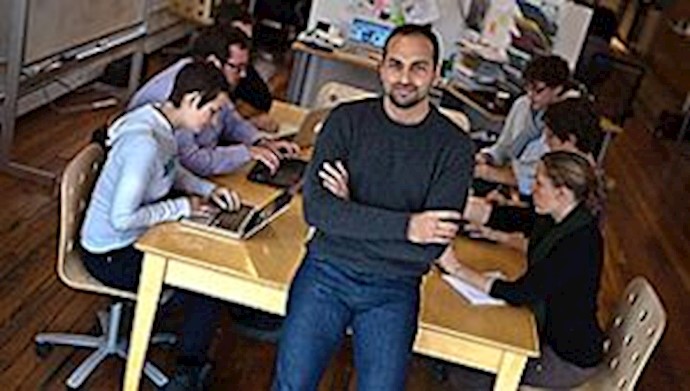
TIME, 16 March 2012 – It was the dead of night in the besieged Syrian town of Homs in late February, but lights were still on two floors up in a brick building off Manhattan’s Union Square. There, in an office decorated with children’s drawings, sat one of the most unlikely players in the yearlong Syrian revolt: Ricken Patel, 35, head of the Internet activist organization Avaaz.
The Canadian is no diplomat or elected representative, but he has managed to insert his group into the eye of the storm in the Arab Spring’s bloodiest conflict yet. The bookish Patel, with degrees from Oxford and Harvard, has a tendency to talk at length about history and politics, but the weapon he wields is information technology in the hands of several million online activists. Their passion and contributions have enabled Avaaz to organize a steady stream of video footage from inside Syria that has helped form the Western picture of the brutality unfolding on the ground. The network has also smuggled dozens of foreign journalists into the country, including most of those featured in TIME’s cover story “Escape from Syria.”
“It’s the wisdom of the crowd,” Patel says during a long interview, over several cups of green tea. “Our members vote with their feet. Anything that goes out from Avaaz is only as strong as the depth of the members’ involvement.”
Patel did not envision Arab revolutions when he first dreamed up Avaaz. In 2003, he was freshly arrived in New York City after a stint in Afghanistan for the International Crisis Group, a Brussels-based advocacy organization, and was intrigued by the buzz around MoveOn.org, an activist movement campaigning against the U.S. Patriot Act. Patel began toying with starting a similar group geared toward global issues. In 2007, he launched Avaaz (the Farsi word for voice), registered in the U.S. as a nonprofit corporation, with a hugely ambitious mission statement: “to close the gap between the world we have and the world most people everywhere want.”
Patel believed that “most people everywhere” encompassed a fast-growing number who were wired, frustrated and looking to jolt the status quo. His aim was to sign them up to a range of issues. Potential campaigns would be launched only if more than 80% of a randomized sampling of 10,000 members wanted it. “There’s a world we all want and there’s a deficit of those values,” he says. “I’d always dreamed of this notion of global citizenship.”
Indeed, Syria is just one of dozens of campaigns the organization has under way right now. Avaaz has raised about $30 million from members over its five-year existence and signed up about 20 million people, of which Patel claims about 13 million are “active” — by which he means that they give money, sign petitions and meet in groups off-line. Donations and membership double roughly every 12 months, and Patel says he plans to increase his paid staff in April, from 46 to 85.
Avaaz’s real organizational strength, however, is its ability to rapidly mobilize huge numbers of people at short notice. During the 2009 Green Movement uprising in Iran, for example, Avaaz set up a network of proxy servers to allow protesters to post videos from the streets.
By the sheer force of its numbers, Avaaz can also bombard its targets with mass petitions, which can produce results among those more sensitive to public opinion. Its website boasts, for example, that a petition signed by 317,000 members helped prod Hilton Hotels to implement sex-trafficking training for staff, although the company tells TIME that it was “already actively engaged” in the process of signing up to an industry code of conduct on the issue when Avaaz launched its petition.
Avaaz’s agenda is as diverse as its membership. Its largest chapters are in Brazil and France, and in a teleconference strategy meeting that TIME witnessed in late February, staff members called in from Bogotá, Tunis, Geneva, Rome, New York City, Majorca and elsewhere. And for those who question how serious such a thinly spread organization can be, the group posts testimonials on its site from the likes of former British Prime Minister Gordon Brown, who is quoted as saying, “Avaaz has driven forward the idealism of the world.”
But no amount of idealism could have prepared Patel for the lethal risks his group encountered in Syria.
When Patel first floated the idea of a Syria campaign online last spring, the response was overwhelming. About $1.5 million in donations poured in within two weeks; a further $1.5 million was raised last month. With that money, the organization has created openings in one of the world’s most closed countries. Operating from a small base in Beirut, Avaaz has forged a network of activists on the ground, and Patel claims it has smuggled in about $2 million worth of medicines to Homs and other opposition strongholds. The group has also smuggled in hundreds of thousands of dollars’ worth of communications equipment, including satellite phones, cameras and laptops loaded with video-editing software, and has trained local activists to shoot and edit video footage — in order to break the media blackout imposed by President Bashar Assad.
The result has been a steady stream of shaky, often gruesome footage of protest and repression, posted on YouTube, which became raw material used by CNN, BBC and other networks denied reporting access to Syria. For example, video feeds from Avaaz activists in Syria recently included six corpses in Idlib province, which the group said were people executed by Syrian forces while in an ambulance. Such imagery has been used by the Syrian opposition in their efforts to spur Western governments to action against the regime. “We think Avaaz is doing a great job in terms of media,” Bassma Kodmani, executive member of the Syrian National Council, told TIME. “We support what they do, and they support what we do.”
But some in the community of Western nongovernmental organizations working in the region have criticized Avaaz for taking sides in an armed conflict. “For us, it’s crossing the line to play a pretty active role fighting against Assad,” says one human-rights activist with long experience working in the region. And a researcher with considerable Syria experience questioned whether the raw video footage disseminated by the organization created an accurate picture of an increasingly complex conflict. Still, it may be a measure of Avaaz’ growing influence that both of these critics asked to remain anonymous because their work required that they remain on good terms with the organization.
Patel rejects these arguments, saying he believes Avaaz has taken the only acceptable side: against Assad. “What we’ve done is support the rights of Syrian people to press for democracy, and that does involve a change of government,” he says. “These videos are the voices of Syrian citizens telling their story. It deserves to be told.”
Simply getting their story out, however, has exacted a heavy toll on the activists, which has left some of Avaaz’s members in the region reeling.
On Feb. 22 Syrian forces hit a makeshift media center in the besieged Homs neighborhood of Bab Amr, killing U.S. war correspondent Marie Colvin and French photographer Rémi Ochlik, and obliterating equipment donated by Avaaz; Ochlik, like 33 other foreign journalists, had entered Syria with Avaaz’s help. Patel grants that it’s possible that the satellite phones’ GPS coordinates could have led government forces to track their location, though he says Avaaz had trained activists to use the equipment for two minutes or less, and then to change their position, in order to conceal their whereabouts. The system had worked well for 11 months, he says, but “none [of the satellite phones] are perfect, they are all vulnerable.”
A few days later, Avaaz suffered an even more devastating loss. Activists trying to smuggle out the four Western journalists who had survived the shelling that killed Colvin and Ochlik were ambushed on Feb. 27, and some 13 of Avaaz’s operatives were killed. In all, Patel estimates that about 20 Syrian activists died during the complicated rescue operation, which lasted several days.
Avaaz was deeply shaken by the events. “It had a big emotional impact,” Patel says, and the organization has since begun turning away journalists hoping to use Avaaz networks to make their way into Syria. Still, Patel still believes that despite so many of its Syrian members paying the ultimate price for doing so, Avaaz had been right to help get journalists in and out of Syria. “We don’t have much doubt that what we did was a tremendous added value to the Syrian people,” he says. “Bearing witness in Bab Amr was incredibly important.” The math on morality will have to be calculated later. For now, at least, four foreign journalists are home safe, with tales of survival to tell because a score of Syrians were willing to give up their own lives.
How a New York City–Based Activist Group Became a Player in Syria
RELATED ARTICLES