By: PMOI/MEK staff
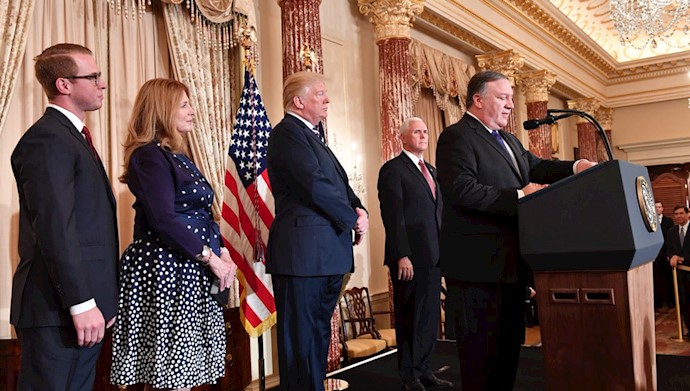
3 May 2018– When sworn in as the new United States Secretary of State on Wednesday, Mike Pompeo emphasized in his speech how Washington is currently confronting all of Iran’s aggressive behavior.
In reference to developments related to North Korea, America’s new top diplomat made it clear this is an unprecedented opportunity to change the course of history in the Korean Peninsula.
North Korea’s new direction, along with major domestic issues, are resulting in a variety of reactions inside the Iranian regime.
Ali Khoram, Iran’s former ambassador to the United Nations in Geneva, explicitly said the status quo is not in Tehran’s interests.
“Prior to these peace talks, North Korea was priority number one and the world’s number one crisis. No longer is anyone worried about North Korea anymore and as a result, all eyes are now on Iran,” he said in a recent interview.
The North Korea dossier isn’t the only concern on Iran’s table. It is, however, a grave reminder of this regime’s increasing isolation.
Iran’s human rights violations are gaining new attention lately in a damning Amnesty International report titled, “Criminal Cover-up: Iran Destroying Mass Graves of Victims of 1988 Killings.”
This report cites new satellite imagery, video footage, and photos, emphasizing Iranian officials deliberately destroying mass graves associated with the 1988 massacre of over 30,000 political prisoners.
“The atrocities of the 1988 massacre in Iran is a wound that still remains open three decades later. By destroying this vital forensic evidence, the Iranian authorities are deliberately reinforcing an environment of impunity,” said Philip Luther, Research and Advocacy Director for the Middle East and North Africa at Amnesty International.
This global human rights organization is calling for an independent query and accountability for those involved in the 1988 massacre.
“These horrific crimes must be properly investigated and all those responsible for committing, ordering and concealing these crimes brought to justice in fair trials without recourse to the death penalty,” said Shadi Sadr, the Executive Director of Justice for Iran.
Conditions are also looking grim for the Iranian regime in Europe.
According to German state radio, Chancellor Angela Merkel is emphasizing talks with Iran must be expanded to reach a new deal. Merkel went on to emphasize there are problems with Iran’s influence in Syria, this country’s missile program and its future following the JCPOA’s ten-year period coming to an end. This is to a great extent a common position in Europe, she added.
Iran’s isolation is also rendering economic consequences, resulting in further headaches for the senior Iranian regime.
Speculation about Trump withdrawing from the Iran nuclear deal has increased pressure on Iran’s economy and further decreased the country’s currency.
Reports indicate Iran’s rial is selling in the black market at a price of 61,500 to the U.S. dollar.
Furthermore, companies entering contracts with Iran following the JCPOA’s signing are seen canceling or suspending their agreements. We have recently learned Boeing is postponing its delivery of 777s to Iran and selling the readied planes to the United Arab Emirates instead.
To add insult to injury, a New York court has ordered Iran to pay $6 billion in compensation to the families of the September 11 terror attacks victims.
Tehran is facing continuing dead-ends. It is only natural that Iranian regime officials are even more concerned with an escalating number of protests reported across the country.
Increasing domestic and international isolation is becoming the new norm for the mullahs’ regime, sensing a very harsh ending in the making.