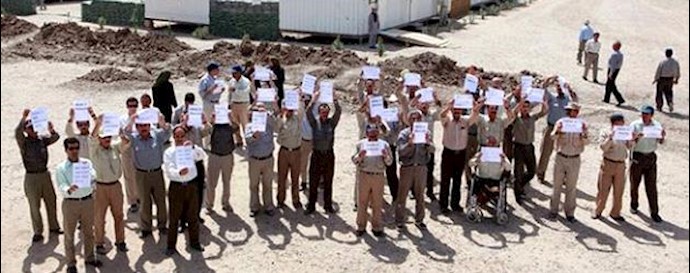
Key lawmakers on both sides of the aisle pressed the Obama administration to do more to help relocate members of a controversial Iranian dissident group confined to a camp in Iraq, a group that the head of the Senate Armed Services Committee credits with providing “useful intelligence” on Tehran’s secret nuclear activities, the Washington Times reported on Wednesday, October 7, 2015.
Sen. John McCain and others on the committee say successive U.S. administrations have broken their promise to protect members of the Mujahedin-e-Khalq — or “MEK” — and that the group is now increasingly under threat of Iranian government-backed militias operating in Iraq.
The assertions came at a hearing Wednesday, during which President Obama’s former national security adviser warned that Iranian leaders have turned Iraq into a “client state” and are bent on exploiting the war against the radical Sunni Muslim group Islamic State in the nation to promote their own brand of Shiite extremism.
“Iran’s grand strategy entails consolidating the hold it has gained in Iraq — a grip it seeks to tighten, directly and through proxies, and by stoking the sectarian fires,” said retired Marine Corps Gen. James L. Jones.
Iran’s expanding influence in Baghdad, the general added, does not bode well for the members of the Iranian dissident MEK group — some 2,500 members of which have been kept in a state of semicaptivity by the Iraqi government since U.S. forces pulled out of the nation in 2011.
Sen. Jack Reed, the ranking Democrat on the Armed Services Committee, said that the “deteriorating security situation in Iraq only highlights the need to find safe refuge for these individuals outside that country.”
For his own part, Mr. McCain said Iranian government-backed militias have already carried out atrocities against “innocent women and children” in the group at a facility near Baghdad known as “Camp Liberty.”
While the dissidents were previously protected by U.S. forces, Iraqi authorities moved them to Camp Liberty following the U.S. drawdown four years ago.
“The U.S. government and military made a commitment to protect thousands of people [in the group] who surrendered their weapons,” Mr. McCain said. “Clearly this commitment has not been sustained.”
“This is not just a matter of our ideals but also our interests,” the Arizona Republican added. “The group to which the residents of Camp Liberty belong has provided some very useful intelligence on Iran’s nuclear program, specifically revealing the existence of covert Iranian nuclear activities.”
The MEK has had a long and turbulent relationship with Washington, where U.S. officials had actually listed it as a terrorist organization during the 1990s.
More recent years saw the group form a powerful public relations push through a wider France- and U.S.-based Iranian dissident organization known as the National Council of Resistance of Iran.
Both the NCRI and the MEK are said to have deep sources inside Iran’s nuclear community, and members have made some game-changing revelations about Tehran’s secretive activities over the years.
Most notably, during the early 2000s the NCRI revealed the existence of Iran’s Natanz uranium enrichment facility and the Arak heavy water plutonium facility — two operations that have been at the center of international scrutiny and distrust of Tehran during the years since.
Mr. McCain said the stakes of protecting the MEK have increased in light of the Obama administration’s pushing through of a major international nuclear deal with Tehran, because “we need the best information on whether Iran is meeting its commitments” under the accord.
The MEK argues that during the late 1990s, officials within the Clinton administration engaged in a calculated smear campaign against the MEK and ultimately listed the group as a terrorist organization as part of an ill-conceived attempt to curry favor with Tehran.
Some contend the George W. Bush administration continued to try and use the MEK as a bargaining chip in back channel negotiations with the regime in Tehran by keeping the group on U.S. terror lists throughout the first decade of the 2000s — even as U.S. troops protected its members in Iraq.
Obama and the MEK
While the Obama administration officially removed the MEK from U.S. terror lists in 2012, it has done little to protect the group since. And by handing the group’s fate over to the Iraqi government, critics say, the administration has provided a gift to Tehran.
Now Iranian-backed militias are “seeking to eliminate and silence these dissidents,” Mr. Reed said.
But Gen. Jones told The Washington Times after Wednesday’s hearing that he was never aware of any discussion about the MEK’s status among senior administration officials when he served as national security adviser in 2009 and 2010.
“It never came up to my level,” he said.
Rep. Ted Poe, Texas Republican, prompted outrage among MEK detractors last April when he invited the group’s leader, Maryam Rajavi, to testify before the House Committee on Foreign Affairs.
Retired Army Col. Wesley Martin defended the group Wednesday, telling lawmakers that misinformation has circulated about it for years.
Former U.S. Sen. Joe Lieberman of Connecticut, who also testified at Wednesday’s hearing, lamented that U.S. officials have “broken their promise” to protect the group.
“Unfortunately, this resettlement process has dragged on for years, and much more still needs to be done,” he said.