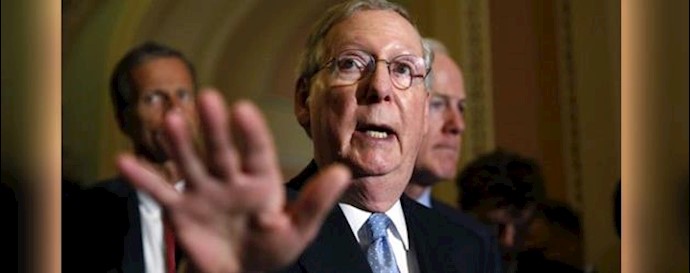
Tough votes will be forced this week on whether senators back Iran over four American prisoners still being held by the regime in Tehran, said Senate Majority Leader Mitch McConnell. All sides are scrambling for ways to stiffen the nuclear deal US President Barack Obama reached with Tehran, The Washington Times reported on Thursday.
Mr. McConnell, Kentucky Republican, said the Senate will keep debating the deal and will take votes Thursday insisting Mr. Obama not be allowed to lift sanctions until Iran releases U.S. prisoners and recognizes the right of Israel to exist. The move could put Democrats into a politically unattractive position.
“This is an issue with a very, very long shelf life,” Mr. McConnell said. “And it will be before the American people for the next year and a half and certainly be a factor in their determination of who they want to lead our country as president in the next election.”
The moves come as both Republicans and Democrats have begun debating the next steps Congress can take after the Thursday deadline passes.
Reps. Duncan Hunter, Adam Kinzinger and Ryan Zinke, all military veterans, have proposed legislation that would pre-approve military action should Iran breach its vow in the agreement to “never seek, develop or acquire a nuclear weapon.”
“It’s necessary that Iran receive the message that the U.S. is prepared to destroy any and all capability and facilities without warning or prolonged negotiation,” Mr. Hunter said. “These are terms that Iran can actually understand and will be the difference between Iran acquiring a nuclear bomb or not.”
Other lawmakers haven’t given up on trying to stiffen the existing deal.
Sen. John McCain, Arizona Republican, said he would support for a plan floated by Sen. Lindsey Graham, South Carolina Republican, which defunds the International Atomic Energy Agency until Congress gets more details on how inspections will be carried out.
“We may have to wait for the next president of the United States,” Mr. McCain said, reflecting the GOP’s belief it can take the White House in 2017. “Obviously our options are limited because of the 60-vote situation in the Senate and the president’s ability to veto. But I will not give up until we cancel this agreement, one way or another.”
Democrats, too, say Iran cannot be trusted and that Congress can sharpen the deal.
Rep. Adam Schiff, California Democrat, said Congress should beef up its surveillance of Iran and stand ready to rally to Israel’s aid if Iran uses its windfall from sanctions relief to sponsor unrest in the region.
“With the deal now effectively passed, the Administration will begin to implement it. In Congress, we should focus on making it stronger,” said Mr. Schiff, the top Democrat on the House Intelligence Committee.
Two Republican senators running for president, Rand Paul of Kentucky and Lindsey Graham of South Carolina, did not vote.
Polling has been trending negative toward the Iran deal, and Mr. McConnell said some of the Democrats now offering proposals to try to stiffen the agreement are hoping to repair relations with voters.
“Public opinion surveys show that the Iran agreement is not very popular among the general public. Voters do not trust any agreement with Iran,” said Darrell West, director of governance studies for the Brookings Institution. “Politicians are maneuvering to see if they can exert maximum hurt on those who supported the deal.”
After Tuesday’s Senate vote, GOP leaders are weighing their options.
Speaker John A. Boehner said last week that “all options are on the table” to stop or stall the deal. That includes attaching an Iran measure to a must-pass spending bill to avert a government shutdown on Oct. 1, or even mounting a court challenge arguing the president violated the terms of the Iran Nuclear Agreement Review Act by not submitting some of the secret side deals between Iran and the IAEA.