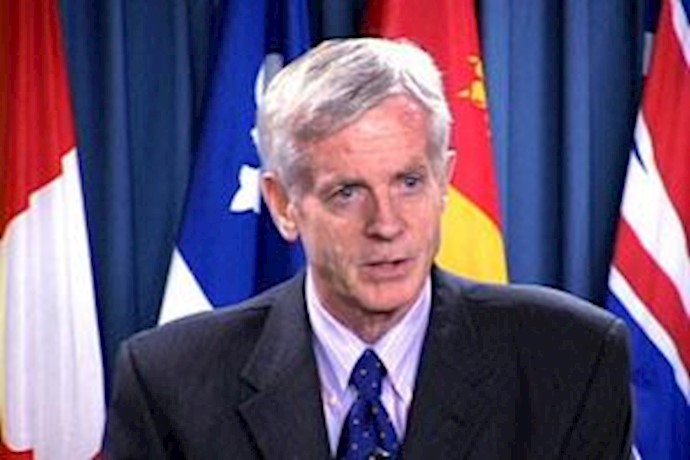
Simultaneous with the sessions of the third Committee of the UN General Assembly to evaluate human rights violation in Iran and some other countries, a session was held in the UN Building in New York in which David Kilgore, the prominent human rights figure of Canada and co-chairman of the Canadian Parliamentary Committee for Free Iran, described the human rights situation in Iran.
David Kilgore said in his speech: “Since seizing office in 1979, I understand the regime in Tehran has been criticized by various United Nations bodies 53 times. The two votes to be held soon in the Third Committee, presumably under the human-dignity-for-all goals of the U.N. organization, should be the next acts of collective responsibility by both its Third Committee and the General Assembly as a whole.
A book contains the names, photos and other personal information about twenty thousand members and supporters of the main opposition to the clerical regime, the People’s Mojahedin Organization of Iran (PMOI/MEK), who have been murdered by it since 1979. One of the victims was Ramin Arastafar, whose mother Mina said over this past weekend that he was tortured and killed in 1981 at the age of seventeen for participating in a demonstration in Tehran.
The late Zahra Kazemi, a Canadian of origin in Iran, attempted to photograph a student demonstration in Tehran in July, 2003. She was arrested and sent to the notorious Evin prison, where, as we now know from an escaped-from-Tehran medical doctor, she was tortured and murdered by agents of the government. The nature and extent of the treatment she received is by itself enough reason to prompt passage of the resolution in issue, sponsored by the government of Canada and 40 other countries.
Abdolreza Rajabi, a PMOI member, died under torture on October 30th of this year in Gohardasht prison. He had been in Evin prison since 2001 sentenced to death, but it was later commuted to life in prison. He was nonetheless subjected to mock executions and essentially continuous torture until the time of his death.
Mr Rajabi has two sons and a daughter living in Camp Ashraf in Iraq. Their fate and that of the approximately 4000 other PMOI members with them there, should they be expelled back to Tehran, is quite predictable. The ayatollahs’ law says that membership in the PMOI is a capital offense. According to Article 186 of the Iranian “Islamic Punishment Act” (1997), “all members and supporters” of the PMOI “who in one way or the other are effectively involved in advancing its aims, are “Mohareb”, which is to say guilty of waging war on God. Article 190 of that Act establishes that the punishment for “Mohareb” is “killing’, “hanging”, “amputation of the right hand and the left leg”, or internal exile’ A “religious judge” determines which punishment is applied.
Recently, I met with family members of some other Ashraf residents. A number of horrifying experiences were related, but four I can never forget. A woman of approximately twenty, who escaped the country a few years ago, said that about two thirds of Iran’s population is under 35, but many young people are addicted to opium, the consumption of which is encouraged by the mullahs so as to pacify them. A woman whose son was murdered was sent to prison for five years by a mullah judge, who spent approximately two minutes disposing of her case.
A grandmother lost eight family members, one of whom was thirteen at the time she was tortured, raped and murdered. Another former inmate of Evin prison told of a grandfather in Tehran, a grave digger, who committed suicide. His note to his family said that the Revolutionary Guards would bring children of 14, 15 and 16 to the cemetery where he worked. They would murder them and then force him to bury the bodies. The moral agony caused him to take his own life.”