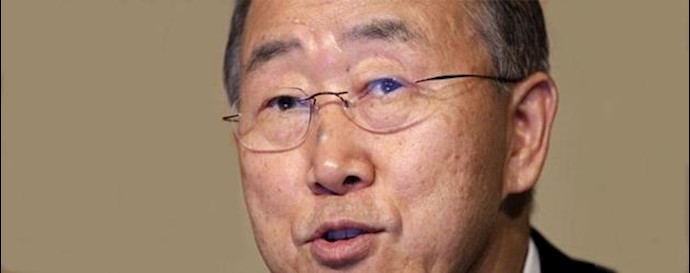
UN Secretary-General Ban Ki-moon issued his annual report expressing deep concerns over widespread and flagrant human rights violations and a wave of executions in Iran.
“Since the issuance of the most recent report of the Secretary -General on the subject to the Human Rights Council ( A/HRC/28/26), the application of the death penalty, including in relation to drug -related offences and executions in public, has continued at an alarmingly high rate,” the report reads in part.
The following is the entire text of this report:
United Nations A/70/352
General Assembly Distr.: General
31 August 2015
Seventieth session
Item 73 (c) of the provisional agenda*
Promotion and protection of human rights: human rights situations and reports of special rapporteurs and representatives
Situation of human rights in the Islamic Republic of Iran
Report of the Secretary-General
Summary
The report is submitted in accordance with General Assembly resolution
69/190, in which the Assembly requested the Secretary -General to report to it at its seventieth session on the progress made in the implementation of the resolution. The report reflects patterns and trends in terms of the human rights s ituation in the Islamic Republic of Iran and includes recommendations to improve the implementation of the resolution.
I. Introduction
1. The present report is submitted pursuant to General Assembly resolution
69/190, in which the Assembly requested the Secretary-General to report to it at its seventieth session. The report provides information on progress made in the implementation of the resolution, with a focus on the concerns identified in that resolution.
2. In preparing the present rep ort, the Secretary-General has drawn upon observations made by the United Nations human rights treaty monitoring bodies, the special procedures of the Human Rights Council and various United Nations entities. Reference is also made to information fr om official State media and non-governmental organizations.
3. Since the issuance of the most recent report of the Secretary -General on the subject to the Human Rights Council ( A/HRC/28/26), the application of the death penalty, including in relation to drug -related offences and executions in public, has continued at an alarmingly high rate. In addition, journalists, human rights defenders and wo men human rights activists have continued to face arrest, detention and prosecution for exercising their profession or their legitimate rights to freedom of expression and association. Furthermore, the situation of wo men’s human rights remains of major concern, in particular in the light of the number of child marriages and the underrepresentation of women in the labour force and in decision -making positions.
4. The Government of the Islamic Republic of Iran has continued to engage constructively with the United Nations treaty bodies and submitted its periodic reports to the Committee on the Rights of the Child ( CRC/C/IRN/1) and the Committee on the Rights of Persons with Disabilities ( CRPD/C/IRN/1). It also engaged substantively with the Working Group on the Universal Periodic Review for the second cycle of its universal periodic review, in October 2014. Although it has invited the Special Rapporteur on the right to food to visit the country, requests to visit from other mandate holders, i ncluding the Special Rapporteur on the situation of human rights in the Islamic Republic of Iran, remain unaddressed.
5. The Secretary-General welcomes the agreement between China, France, Germany, the Russian Federation, the United Kingdom of Great Britai n and Northern Ireland and the United States of America, with the High Representative of the European Union for Foreign Affairs and Security Policy, and the Islamic Republic of Iran on the latter’s nuclear programme, which could contribute to peace and stability in the region. The agreement will also pave the way for the lifting of economic sanctions, which is important for the promotion and protection of economic, social and cultural rights. The Secretary -General believes that the lifting of economic sanctions and unilateral coercive measures will help to relieve the negative effects of sanctions on the population. He encourages the Government to accord priority to the protection and allocate adequate resources for the promotion of human rights in its strat egies and planning.
II. Overview of the human rights situation in the Islamic
Republic of Iran
A. Death penalty
1. Use of the death penalty
6. The Secretary-General remains concerned at the frequency of executions, especially for drug -related offences and of juvenile offenders, which occurred during the reporting period. The Secretary -General regrets the Government’s decision to reject 40 of 41 recommendations that it received concerning the death penalty during the second cycle of its universal periodic review, notwithstanding the ever-growing concerns about the increased number of executions and the numerous appeals to the Government to put in place a moratorium on the use of the death penalty. The Government accepted only a recommendation to ta ke measures to ensure due process and a fair trial, in particular in any process that could lead to the application of the death penalty (see A/HRC/28/12 and Add.1).
7. There has been a steady upward trend in t he number of executions from 2008 to 2015, with a peak of at least 750 in 2014 (see A/HRC/28/70, para. 13). Executions for drug -related offences account for more than 70 per cent of all executions. At least 520 people were executed during the first half of 2015, including 384 for drug -related offences. On 8 May 2015, the special rapporteurs on the situation of human rights in the Islamic Republic of Iran and on extrajudicial, summary or arbitrary executions publ icly condemned the sharp increase in executions that had occurred despite serious questions about fair trial standards. They observed that, in many instances, executions went unreported by official sources and the names of prisoners were not published. 1
8. The Government continues to argue that the application of the death penalty is confined to the most serious crimes, which, under Iranian law, include drug trafficking. It argues that the death penalty serves as a deterrent, especially for drug – related offences,2 and is applied only to offenders who committed crimes against law enforcement officers and citizens in the course of drug trafficking and were found guilty in judicial proceedings meeting fair trial standards. The anti -narcotics legislation provides for the death penalty for a broad range of drug -related offences and automatically triggers such a sentence when a minimum threshold quantity of a drug is involved, such as 30 g for specific drugs (see ibid., para. 14).
9. Given the steady upward trend in the number of executions in recent years, the Secretary-General questions the effectiveness of the death penalty as a deterrent and urges the Islamic Republic of Iran to seek alternative solutions that comply with international human rights law and stan dards. In that context, and to examine alternative strategies to combat drug -related offences, the Secretary -General encourages the Government to engage with the Office of the United Nations High
2 See the statement of the High Council for Human Rights of the Islamic Republic of Iran in response to the joint press statement issued on 8 May 2015 by the Special Rapporteur on the
situation of human rights in the Islamic Republic of Iran and the Special Rapporteur on extrajudicial, summary or arbitrary executions, available from ht tp://en.humanrights -iran.ir/ news-22714.aspx.
Commissioner for Human Rights (OHCHR) and the United Nations Office on Drugs and Crime, which have offered technical dialogue and support to the authorities.
10. The Human Rights Committee, which monitors the implementation of the International Covenant on Civil and Political Rights, to which the Islamic Republic of Iran has been a State party since 1975, has repeatedly stressed that capital punishment for drug -related offences does not comply with the “most serious crimes” requirement under article 6 of the Covenant, which international human rights jurisprudence has defined as murder or intentional killing (see E/2010/10, paras. 56-68). That interpretation has been reiterated by the Secretary -General, the United Nations High Commissioner for Human Rights and the Special Rapporteur on extrajudicial, summary or arbitrary executions, who have also stressed that drug – related offences that do not involve intentional killing do not meet that threshold. 1
The United Nations Office on Drugs and Crime has also consistently expressed concern about drug -related offences being qualified as the “most serious crimes” in its high-level talks with senior Iranian officials, while the International Narcotics Control Board recently encouraged States that still imposed the death penalty for drug-related offences to abolish that punishment. 3 While the Government asserts that its regulations allo w for the death penalty only for the most serious crimes, the Secretary-General is concerned that capital punishment is used for crimes that do not meet that threshold. He urges the Islamic Republic of Iran to consider strengthening its anti-money-laundering laws and ratifying the United Nations Convention against Transnational Organized Crime and the Protocols thereto in order to help to eradicate drug trafficking and related offences.
2. Public executions
11. While a circular banning public executions was issued by the former head of the judiciary in January 2008, the Secretary -General is disturbed about the persistence of the practice, which has a dehumanizing effect on both the victim and the observers, reinforcing the cruel, inhuman and degrading nat ure of capital punishment. Of the 520 executions recorded in the first half of 2015, 28 were public. There were also reportedly 53 public executions in 2014 (see A/HRC/28/70, para. 13).
12. In its response to the joint statement of 8 May 2015 by the special rapporteurs on the situation of human rights in the Islamic Republic of Iran and on extrajudicial, summary or arbitrary executions, the Government stated that public executions were conducted only in certain limited circumstances, while observing specific laws, to deter drug-related offences. Reports have indicated, however, that as recently as
9 June 2015 three people were publicly hanged in two cities for rape. In addition, while the Government has given ass urances that measures are taken to avoid the presence of minors at the site of executions, 2 photos taken at such sites often show children in the audience. In its concluding observations on the third periodic report of the Islamic Republic of Iran, the Hum an Rights Committee was concerned about the continued use of public executions and recommended its prohibition (CCPR/C/IRN/CO/3, para. 12). The Secretary-General encourages the Government to promptly end all public executions.
3. Execution of minors
13. Regardless of the circumstances and nature of the crime, the use of the death penalty for crimes committed by persons under 18 years of age is explicitly prohibited by international human rights law, espec ially under article 6 of the International Covenant on Civil and Political Rights and article 37 of the Convention on the Rights of Child. While the Islamic Republic of Iran is a State party to both those instruments, juvenile executions continue to occur regularly. No official data on children in conflict with the law, in particular those at risk of execution, are publicly available. Nonetheless, as at 2014, there were reportedly 160 juveniles at risk of execution (see A/HRC/28/26, para. 14) and at least 13 juvenile offenders were reportedly executed in 2014 and 1 in 2015 (see A/HRC/28/70, para. 15). In commenting on the present report, the authorities stated that most of those executed were over 18 years of age when they committed the offences.
14. The revised Islamic Penal Code, which entered into force in June 2013, allows capital punishment for a juvenile offender unless he or she is found to have lacked the mental capacity to comprehend the nature and consequences of the crime. Regardless of that revision, in November 2014, the head of the judiciary, Sadegh Amoli Larijani, reportedly expressed support for the execution of adults who were minors when they committed an offence. According to Mr. Larijani, “we don’t have a reason to ignore the heirs to the blood right of qisas [retribution in kind] when a person that was 17.5 years old at the time of the crime turns 25” (see ibid., para. 19). In commenting on the present report, the authorities stated that qisas was a private right of the victim’s family that could not be overrul ed by the judiciary. They added that the judiciary demonstrated a high degree of leniency and flexibility in juvenile cases and had established a working group to help to prevent juvenile executions, including by encouraging the families of victims and per petrators to reach a settlement and offering financial aid.
15. On 18 February 2015, the special rapporteurs on the situation of human rights in the Islamic Republic of Iran and on extrajudicial, summary or arbitrary executions publicly urged the Governme nt to halt the execution, scheduled for
19 February, of Saman Naseem, who had been sentenced to death for alleged offences committed at 17 years of age. He had been convicted of moharebeh (enmity against God) and mofsed fel-arz (corruption on Earth) for alleged involvement in armed activities on behalf of the Party of Free Life of Kurdistan. He had reportedly been tortured into confessing. 4 In commenting on the present report, the authorities stated that Mr. Naseem was being held in Orumiyeh prison and that his case was under review by the judiciary.
B. Restrictions on freedom of opinion and expression
1. Freedom of expression
16. Freedom of expression and information is the cornerstone of any free and democratic society and any restrictions must be proportional in severity and intensity to the purpose being sought in article 19 (3) of the International Covenant on Civil and Political Rights and may not become the rule. The Secretary -General notes the renewed commitment of the President of the Islamic Republic of Iran to
loosening restrictions on freedom of expression and his advocacy for freedom of speech as a basic human right. There have, however, been few signs of progress in improving the conditions for exercising the right to freedom of expressio n and information, notwithstanding the President’s pledges to relax the strict State controls on media publications, Internet access and the work of media activists. In
2015, Reporters Without Borders ranked the Islamic Republic of Iran 173rd of 180 countries in terms of press freedom. Journalists are often arbitrarily and disproportionately charged with national security offences or with spreading propaganda against the system and given a range of punishments, including imprisonment, thereby restricting an d inhibiting their ability to exercise their legitimate right to freedom of opinion and expression.
17. The Secretary-General regrets the Government’s refusal to accept all the recommendations concerning freedom of expression that it received during the second cycle of its universal periodic review. The Government accepted only four recommendations and partially accepted six others, while rejecting recommendations to cease censorship of the media and harassment of journalists, release persons detained for peacefully exercising freedom of expression, amend press laws and end its strict surveillance of the Internet and social media (see A/HRC/28/12 and Add.1).
18. Although Iranian laws protect freedom of expressi on, there are multiple, including severe, restrictions on its exercise by the press. Article 24 of the Constitution states that “publications and the press have freedom of expression except when it is detrimental to the fundamental principles of Islam or t he rights of the public”. That vague formulation allows for broad interpretation and arbitrary application (see A/69/306, para. 28). The Press Law provides that the press has the right to “publish the opinions, co nstructive criticism, suggestions and explanations of individuals and government officials for public information while duly observing the Islamic teachings and the best interest of the community”. While its article 4 provides that “no government or non -government official should resort to coercive measures against the press to publish an article or essay, or attempt to censure and control the press”, it contains many restrictions that lend themselves to multiple interpretations, giving little guidance to j ournalists but abundant opportunity for authorities to censor. 5 The vulnerability of those open -ended provisions to abuse and the harsh forms of punishment provided for threaten and undermine freedom of expression.
19. The Islamic Republic of Iran has one of the highest levels of journalists in detention. In 2015, the Committee to Protect Journalists ranked it as among the 10 most censored countries. On 5 June 2015, the special rapporteurs on the situation of human rights in the Islamic Republic of Iran and on the promotion and protection of the right to freedom of opinion and expression expressed serious concern at the arbitrary and unlawful arrest, detention and prosecution of journalists and at the recurrent use of vague references to threats to national security, propaganda against the system and insult to authorities to prosecute and detain journalists. They stressed that silencing those critical voices undermined public debate and deprived Iranians and the rest of the world of important information on t he reality in the country. 6
Echoing those concerns, the Secretary -General reiterates that detaining and
5 See Human Rights Watch, As Fragile as a Crystal Glass: Press Freedom in Iran (October 1999).
imprisoning journalists on vaguely defined national security charges, including conspiracy, anti-government messages and other activities found objectio nable by a Government, such as working with human rights organizations, is unacceptable and undermines the country’s national and international obligations.
20. On 25 May 2015, the trial of an Iranian -American reporter with the Washington Post, Jason Rezaian, and his wife, Yeganeh Salehi, a correspondent for the National, a newspaper in the United Arab Emirates, began behind closed doors. They are charged with espionage, collaboration with hostile Governments, gathering classified information a nd disseminating propaganda against the Islamic Republic of Iran. A second hearing was conducted on 8 June. Requests by Mr. Rezaian’s family and representatives of the Washington Post to observe the hearings were not granted. Such closed -door proceedings may amount to a violation of the country’s obligation under article 14 (1) of the International Covenant on Civil and Political Rights, which guarantees a right to all parties in civil and criminal trials to fair and public hearings. Mr. Rezaian has been ar bitrarily detained since 22 July 2014, including for several months in solitary confinement, and was not formally charged for some 10 months. It appears that his arrest and prosecution are linked to his profession as a journalist and his legitimate exercis e of the right to freedom of expression. In commenting on the present report, the authorities stated that Mr. Rezaian had been held in solitary confinement for 45 days, had had access to his family during the investigation phase and had benefited from heal th and welfare facilities.
21. On 2 February 2015, a former journalist, Abbas Salimi Namin, was sentenced to a term of imprisonment of six months, 74 lashes and a fine for insulting a former President, Mahmoud Ahmadinejad, among others, in a televised deb ate in 2011.7 On
1 June 2015, a graphic artist and child rights activist, Atena Farghadani, was sentenced to a term of imprisonment of 12 years and nine months for spreading propaganda against the system, gathering and colluding against national security and insulting parliamentarians and the Supreme Leader, after having drawn a cartoon criticizing parliamentarians. She was arrested on 10 January 2015 after being summoned to Branch 15 of the Revolutionary Court and was reportedly beaten upon arrest in front of her parents and a judge. 8 Those cases appear to be part of a broader crackdown, with individuals exercising their rights to freedom of expression and association increasingly targeted for arrest and prosecution. In commenting on the present report, the authorities, while confirming the sentence handed down to Ms. Farghadani, reported that she had been released on bail and that her sentence was under appeal.
22. The Secretary-General notes with concern the Government’s interference with various news publications by closing, suspending and revoking their permits. For example, in late April 2015, a women’s monthly publication, Zanan-e Emrooz, was suspended9 under article 6 of the Press Law for “propagating obscene and religiously
7 See Reporters Without Borders, “Press freedom violations recounted in real time: January 2015 ”. Available from http://en.rsf.org/iran -press-freedom-violations -recounted-21-01-2015,47521.html.
8 See Michael Cavna, “Iranian artist Farghadani, who drew parliament as animals, sentenced to
12-plus years”, Washington Post , 1 June 2015. Available from www.washingtonpost.com/news/ comic-riffs/wp/2015/06/01/iranian -artist-farghadani-who-drew-parliament-as-animals-sentenced- to-12-plus-years/.
9 See Shima Shahrabi, “Clueless female reps unaware of sh utdown”, IranWire, 28 April 2015.
Available from http://en.iranwire.com/features/6457/.
forbidden acts and publishing indecent pictures and issues which violate[d] public decency”. It had published an article about cohabitating without a formal Islamic marriage.10 In January 2015, a reformist weekly publication, Setareh Sobh, was closed for publishing an open letter cr iticizing the legality of the detention of t he Green Movement leaders. 7 A daily newspaper, Mardom-e Emrooz, was also closed in January 2015 after its cover page featured a United States actor, George Clooney, and the phrase “I am Charlie, too”, referring t o the Charlie Hebdo attacks.11 The Government withdrew the newspaper ’s permit for being “provocative and insulting Islam”. In commenting on the present report, the authorities reported that the three publications were active and that their cases were curren tly under review by the judiciary.
2. Internet censorship
23. The Secretary-General welcomes the President’s statement of September 2014 in which he stressed that Internet censorship was counterproductive and detrimental to Iranian interests and pointed out that creating walls and filters only led individuals to circumvent the national regulations through proxy servers and other methods.12 The President also urged clerics to be more tolerant of new forms of technology, explaining that it was important for younger generations to have access to the Internet.13
24. The Government has taken some steps towards greater Internet freedom, although they have come with significant restrictions and sustained levels of control. In August 2014, it approved faster 3G mobile licences for two Iranian companies, but they did not allow for video -calling functions.14
25. The Islamic Republic of Iran has made a transition over the past year towards a policy of “smart filtering”, whereby some objectionable content on social m edia sites is blocked without a complete ban on the websites. 15 Although the policy was framed as an effort to reduce tight restrictions on Internet media, its user identification system remains in violation of users’ privacy and the basic right to information. The system allows authorities to designate certain groups and limit their access to information and to control the content of material that individuals can publish online.14 The targeted nature of the system means that users can be identified, exposing their personal information and activities to security and other
10 See Ladane Nasseri, “ Iran bans women’s magazine for backing unmarried households ”, Bloomberg, 27 April 2015. Available from www.bloomberg.com/news/articles/2015 -04-27/iran- bans-women-s-magazine-for-promoting-cohabitation.
11 See Saeed Kamali Dehgan, “Iranian newspaper shut down for showing solidarity with Charlie
Hebdo”, Guardian, 19 January 2015. Available from www.theguardian.com/world/2015/jan/19/
iranian-newspaper-mardom-e-emrooz -shut-down-showing-solidarity-charlie-hebdo.
12 See “Iran Internet: Hassan Rouhani tells clerics web is vital”, BBC News, 1 September 2014. Available from www.bbc.com/news/world -middle-east-29017729.
13 See “Iran’s Internet censorship not working: President”, Yahoo! News, 6 September 2014. Available from http://news.yahoo.com/irans -internet-censorship-not-working-president –
004035916.html.
14 See International Campaign for Human Rights in Iran, “Official claims of smart Internet filtering overblown, but efforts to monitor users grow”, 12 January 2015. Available from
www.iranhumanrights.org/2015/01/internet -filtering-iran/.
15 See “Iran moves to ease Internet censorship via ‘smart filtering’”, Reuters, 14 May 2014. Available from www.reuters.com/article/2014/05/14/iran -internet-filters-idUSL6N0O04
XV20140514.
State agencies.16 Under the system, individuals engaged in online social or political activism are particularly at risk of arrest, dete ntion and lengthy prison terms.7 In commenting on the present report, the authorities stated that the blocking and smart – filtering of social media were aimed at preventing incitement to riot, disorder, damage to public property, terrorism, extremism and violence.
26. In March 2015, the authorities blocked two websites, Jamaran and Bahar, for posting a photograph of a former President, Mohammad Khatami, after the Supreme National Security Council had banned any coverage of him. 17
C. Situation of human rights defenders and other civil society actors
27. On 5 June 2015, a group of special rapporteurs publicly expressed concern at the detention and sentencing of human rights activists in the Islamic Republic of Iran.6 The Special Rapporteur on the situation of human rights defenders has also expressed concern about the arrests, arbitrary detention and imprisonment of human rights defenders, student activists and lawyers on the ground of acting against national security, often without the fundamental guarantees of due process and fair trial (see A/HRC/28/63/Add.1).
28. On 5 May 2015, the former vice -president of the Defenders of Human Rights Centre and one of the founders of the group Step by Step to Stop the Death Penalty, Narges Mohammadi, was arrested to serv e the remainder of the six-year prison sentence that she received in April 2012 on charges of assembly and collusion against national security, membership of the Defenders of Human Rights Centre and spreading propaganda against the system. She had begun se rving her sentence in April 2012 and been released on bail in July 2012 on medical grounds. 18
D. Situation of women
29. The Secretary-General notes the Government’s full or partial acceptance of 42 of the 53 recommendations on the status of wo men made during the second cycle of its universal periodic review. He encourages the adoption of practical measures to implement those recommendations and to ratify the Convention on the Elimination of All Forms of Discrimination against Women.
30. On 4 April 2015, the Deputy Minister for Sports announced that women would be permitted to enter sports stadiums and attend some sporting events, ending the ban on wo men’s access to stadiums. The authorities had justified the ban by referring to the lack of proper infras tructure, including seats and sanitary services
16 See Michelle Moghtader, “Iran expands ‘smart’ Internet censorship”, Reuters, 26 December
2014. Available from www.reuters.com/article/2014/12/26/us -iran-internet-censorship-
idUSKBN0K40SE20141226.
17 See “Two websites linked to reformists blocked”, Radio Zamaneh, 27 February 2015. Available from http://archive.radiozamaneh.com/english/content/two -websites-linked-reformists-blocked.
18 See Reporters Without Borders, “Journa list and human rights activist Narges Mohammadi arrested”, 6 May 2015. Available from http://en.rsf.org/journalist -and-human-rights-06-05-
2015,47857.html.
for women.19 The Secretary-General welcomes the announcement and is encouraged by the statements made by the President and the Vice -President for Women and Family Affairs on various occasions, including on Int ernational Women’s Day, in support of gender equality and the elimination of violence against wo men, including domestic violence. The Secretary -General also welcomes public statements condemning crackdowns by the religious police for violations of the Isla mic dress code and statements recommending that the sanctuary and safety of the home extend to the workplace, the streets and everywhere else in society.
31. Those positive statements and the recent strides made by the Islamic Republic of Iran to improve the situation of wo men notwithstanding, wo men continue to face systemic inequalities and discrimination, both in law and in practice, and in all areas of their lives. Some 66 per cent of Iranian wo men have reportedly experienced domestic violence20 and a recent study found that 14.1 per cent of wo men had been subject to violence by their partner during pregnancy. 21
32. The Islamic Republic of Iran has no specific law criminalizing domestic violence. Women who experience violence must file a complaint under t he provisions of the Islamic Penal Code governing bodily assault and satisfy the evidentiary requirements, which include producing two adult male witnesses. There are no support services such as shelters, legal and psychological counselling, specialized assistance or rehabilitation. Women face numerous obstacles when seeking a divorce. Women wishing to leave their husband must prove a significant risk of bodily harm or a threat to their life and safety. Similarly, to obtain a divorce under the Civil Code as a result of domestic violence, wo men must prove that the abuse was intolerable (see A/69/356, para. 19). In commenting on the present report, the authorities argued that wo men could file for divorce if they faced violence and that various mechanisms existed to support victims of domestic violence, including intervention and rehabilitation centres, a social emergency telephone line, rehabilitation centres for affected wo men and girls, 31 health houses and specializ ed social assistance.
33. The Islamic Penal Code gives husbands significant control over the lives of their wives and children. 21 Article 630 allows a husband to kill his wife if she is caught committing adultery.22 The Secretary-General finds it regrettable that the proposed comprehensive population and exaltation of family bill (No. 315), currently under discussion by the parliamentary cultural affairs committee, could potentially expose wo men to increased risks of domestic violence. In the bill, bonuses are proposed for judges on the basis of the number of divorce cases before them that
19 See Saeed Kamali Dehghan, “Iran’s deputy minister for sports: yes, women can go to watch big matches”, Guardian, 4 April 2015. Available from www.theguardian.com/world/2015/apr/04/ iran-national-security-council-women-watch-big-sports-matches.
20 See Fatemeh Abdollahi and others, “Physical violence against pregnant women by an intimate
partner, and adverse pregnancy outcomes in Mazandaran Province, Iran”, Journal of Family and Community Medicine , vol. 22, No. 1 (2015). Available from www.ncbi.nlm.nih.gov/pmc/articles/ PMC4317989/.
21 See Amnesty International, “You shall procreate: attacks on women’s sexual and reproductive
rights in Iran” (2015). Available from www.amnestyusa.org/sites/default/files/you_shall_
procreate_-_attacks_on_womens_sexual_and_reproductive_rights_in_iran.pdf.
22 See Mohammad H. Nayyeri, “Gender inequality and discrimination: the case of Iranian women” (Iran Human Rights Documentation Center, March 2013). Available from http://iranhrdc.org/
english/publications/legal -commentary/1000000261 -gender -inequality-and-discrimination -the-
case-of-iranian-women.html#5.
result in reconciliation rather than divorce. In addition, police intervention in family disputes is discouraged. 23
34. On 20 June 2015, the Ministry of the Interior issued a circular in which a new dress code for State and private sector employees was introduced. Women are now required to strictly respect the new dress code and to refrain from wearing jewellery and make-up in offices. Women are required to observe the Islamic dress code in public places. More than 2.9 million women reportedly received a warning for failure to observe the code between March 2013 and March 2014. Women are not allowed to travel abroad without permission f rom their husband or legal custodian, and the Government is reluctant to promote unmarried wo men in public service. The authorities argue that travel restrictions on women and girls are aimed at preventing the trafficking of women to neighbouring countries .
35. In April 2015, the parliament and the Guardian Council of the Constitution adopted a plan “to promote virtue and prevent vice”. It criminalizes the creation of obstacles against “promoters of virtue and preventers of vice”, providing for penalties including imprisonment, with “vice” vaguely defined as any deed, saying or omission ordered by sharia or existing legislation. The “headquarters of the promotion of virtue and prevention of vice”, which includes the intelligence services and the paramilitar y basij forces, is responsible for implementing the legislation. Immodest attire was reportedly the motive for several acid attacks and stabbings in late 2014 by unknown individuals on the ground of preventing vice. The Secretary – General is concerned about the considerable increase in the number of laws and public policies that threaten the universally established standards on the rights of wo men, including freedom of movement, health and economic activity. The Secretary-General is also concerned at the res trictions imposed on access to justice for wo men and girls who have been subjected to violence, including marital rape.
1. Child marriage
36. According to the Convention on the Rights of the Child, the age of majority is
18 years. However, early marriag e remains commonplace in the Islamic Republic of
Iran, where the marriageable age for girls is 13 years. Furthermore, girls as young as
9 years of age may be married with permission from a court. The Law on the Protection of Children without Effective Care givers even allows marriage between a legal custodian and his adopted daughter if a court deems it in the best interest of the child (see A/69/356, para. 40).
37. Between March 2012 and March 2013, more than 40,60 0 girls under 15 years of age were married. At least 1,537 of the marriages registered in 2012 involved girls under 10 years of age — a significant increase compared with previous years. 24
The number of early marriages reportedly reached an all -time peak in 2013-2014. Recent statistics reveal that 201 girls younger than 10 years of age and more than
41,000 girls between 10 and 14 years of age were married during that period (see ibid., para. 41).
23 See Amnesty International, “Iran: proposed laws reduce women to ‘baby making machines’ in misguided attempts to boost population”. Available from https://www.amnesty.org/en/latest/news/
2015/03/iran-proposed-laws-reduce-women-to-baby-making-machines/.
24 See Justice for Iran, “Early marriages reach record levels in Iran as Government ignores the international community recommendations to reform the law” (18 May 2015). Available from
http://justice4iran.org/publication/call -for-action/early-marriages-reach-record/.
38. The Secretary-General welcomes the efforts of the Office o f the Vice-President for Women and Family Affairs, along with the State Welfare Organization and the Ministry of Justice, to finalize a bill to abolish the provisions allowing marriage between a legal custodian and his adopted daughter. The Secretary -General is deeply concerned, however, at the increase in the number of child marriages and urges the authorities to repeal the relevant laws so as to increase the age of marriage as matter of urgency and to have in place safeguards and guarantees to protect the rights of wo men and girls who are already married. Child marriage violates the dignity of wo men and girls.
2. Right to education
39. The Secretary-General commends the Islamic Republic of Iran for its progress regarding wo men’s access to education. It has almost achieved universal enrolment and gender parity at all educational levels, with the gender parity index in primary and secondary education reported as 0.99 and 0.96, respectively. Furthermore, 99 per cent of women between 15 and 24 years of age are reportedly literate.
40. Following the institution of gender -rationing policies in 2012, however, the percentage of female students entering university decreased from 62 per cent in
2007-2008 to 48.2 per cent in 2012 -2013. The policies also led to the admission of more men than wo men in some specialties between 2013 and 2014. The Secretary – General encourages the Islamic Republic of Iran to allow girls to gain access to higher education on an equal basis with boys.
3. Women and public life
41. The Secretary-General welcomes the statements by the President that women must have opportunities, rights and social status equal to those of men and an improved participatory role in management. Significant efforts are required to achieve that goal. The international human rights instruments, especially the International Covenant on Economic, Social and Cultural Rights, to which the Islamic Republic of Iran is a State party, provide for equal rights between men and wo men, including the right to work.
42. According to the Global Gender Gap Report 2014, the Islamic Republic of Iran is ranked 139 of 142 countries in terms of female representation in the labour market globally, with a mere 17 per cent of women between 15 and 64 years of age actively engaged in the labour market. The same report also shows that the unemployment rate for women is almost twice as high as that for men (16.8 and 9.1 per cent, respectively). There has been a net decrease in the number of female employees from 3,691,000 in 2006 to 3,145,000 in 2015, an average loss of 100,000 jobs in each intervening year.
43. Women are underrepresented in decision-making positions. Currently, 3 per cent of parliamentarians are women and there is no female Cabinet ministe r. The judiciary has recruited female lawyers who can act as advisers to male judges in family courts. However, while wo men can be appointed to some judicial positions, such as counsellors and investigators, they are barred from acting as sitting judges who issue verdicts. In commenting on the present report, the authorities indicated that women were represented at the highest political level, with three wo men currently serving as vice -presidents. They also stated that women held high -level
public functions, including as parliamentarians, mayors, governors of provinces, advisers to ministers and directors general.
44. The above-mentioned comprehensive population and exaltation of family bill makes marriage a precondition for obtaining a licence from the Iran ian Bar Association to practise family law. All private and public sectors are instructed to accord priority to the recruitment of men with children, followed by married men without children and only then women with children. Unmarried wo men are banned from public and private teaching positions and as members of faculties at universities and higher education institutions, with exceptions where there is no qualified married applicant available (see A/69/356, para. 70). Child marriage and repeated childbearing are encouraged as a means of boosting the population. If adopted, the text would have a negative impact on women’s access to employment.
4. Family planning
45. The Secretary-General is concerned about restrictions on women’s right to accurate and objective information on contraception. A proposed bill to increase fertility rates and prevent population decline would ban abortion and sterilization unless there was a risk to the health of the mother and/or child and impose harsh punishments on doctors performing such procedures. It also includes provisions that would prohibit information promoting contraception and reduced childbearing, with an exception for educational materials on preventing threats to th e child’s health.
46. The Secretary-General notes that the Islamic Republic of Iran has established consultative centres at the local and national levels to provide advice on family issues, including family planning, usually for free. Nevertheless, while a n amount of
133 billion rials was allocated to the family and population planning programme in the 2012-2013 budget, the allocation was reduced to zero in the 2014 -2015 budget.
E. Labour rights
1. Rights to freedoms of association and peaceful assemb ly
47. The Islamic Republic of Iran has not ratified the Freedom of Association and Protection of the Right to Organize Convention, 1948 (No. 87), or the Right to Organize and Collective Bargaining Convention, 1949 (No. 98), of the International Labour Organization (ILO). Nevertheless, the Constitution and the Labour Law (1990) recognize the principle of freedom of association, the right to organize and collective bargaining.
48. On several occasions, the Special Rapporteur on the situation of human right s in the Islamic Republic of Iran and the Committee on Freedom of Association of ILO have expressed concern over article 131 of the Labour Law, which enshrines organizational monopoly, thereby preventing trade union pluralism.
49. In June 2013, the Commi ttee on Economic, Social and Cultural Rights noted that labour rights activists continued to face restrictions, arrest, conviction and detention on vaguely defined charges, while striking workers faced reprisals from the State and dismissal. Leaders of ind ependent unions allegedly faced ill -treatment and torture during interrogations, as well as denial of medical treatment (see E/C.12/IRN/CO/2, para. 15). Bans imposed on the activities of the Syndicate of Workers of Tehran and Suburbs Bus Company, the Haft Tapeh Sugar Cane Company
Workers’ Trade Union and the Teachers’ Trade Association remained in place, owing to their non-affiliation to the confederation of Iranian trade unions. In commenting on the present report, the authorities stated that seven teachers’ trade associations were active in the Islamic Republic of Iran and that one of their representatives had been appointed as an adviser to the Minister of Education.
2. Protection of wages: wage arrears
50. The serious issue of wage arrears in the Islamic Republic of Iran, combined with low wages, has led to recurrent and widespread protests. Between March 2014 and March 2015, there were at least 233 protests, in particular by teachers (whose wages fall below the official national poverty line) and factory workers. 25 Such protests have been met by increasingly severe crackdowns and reprisals, including the dismissal of workers who go on strike. Meanwhile, in its most recent report to the ILO Committee of Experts on the Application of Conventions and Recommendations, the Government indicated measures taken to alleviate the problem of wage arrears, including the adoption of a social protection scheme, and increased tripartite cooperation.
3. Discrimination based on religion and ethnicity
51. In 2013, the Committee on Economic, Social and Cultural Rights noted the continued application of the selection process ( gozinesh) for employment based on religious and ethical standards under the Selection Law (1995) and expressed concern over its contravention of the principles of equality of opportunity or treatment in employment for persons belonging to ethnic and religious minorities (see E/C.12/IRN/CO/2, para. 12). The ILO Committee of Experts on the Application of Conventions and Recommendations raised similar concerns in 2015.
F. Right to fair trial and due process
52. Article 14 of the International Covenant on Civil and Political Rights sets forth international norms regarding fair trial and due process, but violations of fair trial rights continue to be widely documented at every stage of proceedings, including before and after trials, in the Islamic Republic of Iran. In many cases, suspects are often unaware of the charges against them or the charges are pronounced only when the suspects are presented before the court. Detention without charge, incommunicado detention, lack of access to lawyers and the handing down of heavy sentences after summary hearings are also reported patterns.
53. In addition, the judiciary’s failure to comply with the codified procedural requirements of the Islamic Penal Code is preoccupying. Article 169 explicitly prohibits confessions taken under coercion, force, torture o r mental or physical abuse. It is reported, however, that such confessions have been commonly relied upon by prosecutors and accepted as evidence in proceedings, in clear violation of the country’s obligations under articles 7 and 14 of the International C ovenant on Civil and Political Rights. For example, Reyhaneh Jabbari was executed on 25 October
2014 for the alleged murder of a former employee of the Ministry of Intelligence,
25 See International Campaign for Human Rights in Iran, “Labor leaders detained in Iran as International Workers’ Day approaches” (29 April 2015). Available from www.iranhumanrights. org/2015/04/international -workers-day/.
Morteza Abdolali Sarbandi, after confessing under duress and amid allegations of the court’s failure to consider all relevant evidence. In that case and others, courts have frequently ignored allegations of torture and coercion, failing to take steps to investigate, notwithstanding the fact that article 171 of the Code requires investigation when any evidence contrary to the confession exists. State -controlled media have on multiple occasions broadcast confessions on television in advance of trials, flagrantly breaching the presumption of innocence. In commenting on the present report, the authorities argued that the Constitution and the Law on Citizens’ Rights forbade all forms of torture and that confessions extracted through torture were inadmissible in judicial proceedings. They argued that, in the case of Ms. Jabbari, the court had issued a verdict in the light of the evidence and documentation, not on the basis of her confession.
54. The Secretary-General is concerned about alleged State interference with the Iranian Bar Association, which appears to be in violation of the Basic Principles on the Role of Lawyers, which provide for lawyers to form and join self -governing professional associations to represent their interests, prompt their continuing education and training and protect their professional integrity. The three -year ban from legal practice imposed by the Association upon an internationally recognized lawyer and human rights defender, Nasrin Sotoudeh, following her arbitrary detention in 2011 revealed improper pressure on the Association. This is the first decision of this type. Although the Association reduced the ban to nine months on
30 June 2015, the authorities have continued to harass and threaten individuals who showed solidarity with Ms. Sotoudeh during her eight -month protest at the premises of the Association. A formal appeal against the decision can occur only through the Disciplinary Court for Judges, a body that is responsible to the very judiciary that requested the suspension of her licence. 26 Furthermore, the bill of attorneyship submitted to the parliament in September 2014 contains provisions that would further encroach upon the independence of the Association. The Secretary -General calls upon the authorities to guarantee the independence of the Association.
G. Treatment of persons belonging to religious and ethnic minorities
55. The Secretary-General remains concerned by reports of persistent discrimination in the Islamic Republic of Iran against ethnic and religious minorities, often among the most vulnerable groups in society. He urges the Government to promote and uphold the rights of persons belonging to those groups and to respect the commitments made b y the President and other high -profile officials to ensuring equality, upholding freedom of belief and religion, extending protection to all religious groups and amending legislation that discriminates against minority groups.
56. The authorities have not relaxed restrictions on members of the Baha’i community, who continue to face severe constraints on their professional activities, including the closure of their businesses. For example, 11 businesses were reportedly shut down on 24 May 2015 by the Office of Properties and City
26 See International Federation for Human Rights, “Iran: judicial harassment against human rights lawyer Ms. Nasrin Sotoudeh” (20 October 2014). Available from www.fidh.org/International – Federation-for-Human-Rights/asia/iran/16268 -iran-judicial-harassment -against-human-rights- lawyer-ms-nasrin-sotoudeh.
Development in Sari for being closed on a working day, which was a religious day for the Baha’i community. 27 Furthermore, between November 2014 and January
2015, 17 cases of home raids, confiscation of property and interrogation targe ting members of the Baha’i community were recorded in Rasht, Esfahan, Marv Dasht, Kashan and Aligudarz. Between December 2014 and February 2015, seven members of the Baha’i community were reportedly arrested in Abadeh, Esfahan and Tehran on charges relating to proselytizing, spreading propaganda against the system and threats to national security. Materials relating to their faith were confiscated, as were computers and printers.
57. There were also incidents of desecration of Baha’i cemeteries and denial of burial rights to Baha’i individuals, purportedly on the orders of the authorities. The authorities reportedly prohibited the expansion of Baha’i cemeteries for new burials in Ahvaz in 2014 and would have authorized the desecration and destruction of the Baha’i cemetery in Shiraz. 28
58. Ethnic minority groups also face restrictions on their rights to freedom of expression and peaceful assembly. For example, some 1,000 people were arrested on 17 March 2015 for protesting against the plight of an Arab from K horramshahr, Younes Asakere, who set himself on fire in response to repeated harassment by the local authorities regarding the licence for his produce stand. 29 He died, allegedly after being denied appropriate medical treatment. Most of the protesters were reportedly released after signing a pledge. Moreover, from mid -March to April
2015, nearly 100 Ahwazi Arabs, including activists and several minors, were arrested and detained following peaceful protests organized in the lead -up to the tenth anniversary of the Ahwazi uprising.30 In commenting on the present report, the authorities, disputing the above allegations, stated that Mr. Asakere had received adequate medical treatment but had died owing to the seriousness of his injuries. They added that the local a uthorities and non -governmental organizations had provided support to his immediate family after his death.
59. The Secretary-General calls upon the President to pay special attention to the plight and protection of Baha’i, Christian and Muslim minorities , as he pledged during his electoral campaign.
27 See Iran Press Watch, “Eleven Baha’is’ businesses closed in Sari” (2 June 2015). Available from http://iranpresswatch.org/post/12312/.
28 See Baha’i World News Service, “Two months in the morgue: One facet of campaign to mak e
Iranian Baha’is invisible” (29 December 2014). Available from http://news.bahai.org/story/1034.
29 On 13 March 2015, the authorities reportedly confiscated his stand because it was unlicensed. On
15 March, he reportedly set himself on fire after having been denied a permit to operate his stand the previous day. Following his death, the authorities reportedly visited his family and warned them to remain silent about his death.
30 In April 2005, Ahwazi Arabs took to the streets to protest against the Gove rnment’s alleged
policy aimed at changing the ethnic composition of Khuzestan Province. The protests, which lasted for two weeks, reportedly turned violent, with several protesters killed. Since then, Ahwazi Arabs commemorate the uprising by staging protes ts throughout the area.
III. Cooperation with international human rights mechanisms and the Office of the United Nations High Commissioner for Human Rights
A. Cooperation with the treaty bodies
60. The Secretary-General notes with regret the Government’s negative response to the many recommendations that it received during the second cycle of its universal periodic review regarding the ratification of international human rights instruments. The Islamic Republic of Iran rejected all 31 recommendations relating to the ratification of the Second Optional Protocol to the International Covenant on Civil and Political Rights, aiming at the abolition of the death penalty, the Convention on the Elimination of All Forms of Discrimination against Women, the Convention against Torture and Other Cruel, Inhuman or Degrading Treatment or Punishment, the Optional Protocol to the Convention against Torture, the International Convention for the Protection of All Person s from Enforced Disappearance and the Rome Statute of the International Criminal Court. It also rejected recommendations relating to its reservations to the Convention on the Rights of the Child (see A/HRC/28/12 and Add.1).
61. In July 2015, the Islamic Republic of Iran submitted its initial report to the Committee on the Rights of Persons with Disabilities ( CRPD/C/IRN/1). It has not, however, submitted its twentiet h to twenty-third periodic reports under the Convention on the Elimination of All Forms of Racial Discrimination, which were due in January 2014. It has also not submitted its comments regarding discrimination against women of minority origin, racial discr imination in the media and the establishment of a national human rights institution, which were due in
2011.
62. The Secretary-General encourages the Government to promptly provide the information requested by treaty bodies and to participate in constructi ve dialogues with those bodies to facilitate the review and improvement of the human rights situation in the country.
B. Cooperation with the special procedures of the
Human Rights Council
63. The Secretary-General and the United Nations High Commiss ioner for Human Rights have frequently emphasized that it is important for the Special Rapporteur on the situation of human rights in the Islamic Republic of Iran and other special procedures mandate holders to visit the country so as to assess the human r ights situation. Although the Special Rapporteur was able to meet representatives of the permanent missions of the Islamic Republic of Iran to the United Nations in Geneva and New York, as well as representatives of the judiciary, parliamentarians, officia ls from the Iranian High Council for Human Rights and other visiting delegations, the Government continues to refuse him admittance to the country.
64. On 16 March 2015, the Government invited the Special Rapporteur on the right to food to visit in 2015. I t was the first invitation issued to a thematic mandate holder since 2005. The Secretary-General welcomes the development and encourages
the Government to also authorize visits to which it has agreed in principle, namely those by the special rapporteurs on extrajudicial, summary or arbitrary executions and freedom of religion or belief and the Working Group on Enforced or Involuntary Disappearances.
65. The Working Group on Enforced or Involuntary Disappearances has noted that it has transmitted 537 cases to the Government since its establishment and that 518 remain outstanding (see A/HRC/WG.6/20/IRN/2, para. 10). The authorities responded to 15 of 38 communications by special procedures mandate holders between January
2014 and June 2015. Most communications pertained to cases of torture and ill – treatment, executions, arbitrary arrest and detention of journalists and human rights defenders, persecution of religious minorities, unfair trials, denial of med ical treatment of detainees and reprisals against individuals for their contacts with United Nations human rights mechanisms.
C. Cooperation with the Office of the United Nations
High Commissioner for Human Rights
66. OHCHR has continued to express h uman rights concerns in private meetings with the authorities and through letters and public statements, mainly in relation to the death penalty, freedom of expression and the rights of women.
D. Universal periodic review
67. The Secretary-General welcomes the active engagement of the Islamic Republic of Iran with the Working Group on the Universal Periodic Review by submitting its national report on the implementation of the recommendations resulting from the first review, in 2010, ( A/HRC/WG.6/7/IRN/1) and by sending a high-level delegation for the interactive dialogue held on 31 October 2014. During the second cycle of its universal periodic review, the Government accepted 189 of the 291 recommendations made. Of the 161 recomm endations that pertained to non-discrimination and civil and political rights, the Government supported 40 and noted 121. The Government argued that it could not accept some recommendations because they conflicted with the country’s international commitments, were incompatible with constitutional laws and regulations or contained abusive lang uage (see A/HRC/28/12/Add.1).
68. The Secretary-General encourages the Government t o actively include civil society actors and other relevant institutions and organizations and seek support from the United Nations to effectively implement the recommendations.
IV. Recommendations
69. The Secretary-General remains deeply troubled by the increased number of executions and reiterates his call upon the Government to introduce a moratorium on the use of the death penalty and to prohibit executions of juvenile offenders in all circumstances. He encourages the Government to work with the United Nations to restrict and ultimately abolish the death penalty in law and in practice. Pending such abolition, the Government should adhere to
international human rights requirements, as stipulated in article 6 of the International Covenant on Civil and Political Rights, and grant amnesty, pardon or commutation of death sentences in all cases.
70. The Secretary-General urges the Government to create space for human rights defenders, lawyers and journalists and to release political prisoners, including human rights defenders and lawyers, detained solely for legitimately exercising their rights to freedom of expression, association and peaceful assembly.
71. The Secretary-General welcomes the Government’s invitation to the United Nations High Commissioner f or Human Rights to visit the Islamic Republic of Iran. He encourages the Government to invite the Special Rapporteur on the situation of human rights in the Islamic Republic of Iran to visit the country and to fully cooperate with him.
72. The Secretary-General welcomes the achievements made by the Islamic Republic of Iran in the field of women’s education and the President’s emphasis on gender equality. He urges the Government to repeal discriminatory provisions of relevant laws in accordance with internat ional standards, to develop national strategies to address harmful and violent practices against women and girls and to take practical measures to eliminate discrimination against women in all spheres of life.
73. The Secretary-General urges the Government to promote and protect the rights of all persons belonging to religious and ethnic minorities in the Islamic Republic of Iran and to address any form of discrimination against them.
74. The Secretary-General welcomes the Government’s engagement with the human rights treaty bodies and urges it to follow up on the concluding observations of all treaty bodies and to ratify the Convention on the Elimination of All Forms of Discrimination against Women, the Convention against Torture, the Second Optional Protoc ol to the International Covenant on Civil and Political Rights, aiming at the abolition of the death penalty, the International Convention for the Protection of All Persons from Enforced Disappearance and the International Convention on the Protection of t he Rights of All Migrant Workers and Members of Their Families.
75. The Secretary-General welcomes the Government’s active engagement with the Working Group on the Universal Periodic Review and calls upon it to ensure the implementation of all the recommen dations that it has voluntarily accepted and to seek relevant technical assistance from the United Nations and other counterparts to support such efforts.