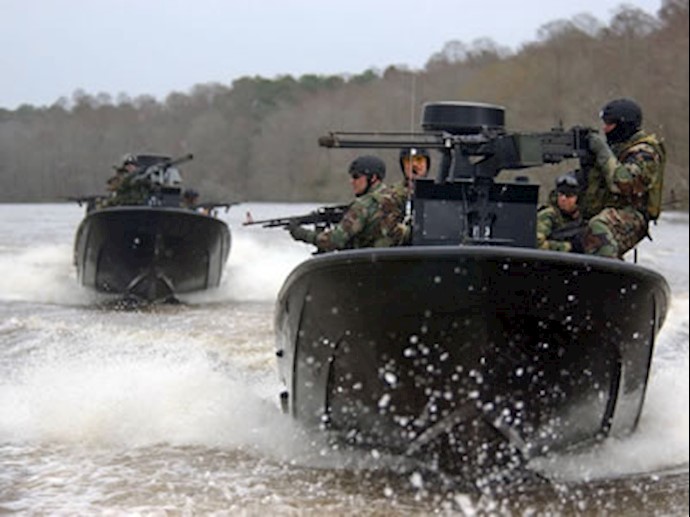
The Washington Times, August 14, 2008 (excerpts) – No sooner was there an end to Operation Brimstone – a joint U.S., British and French naval mega exercise held in the Atlantic Ocean, where the allies practiced enforcing an eventual blockade on Iran – than, according to numerous reports, the armada set sail for Gulf waters and a potential showdown with Iran.
The move came shortly after the European Union issued a decree Friday authorizing the imposition of stronger sanctions against Iran, on top of existing U.N. Security Council sanctions, over its refusal to back down from its controversial nuclear program.
Leading the joint naval task force is the nuclear-powered carrier the USS Theodore Roosevelt and its Carrier Strike Group 2. In addition to the 80-plus warplanes the Roosevelt normally transports, it is carrying an additional load of Rafale fighter jets from the French carrier Charles de Gaulle, currently in dry dock.
Also reportedly heading toward Iran are another nuclear-powered carrier, the USS Ronald Reagan, and its Carrier Strike Group 7; the USS Iwo Jima; the Royal Navy aircraft carrier HMS Ark Royal; and a number of French warships, including the nuclear hunter-killer submarine Amethyste.
Once on site, the joint naval force in the Persian Gulf region will be joining two other U.S. battle groups already in position: the USS Abraham Lincoln and the USS Peleliu, the Lincoln with its carrier strike group and the latter with an expeditionary strike group.
Meanwhile, Tehran seems undeterred, saying it will not back down on its nuclear stance, regardless of the threat of stricter sanctions, an Iranian government spokesman said Sunday.
A European diplomat was quoted as saying that Britain, the United States and France could impose sanctions that go beyond what is called for by the United Nations, in essence giving weight to the formidable armada heading toward Iran.
Led by the United States and leading EU members Britain, France and Germany and supported by China and Russia, all have tried to persuade Iran to freeze its uranium enrichment program.
Expecting a formal reply from Iran, the six nations leading the charge against Iran’s nuclear ambitions were disappointed when the much-awaited reply was a noncommittal one-page letter despite a promise from Iran that it would provide a “clear response.”
The deployment of the multinational naval task force is the largest show of military power from the United States and allied countries to assemble around the strategic waters of the Persian Gulf since the first and second Gulf wars.
The object of the naval deployment would be to enforce an eventual blockade on Iran if, as expected by many observers, current negotiations with the Islamic Republic over its insistence on pursuing enrichment of uranium yield no results.
For Iran, however, a naval blockade preventing it from importing refined oil would have devastating effects on its economy, virtually crippling its infrastructure. Although Iran is a major oil producer and exporter, the country lacks refining facilities, having to re-import its own oil once refined.
Iran’s oil – both the exported crude as well as the returning refined product – passes through the strategic Strait of Hormuz, controlled by Iran on one side and the Sultanate of Oman – a U.S. ally – on the other. The strait is about 30 miles wide at its narrowest point, making it easy to control, but at the same time placing Western naval vessels within easy reach of the Iranian Revolutionary Guards’ fast-moving light craft, which could be used by Iranian suicide bombers.
Iran is playing for time, hoping to ride out the remaining 160-plus days of the Bush presidency. The question is whether the Western powers will blink or call Iran’s bluff.