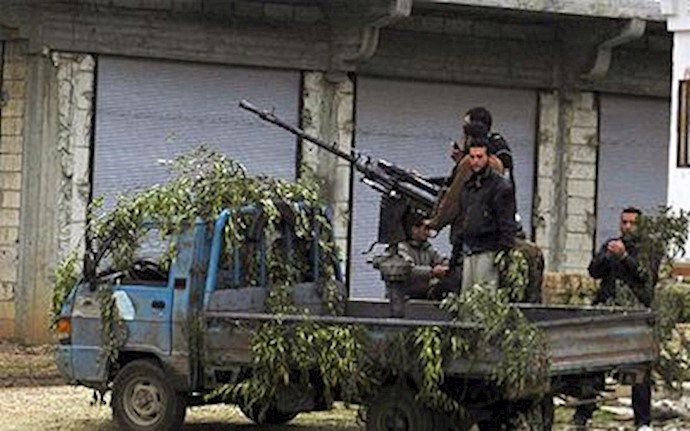
Al Arabiya, 11 Dec 2012 – Syria’s rebel generals pledge not to seek power for themselves but will support a civilian transitional government if they depose President Bashar al-Assad, the head of a newly established military command told Reuters.
“The military people do not want to seize power after Assad is gone,” Brigadier Selim Idris said by telephone on Tuesday, three days after he was appointed to lead the new organization.
“We just want to form a national army and we will not intervene in politics,” said Idris, who defected from Assad’s forces last year. He was speaking on the eve of a gathering in Morocco of Assad’s Syrian and international adversaries.
Assad inherited the presidency from his father, a former air force commander, and ending decades of rule by such army-backed autocrats has been a central demand of the Syrian opposition, as it has been in other uprisings across the Arab world.
Underlining his commitment to civilian control, Idris said that while the rebel forces were anxious to obtain new weaponry, particularly anti-tank and anti-aircraft missiles, they were ready to wait until the rebels’ newly reshaped political leadership was ready to oversee international arms procurement.
“We are looking to have a Syrian government that has the legitimacy that brings the right to buy weapons,” he said. A civilian defense minister would handle purchases in due course.
As well as battling Assad, the tasks facing the new military body include coordinating fractured rebel groups and overseeing arms movements which some rebels say are out of control.
The new rebel command brings together most existing rebel entities including several brigades which formed an Islamist front two months ago and “provincial military councils” which operated under the umbrella of the Free Syrian Army, a group largely run by officers who had defected from Assad’s forces.
Military chiefs meet on Syria
Meanwhile, international military chiefs met in London to discuss the Syria conflict, AFP reported a diplomatic source as saying on Tuesday, after a report that they discussed plans to train rebels and give air and naval support.
General David Richards, the head of Britain’s armed forces, held talks recently in London with military leaders from France, Turkey, Jordan, Qatar, the United Arab Emirates and a U.S. general, the Independent newspaper reported.
A British diplomatic source confirmed that the military leaders had held talks, but played down the idea that they discussed military intervention against the regime of Syrian President Bashar al-Assad.
“What they were doing was sharing analysis about the situation on the ground and the strategic overview to help think through issues,” the British diplomatic source said.
“As far as I know they didn’t explore options in any detail, certainly they didn’t explore options for military intervention.”
The source added: “There are not any plans for military intervention.”
The Independent however said that during the meeting, which was organized at the request of Prime Minister David Cameron, the military chiefs held detailed strategic discussions about how to help the Syrian rebels.
Britain, France and the United States have pledged not to put “boots on the ground” to help the rebels, meaning Turkey would most likely host the training camps, the Independent said.
Britain’s Ministry of Defense would not confirm the report and repeated its commitment to finding a diplomatic end to the conflict.
Bombings killed 125
On ground, violence in Syria continued unabated as series of bomb attacks on a village in central Syria mainly inhabited by members of President Assad’s Alawite minority on Tuesday left more than 125 civilian casualties, the Syrian Observatory for Human Rights said.
The bombings struck the village of Aqrab in Hama province, the Britain-based watchdog said, adding that it could not immediately give an exact death toll.
“We cannot know whether the rebels were behind this attack, but if they were, this would be the largest-scale revenge attack against Alawites,” said Observatory director Rami Abdel Rahman.
“We call for the establishment of an independent commission of jurists who can investigate the attack. We want a Syria which is free and democratic, not one which is based on sectarian hatred,” Abdel Rahman told AFP.
Hama province is home to a patchwork of religious communities which have coexisted for centuries, but where sectarian tensions have run high ever since the outbreak of the revolt against Assad’s rule in March last year.
“The rebels took over a checkpoint near Aqrab just over a week ago,” said Abdel Rahman.
Aqrab is located near Houla, where 108 people, including 49 children and 34 women, were massacred on May 25.
The U.N. said there were “strong suspicions” that pro-government militiamen were involved in the Houla massacre.